Grammar B1 Stative vs Dynamic Verbs

Stative verbs quiz and practice

Stative verbs quiz and practice

What are stative verbs?

Stative verbs describe a state or condition that doesn't change. They show how someone feels, what they own, or what they think—not an action they are doing. Unlike dynamic verbs (run, eat, build), stative verbs express situations that stay the same. For example, 'I like pizza' describes a feeling that doesn't change moment by moment. This is why stative verbs behave differently in English grammar, especially with continuous tenses.

Why stative verbs don't use continuous forms

Stative verbs almost never use the continuous aspect (is/are + -ing) because continuous forms show an action in progress at a specific moment. Since stative verbs describe fixed states, not changing actions, we say 'I like coffee' not 'I am liking coffee.' The only exceptions are when a stative verb temporarily becomes dynamic: 'He is being silly' (choosing to act silly) or 'I'm having dinner' (the action of eating). Learning which verbs are stative helps you avoid this common mistake.

Common stative verbs by category

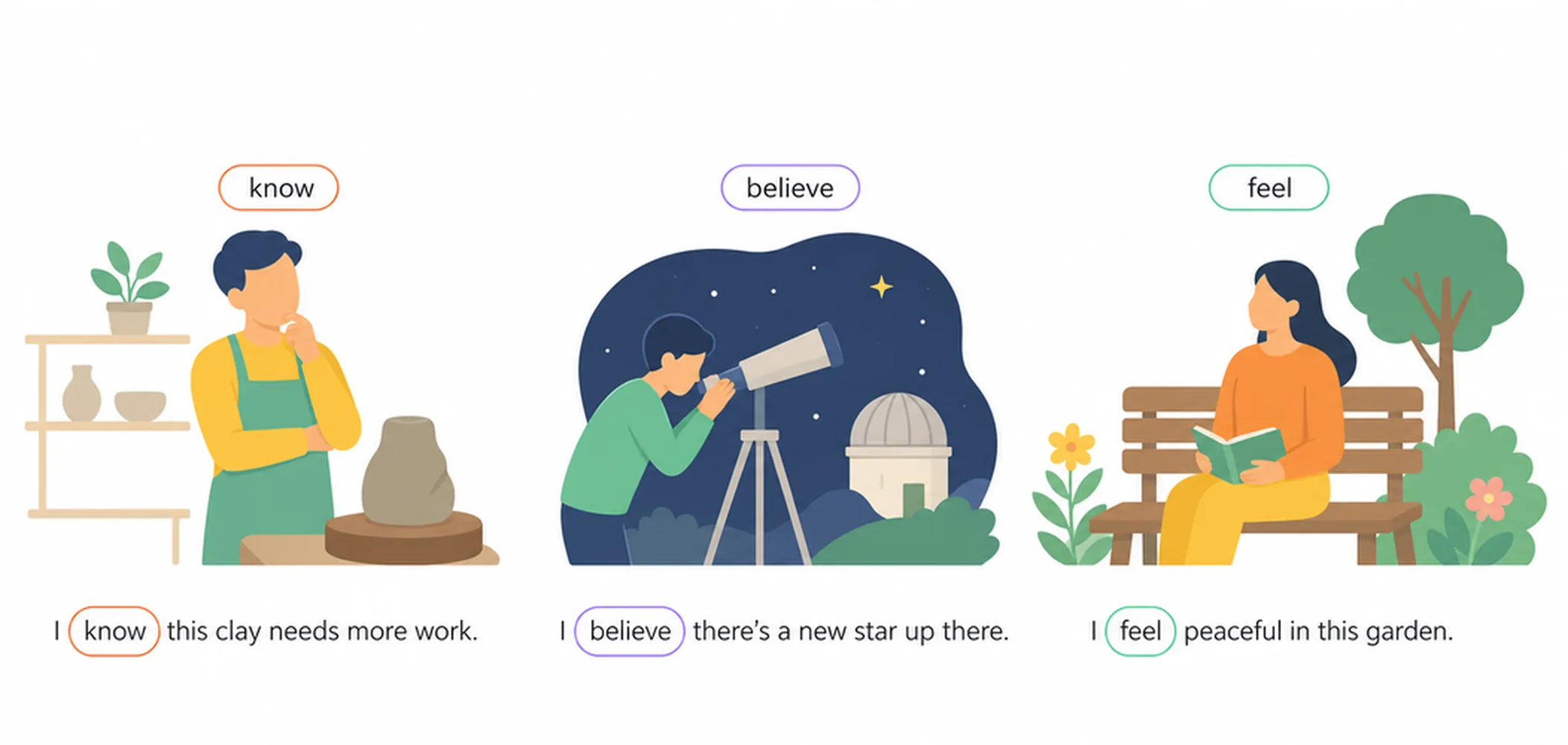
Stative verbs fall into clear groups: feelings and emotions (love, hate, prefer), mental states (think, believe, remember, understand), possession (have, own, belong), appearance (seem, look, appear), and relationships (contain, consist, include). Recognition helps you use them correctly. For instance, 'I believe you' is stative, but 'I am believing in myself' is rarely correct. The verb 'have' is stative in 'I have a car' but dynamic in 'I'm having breakfast' (eating).

Is It Stative or Dynamic? Quiz Yourself

Question 1: Was the action in progress at a specific past moment?
Yes
Question 2: Did another action interrupt it?
Yes
Answer: Past Continuous
No
Answer: Past Continuous
No
Question 3: Did it happen before another past event?
Yes
Question 4: Was it ongoing up to that earlier event?
Yes
Answer: Past Perfect Continuous
No
Answer: Past Perfect
No
Answer: Past Simple
Question 1: Is the action happening right now or temporarily?
Yes
Answer: Present Continuous
No
Question 2: Does it connect past experience or result to now?
Yes
Question 3: Has it been ongoing until now?
Yes
Answer: Present Perfect Continuous
No
Answer: Present Perfect
No
Answer: Present Simple
Question 1: Is it a pre-arranged plan or fixed appointment?
Yes
Answer: Going to or Present Continuous for schedules
No
Question 2: Is it a spontaneous decision or prediction?
Yes
Question 3: Will it be in progress at a specific future moment?
Yes
Answer: Future Continuous
No
Answer: Future Simple (will)
No
Question 4: Will it be completed before a specific future point?
Yes
Answer: Future Perfect
No
Answer: Future Simple (will)

Examples

I really like your new jacket.
Feeling/Emotion · Stative
She understands the homework now.
Mental state · Stative
They own two houses in Spain.
Possession · Stative
This milk tastes sour.
Sensation/Appearance · Stative
The box contains 12 chocolates.
Relationship/Content · Stative
I don't believe that story.
Mental state · Stative
When to use it
Describing feelings & opinions
Use stative verbs to express emotions and thoughts that are stable, not changing actions.
"I prefer tea to coffee every morning."
Showing possession & ownership
Stative verbs describe what someone owns or what belongs to them.
"My family owns a small business downtown."
Describing appearance & sensation
Use stative verbs to describe how something looks, sounds, tastes, or feels.
"That idea sounds complicated to me."
Expressing beliefs & knowledge
Stative verbs show what you know, understand, or believe—not the action of learning.
"I believe her story is true."
Signal words
like love hate prefer want need think believe know understand remember forget have own belong seem look appear feel taste smell sound contain consist include suppose doubt
Common Mistakes
Wrong
I am liking this song very much.
Correct
I like this song very much.
Like is stative; it cannot use continuous form. Use simple present instead.
Wrong
She is understanding the lesson now.
Correct
She understands the lesson now.
Understand describes a mental state, not an action in progress. Use simple present.
Wrong
They are owning three cats.
Correct
They own three cats.
Own is stative (possession). It doesn't show an action; use simple present.
Wrong
The coffee is tasting bitter.
Correct
The coffee tastes bitter.
Taste describing a quality is stative. Do not use continuous form.
Wrong
I am believing you completely.
Correct
I believe you completely.
Believe (in a mental state sense) is stative. Avoid continuous forms.
KEY TAKEAWAYS

What to Remember

  • Stative verbs describe states or conditions, not actions or processes happening right now.
  • Stative verbs rarely use continuous tenses; use simple tenses instead (I like, not I'm liking).
  • Common stative verbs include: be, have, like, love, want, know, understand, believe, own, seem.
  • Some verbs are stative in one meaning but dynamic in another; context matters always.
  • Never use -ing forms with stative verbs unless the verb has shifted to a dynamic meaning.
← Previous
Stative verbs — common mistakes