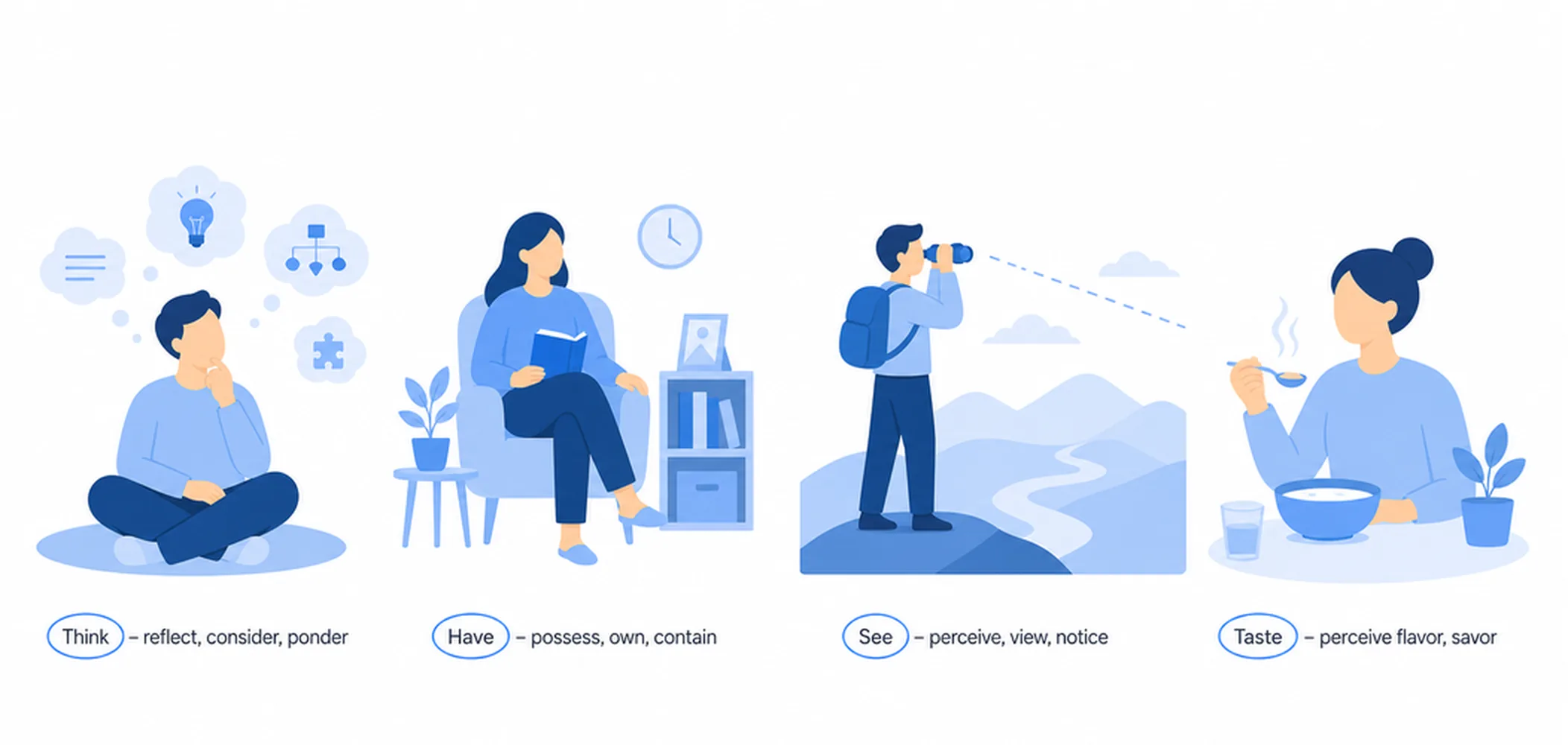
What are Stative Verbs?
Stative verbs describe states, conditions, or feelings — not actions. They show a situation that is permanent or continuous, not something you actively do. Unlike dynamic verbs (run, eat, write), stative verbs cannot be performed deliberately. You cannot choose to 'see' or 'taste' — these happen to you automatically. Common stative verbs include: be, have, know, understand, like, love, hate, believe, belong, consist, appear, seem, taste, smell, sound, and feel.
Why Stative Verbs Matter
Stative verbs are rarely used in continuous tenses (present continuous, past continuous). You say 'I like pizza' — not 'I am liking pizza'. This is a key difference between stative and dynamic verbs. Understanding this helps you avoid common mistakes and sound more natural in English. Some verbs can be both stative and dynamic depending on their meaning, so context is important.
Stative Verbs in Daily English
In conversation, you use stative verbs constantly: 'I think you're right', 'This tastes delicious', 'I have two sisters', 'She seems happy'. These verbs express your beliefs, opinions, relationships, and how things appear or feel to you. Because they describe fixed situations rather than temporary actions, you typically use simple tenses (present simple, past simple) rather than continuous forms.
Stative vs Dynamic: think, have, see, taste
| Aspect | THINKStative (opinion) | THINKDynamic (mental action) | HAVEStative (possession) | HAVEDynamic (activity) | SEEStative (perception) | SEEDynamic (deliberate action) | TASTEStative (flavour state) | TASTEDynamic (deliberate tasting) |
|---|---|---|---|---|---|---|---|---|
| Form | Simple tenses only (no continuous) |
Can use continuous tenses (is thinking, was thinking) |
Simple tenses only (no continuous) |
Can use continuous tenses (is having, was having) |
Simple tenses only (no continuous) |
Can use continuous tenses (is seeing, was seeing) |
Simple tenses only (no continuous) |
Can use continuous tenses (is tasting, was tasting) |
| When to use | Expressing a belief or opinion that exists as a state in the mind | Actively considering or pondering something right now | Describing ownership, relationships, or characteristics | Describing an activity or experience in progress | Passively perceiving something with the eyes (involuntary) | Meeting someone, visiting a doctor, or dating someone (deliberate) | Describing the flavour or quality something has | Deliberately sampling or testing the flavour of something |
| Positive example | "I think this idea is brilliant." Opinion held as a state |
"She is thinking about her future." Active process of consideration |
"He has a red car." Possession, exists as a state |
"They are having dinner right now." Activity in progress |
"I see a bird in the garden." Involuntary visual perception |
"She is seeing a specialist next week." Deliberate appointment |
"This soup tastes amazing." Describes its flavour as a state |
"The chef is tasting the sauce." Deliberate act of sampling |
| Negative example | "I don't think that's correct." Opinion/belief held as state |
"He isn't thinking clearly today." Ongoing mental process impaired |
"She doesn't have any siblings." Lack of a characteristic/possession |
"We aren't having a party tonight." Activity not taking place |
"I don't see anything strange." Nothing perceived involuntarily |
"They aren't seeing each other anymore." No longer dating — deliberate action |
"This doesn't taste like vanilla." Flavour state absent |
"He isn't tasting the food yet." Deliberate sampling not yet done |
| Question example | "Do you think it will rain?" Asking for an opinion/belief |
"What are you thinking about?" Asking about current mental process |
"Does she have a bicycle?" Asking about possession |
"Are you having a good time?" Asking about ongoing experience |
"Do you see that rainbow?" Asking about involuntary perception |
"Are you seeing someone new?" Asking about a deliberate relationship |
"Does this taste too salty to you?" Asking about flavour state |
"Are you tasting it before serving?" Asking about deliberate sampling |
| Key signal words | believe, feel, in my opinion, always, generally | right now, at the moment, currently, still | own, belong, possess, always, since | right now, at the moment, tonight, this evening | can, notice, look at (involuntary), suddenly | next week, tonight, regularly, these days | like, of, similar to, a bit, really | right now, carefully, before serving, still |
Examples






What to Remember
- Stative verbs describe states and feelings, not actions you deliberately perform.
- Common stative verbs include: be, have, know, like, love, hate, understand, seem, appear, taste, smell, sound.
- You cannot choose to see or taste — these happen automatically to you.
- Stative verbs are rarely used in continuous tenses like "I am knowing" or "I am liking."
- Unlike dynamic verbs such as run, eat, or write, stative verbs show permanent or ongoing situations.