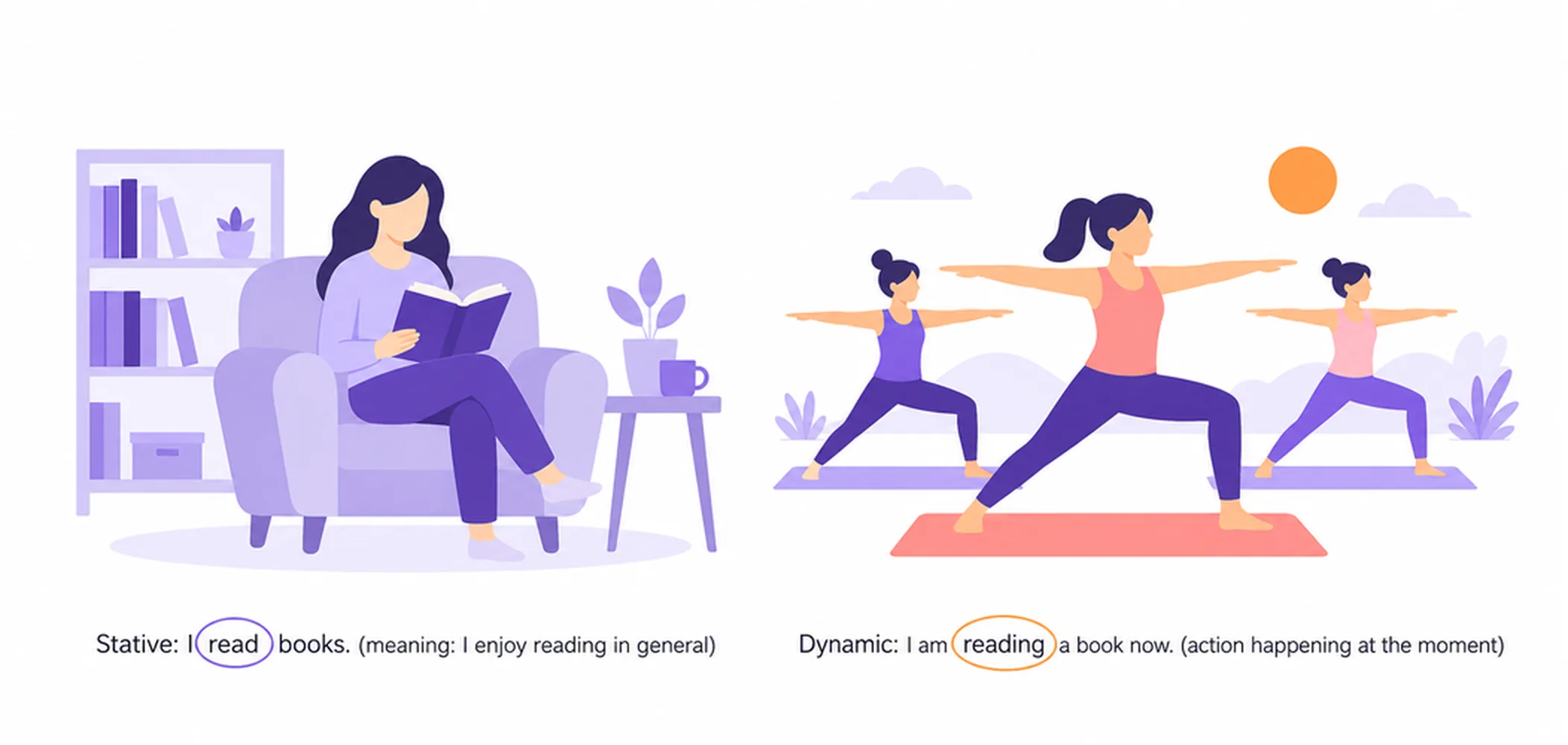
What Are Stative and Dynamic Verbs?
Most English verbs are either stative or dynamic. Dynamic verbs describe actions or processes (run, eat, build). Stative verbs describe states or conditions that don't change (like, love, know). However, some verbs can be both! These verbs change meaning depending on whether they describe an action or a state. Understanding this difference will help you use the correct tense and form.
Common Verbs That Work Both Ways
Verbs like have, see, taste, smell, think, and weigh can be either stative or dynamic. When used as dynamic verbs, they show action or change. When used as stative verbs, they describe a condition. For example, 'I have a car' (stative—possession) versus 'I'm having lunch' (dynamic—the action of eating). The context and the continuous tense often help show which meaning is intended. Learning to recognize these uses will make your English more natural and accurate.
Why This Matters for Speaking and Writing
Using continuous tenses (I am + -ing) with stative verbs is generally incorrect in English. However, when these verbs become dynamic, continuous tenses are completely natural. For example, 'I am thinking about it' (dynamic—considering) is correct, but 'I am understanding' (stative) is wrong. Recognizing whether a verb is functioning as stative or dynamic helps you choose the right tense and sound more like a native speaker.
Stative vs Dynamic Meanings: Side-by-Side Comparison
| Verb | Stative Meaning | Stative Example | Dynamic Meaning | Dynamic Example |
|---|---|---|---|---|
| have | To possess or own something (state of ownership) | She has a beautiful house in the countryside. | To experience or take part in an activity (e.g. a meal, a party, a bath) | They are having dinner with friends right now. |
| see | To perceive with the eyes without effort (involuntary perception) | I see a bird on the windowsill. | To meet or visit someone; to understand; to consult a professional | He is seeing a doctor about his knee this afternoon. |
| taste | To have a particular flavour (describes a quality of the food/drink itself) | This soup tastes amazing. | To deliberately sample or test the flavour of something (intentional action) | The chef is tasting the sauce to check the seasoning. |
| smell | To have a particular odour (describes a quality of the thing itself) | Those flowers smell wonderful. | To deliberately sniff something in order to detect its odour (intentional action) | The dog is smelling everything in the garden. |
| think | To hold an opinion or belief (a mental state) | I think this is the best solution. | To actively consider, reflect, or deliberate on something (a mental process in progress) | She is thinking about changing her career. |
| weigh | To have a particular weight (a permanent or stable characteristic) | The parcel weighs five kilograms. | To measure the weight of someone or something (deliberate action) | The nurse is weighing the newborn baby right now. |
| look | To appear or seem a certain way (describes an observable quality) | You look tired today. | To direct the eyes intentionally toward something; to search | She is looking at the map to find the route. |
| feel | To experience an emotion or physical sensation (internal state) | I feel nervous about the exam. | To physically touch or examine something with the hands (deliberate action) | He is feeling the fabric to check its texture. |
| appear | To seem or give an impression (similar to "seem"; describes a quality) | The situation appears to be under control. | To come into view, perform on stage, or show up at an event (physical action) | The actor is appearing in a new play on Broadway. |
| measure | To be a specific size or dimension (a static characteristic) | The room measures six metres by four metres. | To actively take the measurements of something (deliberate action) | The carpenter is measuring the wall before cutting the wood. |
| fit | To be the right size or shape (a state describing suitability) | This jacket fits you perfectly. | To adjust or install something carefully into a space (active process) | The engineer is fitting the new pipes in the bathroom. |
| imagine | To believe or suppose something without full certainty (mental state of assumption) | I imagine the meeting will last about an hour. | To actively create a mental picture or engage in creative visualisation | She is imagining what her new flat will look like after the renovation. |
Key Difference: Stative vs. Dynamic Use
When a verb is used statively, it describes a condition, state, or permanent characteristic — something that simply exists rather than being performed. In this case, continuous tenses are not normally used (e.g. ✗ "The soup is tasting great"). When the same verb is used dynamically, it describes a deliberate, ongoing, or temporary action that a person or agent actively performs or experiences at a specific moment. In this case, continuous tenses are both possible and natural (e.g. ✓ "The chef is tasting the soup"). The key test: ask whether there is intention or active effort involved. If yes, the usage is dynamic and continuous tenses are appropriate. If no, and the verb simply describes a quality or mental or physical state, then the usage is stative and simple tenses are preferred.
Examples






What to Remember
- Most English verbs are either stative (describe states) or dynamic (describe actions).
- Some verbs like have, see, taste, and think can function as both stative and dynamic verbs.
- Dynamic verbs can use continuous tenses (is running); stative verbs typically cannot (not "is knowing").
- The meaning changes based on context: "I see the problem" (stative) vs. "I'm seeing a doctor" (dynamic).
- Choose tenses carefully because a verb's stative or dynamic form determines whether continuous tenses are grammatically correct.