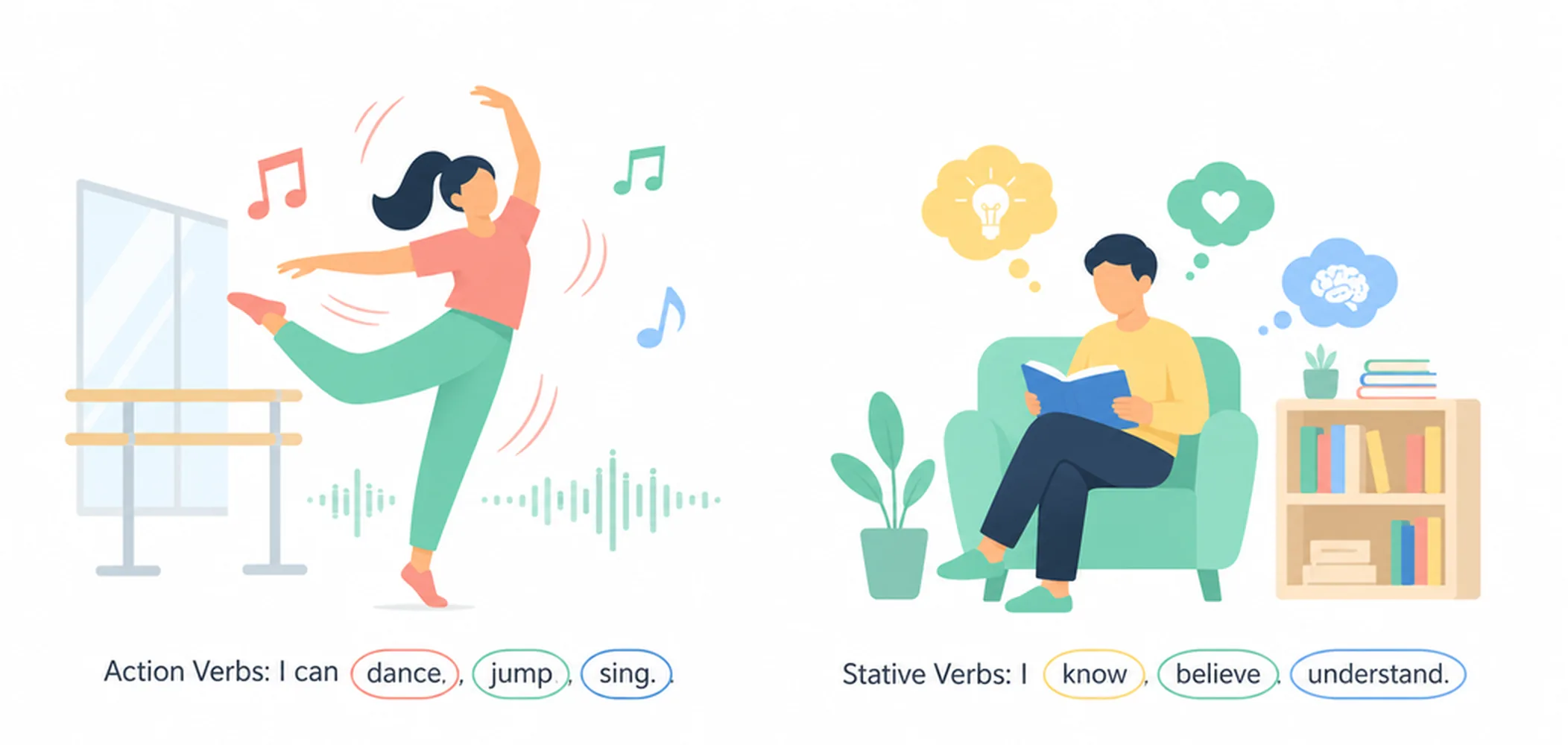
What Are Stative Verbs?
Stative verbs describe a state or condition that doesn't change. They show how someone feels, what they think, or what they own. Unlike dynamic verbs, which show actions or movements, stative verbs describe situations that stay the same. For example, 'I like pizza' describes a feeling that continues over time. The verb 'like' doesn't show an action—it shows a state of preference.
Why This Matters for Grammar
Stative verbs have an important grammar rule: they usually cannot be used in the continuous (progressive) tenses. You cannot say 'I am liking pizza' in standard English. Instead, you must use the simple present: 'I like pizza.' This is one of the most important things to remember when using stative verbs. Many languages do this differently, so it's a common mistake for English learners.
Common Categories of Stative Verbs
The most common stative verbs fall into these groups: emotions and feelings (love, hate, like, want, prefer), thinking and knowing (think, believe, know, understand, remember), possession (have, own, belong), senses (see, hear, smell, taste), and appearance (seem, look, appear). Learning these groups will help you recognize stative verbs and use them correctly in sentences.
Stative Verbs vs Dynamic Verbs
| Feature | Stative Verbs | Dynamic Verbs |
|---|---|---|
| Form | Describe a state, condition, or situation that exists rather than an action. They are typically not used in continuous (progressive) tenses. | Describe actions, events, or processes that have a clear beginning and end. They can be used in all tenses, including continuous tenses. |
| When to Use | Use to express permanent or semi-permanent states: emotions, mental states, senses, possession, and appearance. Commonly used in simple tenses (present simple, past simple). | Use to describe activities, changes, or actions happening at a specific moment or over a period. Can be used in simple, continuous, and perfect tenses. |
| Positive Example | "She knows the answer." "He loves chocolate." "I believe you." |
"She is writing a letter." "He runs every morning." "They are building a house." |
| Negative Example | "I don't understand the question." "She doesn't like loud music." ❌ "I am not understanding" — incorrect in most contexts. |
"He isn't working right now." "They didn't finish the project." Both simple and continuous negatives are acceptable. |
| Question Example | "Do you own a car?" "Does she want more tea?" Progressive question forms are generally avoided. |
"Are you listening to me?" "Did he finish the report?" Both simple and progressive question forms are correct. |
| Key Signal Words / Categories | Emotions: love, hate, fear, prefer Mental states: know, believe, remember, think Senses: see, hear, smell, taste Possession: have, own, belong, contain Appearance: seem, appear, look, resemble |
Physical actions: run, jump, eat, write Changes: grow, change, develop, improve Processes: cook, build, repair, create Communication: speak, tell, ask, explain Events: happen, start, stop, arrive |
| 🔑 Key Difference: Stative verbs describe states of being — things that are true over a period of time without active effort (e.g., knowing, believing, owning) — and are rarely used in continuous tenses. Dynamic verbs describe deliberate actions or processes that can start and stop, and can freely appear in all tenses including continuous forms. Some verbs (e.g., think, have, see) can be both stative and dynamic depending on meaning: "I think you're right" (stative opinion) vs. "I'm thinking about it" (dynamic, active process). | ||
Examples






What to Remember
- Stative verbs describe states or conditions, not actions or movements.
- Common stative verbs include: like, love, hate, want, need, know, understand, believe, own, seem.
- Stative verbs usually cannot use continuous (progressive) tenses like "am liking" or "is wanting."
- Use simple tenses with stative verbs: "I like pizza" not "I am liking pizza."
- Some verbs are stative in one meaning but dynamic in another: "have" (own) versus "have" (eat).