Understanding the Present Subjunctive
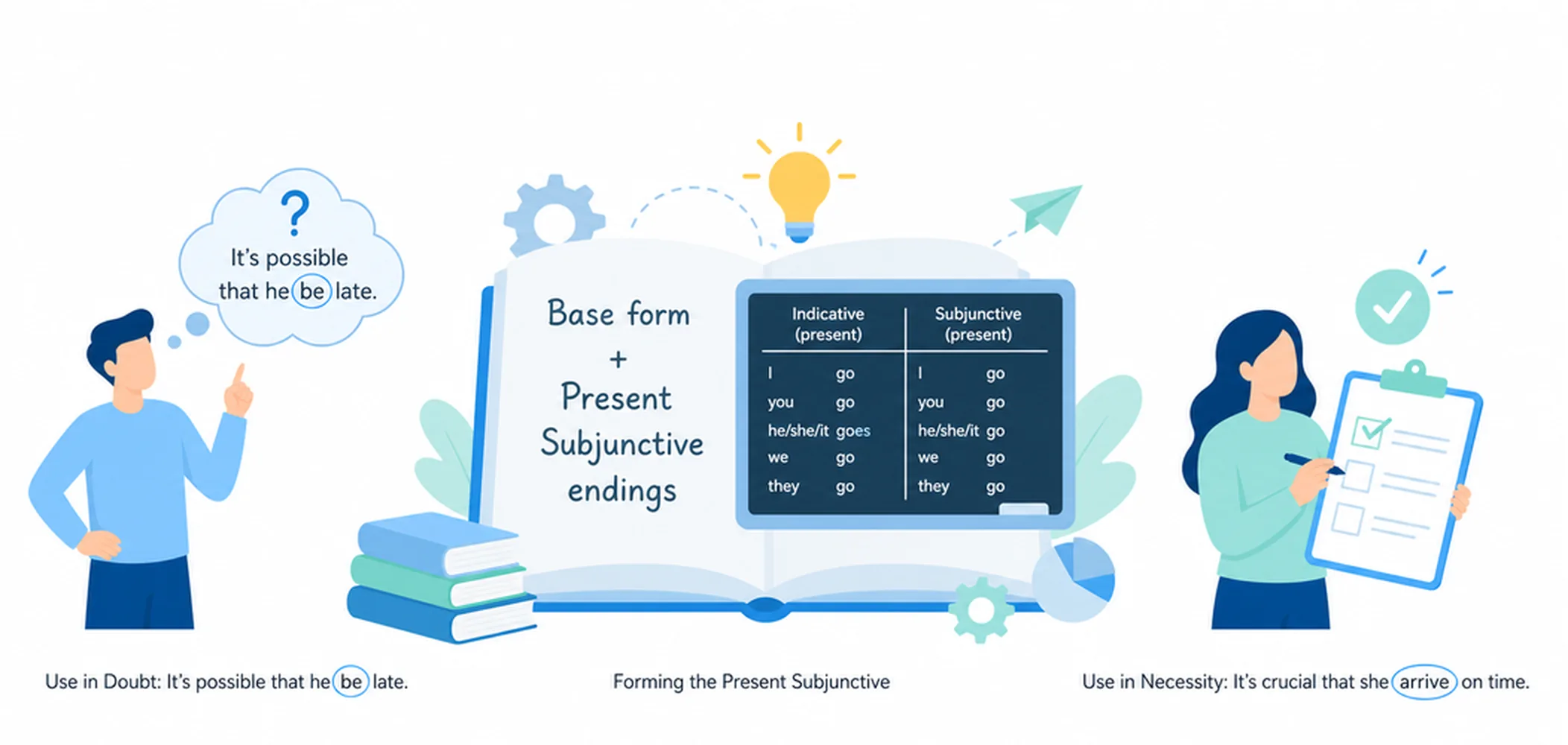
The present subjunctive is a verb form used to express wishes, demands, recommendations, and hypothetical situations in formal or literary English. Unlike many Romance languages, English has largely abandoned productive subjunctive morphology; however, the subjunctive still appears in specific contexts, particularly in American English and formal registers. The present subjunctive uses the base form of the verb for all persons and numbers, without the third-person singular -s ending. This form is often preceded by the conjunction 'that' and typically follows verbs or adjectives that express necessity, desire, or uncertainty.
Formation and Structure
The present subjunctive is formed using the base infinitive form of the verb, regardless of the subject. For example: 'I suggest that he go immediately' (not 'goes'), and 'It is essential that she arrive on time' (not 'arrives'). This form applies equally to all subjects—first, second, and third person, singular and plural. The subjunctive often appears in formal written English, legal documents, and academic discourse. In contemporary English, especially in British usage, the construction 'should + infinitive' frequently replaces the pure subjunctive form, though the direct subjunctive remains standard in formal contexts.
Primary Uses and Contexts
The present subjunctive serves several critical functions: (1) after verbs expressing demand, recommendation, or insistence (insist, demand, suggest, require, propose, recommend); (2) after expressions of necessity or importance (it is essential, it is vital, it is crucial); (3) in formal resolutions and motions (The board moves that the proposal be adopted); (4) in conditional clauses expressing contrary-to-fact situations (If I were you, I would reconsider); and (5) in fixed expressions and formulas (Come what may, God save the Queen). Understanding when to deploy the subjunctive is essential for achieving native-like formality and precision in academic and professional English.
Present Subjunctive Conjugation by Person and Number
| Present Subjunctive — Form and Use (Contrasted with Indicative) | ||||
|---|---|---|---|---|
| Pronoun | Indicative (Present) | Subjunctive (Present) | Differs? | Example in Context |
Verb: be (highly irregular) |
||||
| I | am |
be |
Yes | I suggest that I be excused. |
| you | are |
be |
Yes | It is vital that you be present. |
| he / she / it | is |
be |
Yes | I demand that she be informed. |
| we | are |
be |
Yes | They ask that we be on time. |
| you (plural) | are |
be |
Yes | It is necessary that you all be ready. |
| they | are |
be |
Yes | I insist that they be told. |
Verb: have (irregular 3rd person singular) |
||||
| I | have |
have |
No | I suggest that I have more time. |
| you | have |
have |
No | They recommend that you have a plan. |
| he / she / it | has |
have |
Yes | It is important that he have access. |
| we | have |
have |
No | She proposes that we have a meeting. |
| you (plural) | have |
have |
No | I insist that you all have a copy. |
| they | have |
have |
No | He requests that they have approval. |
Verb: go (irregular 3rd person singular indicative) |
||||
| I | go |
go |
No | They suggest I go first. |
| you | go |
go |
No | I recommend that you go early. |
| he / she / it | goes |
go |
Yes | It is essential that she go alone. |
| we | go |
go |
No | He demands that we go now. |
| you (plural) | go |
go |
No | I ask that you all go quietly. |
| they | go |
go |
No | She insists that they go together. |
Verb: do (irregular 3rd person singular indicative) |
||||
| I | do |
do |
No | They ask that I do the work. |
| you | do |
do |
No | I suggest that you do your best. |
| he / she / it | does |
do |
Yes | It is vital that he do this correctly. |
| we | do |
do |
No | She recommends that we do more research. |
| you (plural) | do |
do |
No | I require that you all do the task. |
| they | do |
do |
No | He insists that they do it properly. |
Verb: know (regular -s pattern) |
||||
| I | know |
know |
No | I suggest that I know the answer. |
| you | know |
know |
No | They ask that you know the rules. |
| he / she / it | knows |
know |
Yes | It is important that he know the facts. |
| we | know |
know |
No | She insists that we know our limits. |
| you (plural) | know |
know |
No | I recommend that you all know the context. |
| they | know |
know |
No | He requires that they know the procedure. |
Examples






What to Remember
- The present subjunctive uses the base form of the verb for all persons, with no third-person singular -s.
- Use the subjunctive after expressions of demand, recommendation, or necessity like "require," "suggest," and "insist."
- The subjunctive appears in that-clauses following verbs of wishing, commanding, or recommending in formal contexts.
- In American English, the subjunctive is more common and productive than in contemporary British English usage.
- Distinguish the subjunctive from conditional statements; subjunctive expresses wishes and demands, not factual hypothetical situations.