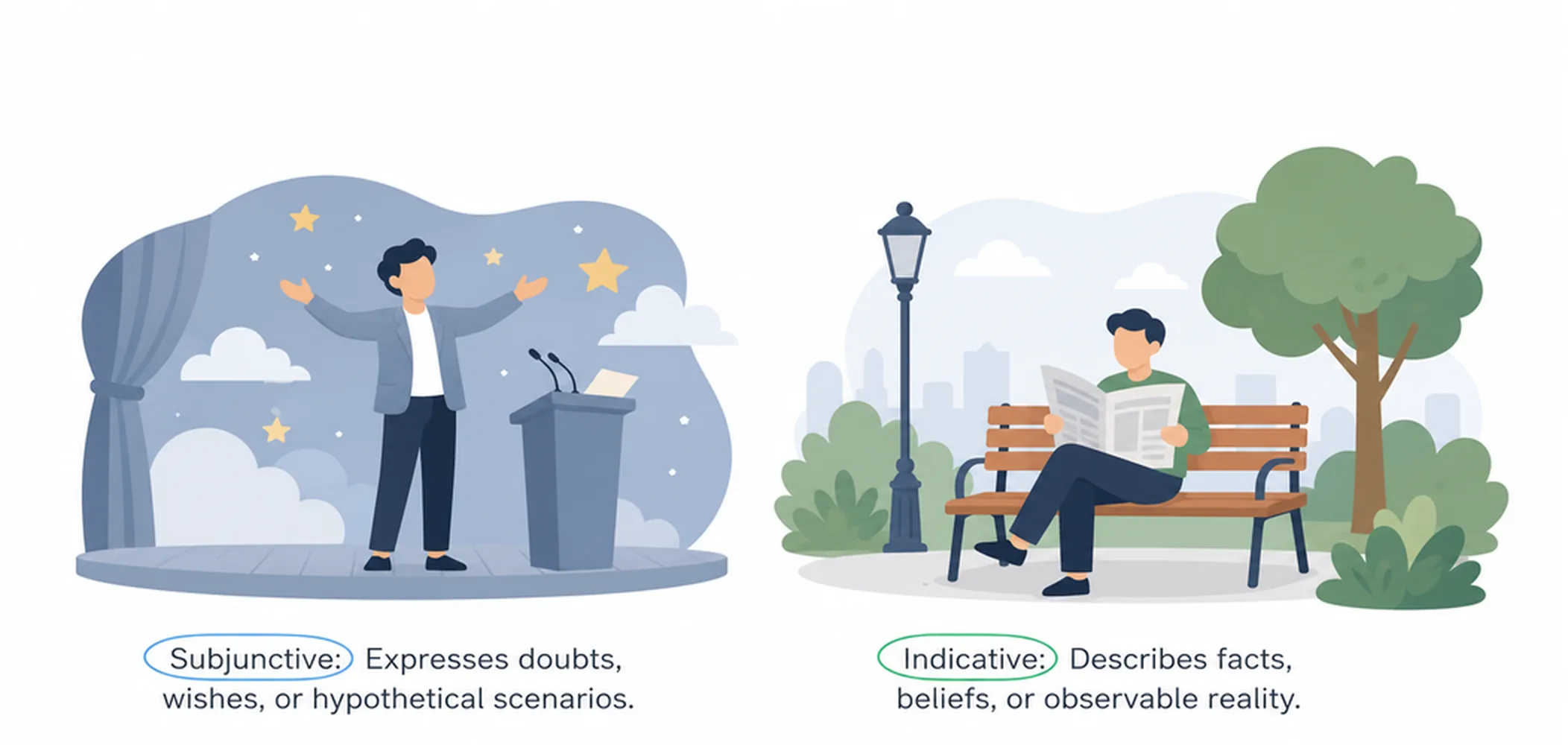
The Core Distinction
The indicative mood expresses factual information, certainty, and objective reality—what is known or observed. The subjunctive mood, by contrast, conveys hypothetical situations, wishes, doubts, emotional reactions, and counterfactual scenarios. In English, the subjunctive is less morphologically marked than in Romance languages, but understanding when to employ it distinguishes advanced learners. The choice between them fundamentally reflects your certainty about the proposition: indicative = certain reality; subjunctive = uncertain, imagined, or desired reality.
When to Use the Indicative
Use the indicative mood to state facts, describe completed events, express observable truths, and convey certainty about a situation. The indicative is the default mood in English and accounts for the vast majority of everyday communication. Sentences with indicative mood answer 'what happened?' or 'what is true?' rather than 'what if?' or 'what might happen?'
When to Use the Subjunctive
Use the subjunctive mood after expressions of necessity, demand, recommendation, or suggestion (e.g., 'I suggest that he arrive early'); in conditional clauses expressing hypothetical or contrary-to-fact situations (e.g., 'If I were you...'); and in clauses following expressions of doubt, fear, or emotional judgment. The subjunctive often appears after 'if,' 'unless,' 'as if,' 'though,' and 'lest,' and in formal contexts, particularly in American English.
Subjunctive vs Indicative: Side-by-Side Comparison
| Dimension | Subjunctive Mood | Indicative Mood |
|---|---|---|
| Form | Uses the base (infinitive) form of the verb for all persons in the present subjunctive (e.g., be, go, have). In the past subjunctive, were is used for all persons. Third-person singular does not take a final -s. | Follows standard conjugation rules: third-person singular present takes -s (e.g., goes, has). Past tense, continuous, perfect, and other tenses are formed normally according to regular or irregular verb patterns. |
| When to Use | Used to express hypothetical situations, wishes, doubts, demands, recommendations, possibilities, or conditions contrary to reality. Common in formal or literary registers and after certain verbs, adjectives, and conjunctions. | Used to state facts, describe reality, make assertions, ask direct questions, or express certainty about events that are real, habitual, or actually occurring. It is the default mood for most everyday statements. |
| Positive Example | "It is essential that he be present at the meeting." "The board recommended that she submit the report by Friday." |
"He is present at the meeting." "She submits the report every Friday." |
| Negative Example | "It is vital that the contract not be signed without legal review." "I wish he were not so difficult to work with." |
"The contract is not signed without legal review." "He is not difficult to work with." |
| Question Example | "Should it be necessary that she appear in court?" (Subjunctive in questions is rare and typically embedded in formal or reported structures.) |
"Does she appear in court?" "Is it necessary for her to appear?" |
| Key Signal Words / Triggers | Verbs: wish, suggest, recommend, demand, insist, propose, require, urge Adjectives: essential, vital, important, necessary, advisable, imperative Conjunctions: if (contrary-to-fact), as if, as though, lest, unless, so that, in order that Phrases: it is important that, it is necessary that, would that |
Time markers: always, usually, every day, now, yesterday, already, since Fact-stating verbs: know, see, believe (when affirming), think (affirmatively), notice, prove Reality conjunctions: because, when (actual), after, before (real events), although General: No special trigger needed — used by default for factual statements. |
| Grammatical Person & Number | Invariable in the present: the same base form is used for I, you, he/she/it, we, they. No third-person singular -s. Past subjunctive uses were for all persons, including I and he/she/it. | Varies by person and number: I go, she goes, they went. Third-person singular present always requires -s. Irregular verbs follow their own patterns (be → am/is/are/was/were). |
| Register & Frequency | More common in formal, academic, legal, and literary writing. In informal spoken English, it is often replaced by modal constructions (should, might, may) or the indicative without a change in meaning. | The most frequently used mood across all registers — formal, informal, spoken, and written. It is the unmarked default mood of English and requires no special grammatical context to appear. |
Examples






What to Remember
- Use the indicative mood to express facts, certainty, and objective reality about what is known or observed.
- Use the subjunctive mood for hypothetical situations, wishes, doubts, emotional reactions, and counterfactual scenarios that aren't certain.
- In English, subjunctive forms are subtle; modern usage favors indicative even where subjunctive would be technically correct.
- The fundamental distinction: indicative reflects certainty about a proposition; subjunctive reflects uncertainty, unreality, or desired outcomes.
- Common mistake: learners often use indicative in subjunctive contexts like wishes or conditions because English morphology lacks clear markers.