Understanding the Subjunctive Mood
The subjunctive mood expresses hypothetical, counterfactual, or desired situations rather than factual statements. Unlike the indicative mood, which describes reality, the subjunctive conveys wishes, recommendations, conditional scenarios, and formal proposals. In modern English, the subjunctive is primarily reserved for formal, academic, and legal writing, though it remains prevalent in certain set phrases and expressions of necessity or urgency.
Forms and Conjugation Patterns
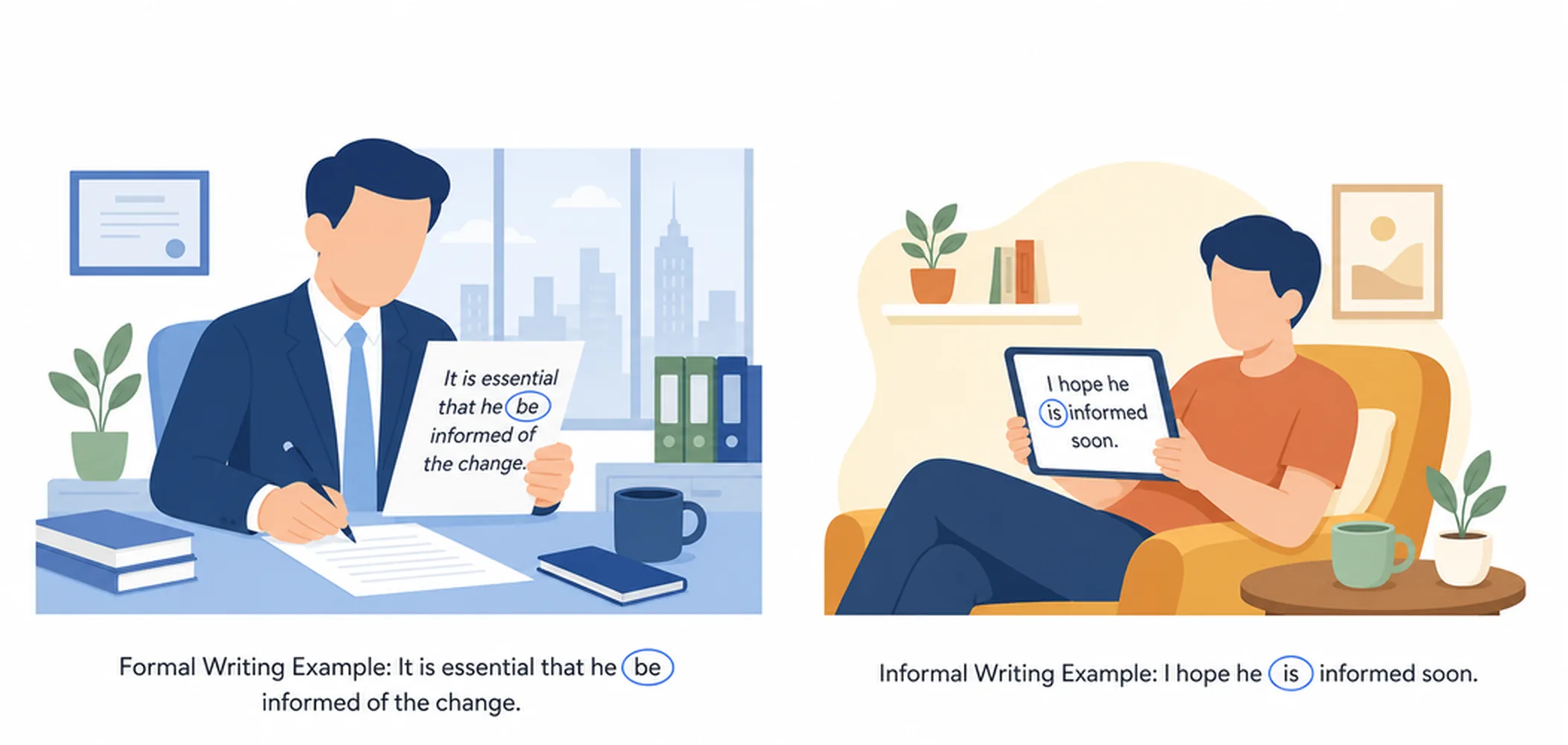
The subjunctive typically employs the base form of the verb without inflection. For the verb 'to be,' the present subjunctive is 'be' (not 'am,' 'is,' or 'are'), and the past subjunctive is 'were' (not 'was'). In other verbs, the third-person singular present subjunctive drops the -s suffix: 'I suggest that he arrive on time' rather than 'he arrives.' These forms distinguish the subjunctive from indicative usage and create the formal register characteristic of academic and official discourse.
Contexts and Application in Formal Writing
The subjunctive appears in formal contexts including legal documents, academic proposals, policies, and recommendations. Common triggers include verbs expressing necessity (demand, require, insist), recommendation (suggest, propose, recommend), and desire (wish, hope). Subjunctive constructions also follow impersonal expressions such as 'It is essential that,' 'It is vital that,' and 'It is imperative that.' Additionally, counterfactual conditionals employ the past subjunctive to express contrary-to-fact situations: 'If I were you, I would reconsider.' Mastering these patterns elevates formal writing and demonstrates linguistic precision.
Subjunctive vs. Indicative in Formal Writing
| Category | Indicative Mood | Subjunctive Mood |
|---|---|---|
| Form | Standard conjugated verb form agreeing with subject in person and number (e.g., he is, she goes, it requires). Third-person singular takes an "-s" ending in the present tense. | Base (infinitive) form of the verb used for all persons and numbers (e.g., he be, she go, it require). No "-s" is added for third-person singular. "Be" remains be in present and were in past for all subjects. |
| When to Use | Used to state facts, ask genuine questions, or describe real, observable situations. Conveys what is, was, or will be true in the real world. Appropriate for reporting findings, describing data, and narrating events. | Used after expressions of necessity, recommendation, demand, proposal, suggestion, or in counterfactual conditional clauses. Conveys what is required, desired, hypothetical, or contrary to fact. Essential in formal reports, academic writing, legal documents, and policy texts. |
| Positive Example (Necessity context) | "It is necessary that the committee reviews the proposal each quarter." Uses standard third-person singular "reviews" — grammatically acceptable in informal usage but considered imprecise in formal writing. |
"It is necessary that the committee review the proposal each quarter." The base form "review" drops the "-s", signalling a required action rather than a factual observation. Preferred in formal and academic writing. |
| Positive Example (Recommendation context) | "The board recommends that the director submits a revised budget." Indicative "submits" treats this as a statement of fact rather than a directive, weakening the prescriptive intent of the recommendation. |
"The board recommends that the director submit a revised budget." Subjunctive "submit" (no "-s") correctly frames the action as something urged or prescribed, not yet done — maintaining the force of the formal recommendation. |
| Positive Example (Counterfactual context) | "If the policy was revised, outcomes would improve." Using "was" (indicative past) blurs the distinction between a real past situation and a hypothetical one, reducing precision in formal argumentation. |
"If the policy were revised, outcomes would improve." "Were" (past subjunctive) signals clearly that the situation is hypothetical or contrary to current fact — a critical distinction in legal, academic, and policy writing. |
| Negative Example | "The regulation requires that the applicant does not disclose proprietary information." The auxiliary "does not" is indicative and implies a factual description of the applicant's behaviour rather than a regulatory obligation. |
"The regulation requires that the applicant not disclose proprietary information." The subjunctive negative is formed by placing "not" directly before the base verb without any auxiliary, maintaining formal register and prescriptive clarity. |
| Question Example | "Is it important that she attends the hearing?" The indicative "attends" treats attendance as a factual matter being queried, appropriate in casual conversation but imprecise in formal procedural contexts. |
"Is it important that she attend the hearing?" Even in interrogative sentences, the subjunctive is preserved in the subordinate clause. The base form "attend" signals that the necessity or importance being questioned is about a prescribed, not yet realised, action. |
| Key Signal Words | Factual verbs and phrases: states that, confirms that, shows that, reports that, believes that, notes that. These introduce factual or reported content and call for indicative forms. | Necessity: it is essential / necessary / vital / imperative that Recommendation/Demand: recommend, suggest, propose, require, demand, insist, urge, move, request that Counterfactual: if … were, as if, as though, were … to, supposing that |
| Key Difference: The indicative mood describes reality — it reports what is, was, or will be true, conjugating verbs to agree with their subjects in the standard way. The subjunctive mood steps outside reality to express what is required, recommended, hypothetical, or contrary to fact — it uses the uninflected base form of the verb (present subjunctive) or were for all persons (past subjunctive), deliberately suspending normal subject-verb agreement to signal that the clause does not describe an established fact but rather an obligation, desire, or counterfactual scenario. In formal writing, choosing the subjunctive over the indicative is not merely stylistic: it is a precise grammatical signal of intent that distinguishes prescription from description, hypothesis from assertion. | ||
Examples






What to Remember
- The subjunctive mood expresses hypothetical, counterfactual, or desired situations, not factual statements.
- Use the base form of the verb in subjunctive constructions, even with third-person singular subjects.
- Common subjunctive triggers include "I suggest that," "it is essential that," and "I wish that" expressions.
- The subjunctive is increasingly rare in modern English but remains essential in formal and legal writing.
- Avoid confusing subjunctive with conditional mood; subjunctive expresses wishes and recommendations, not probable future events.