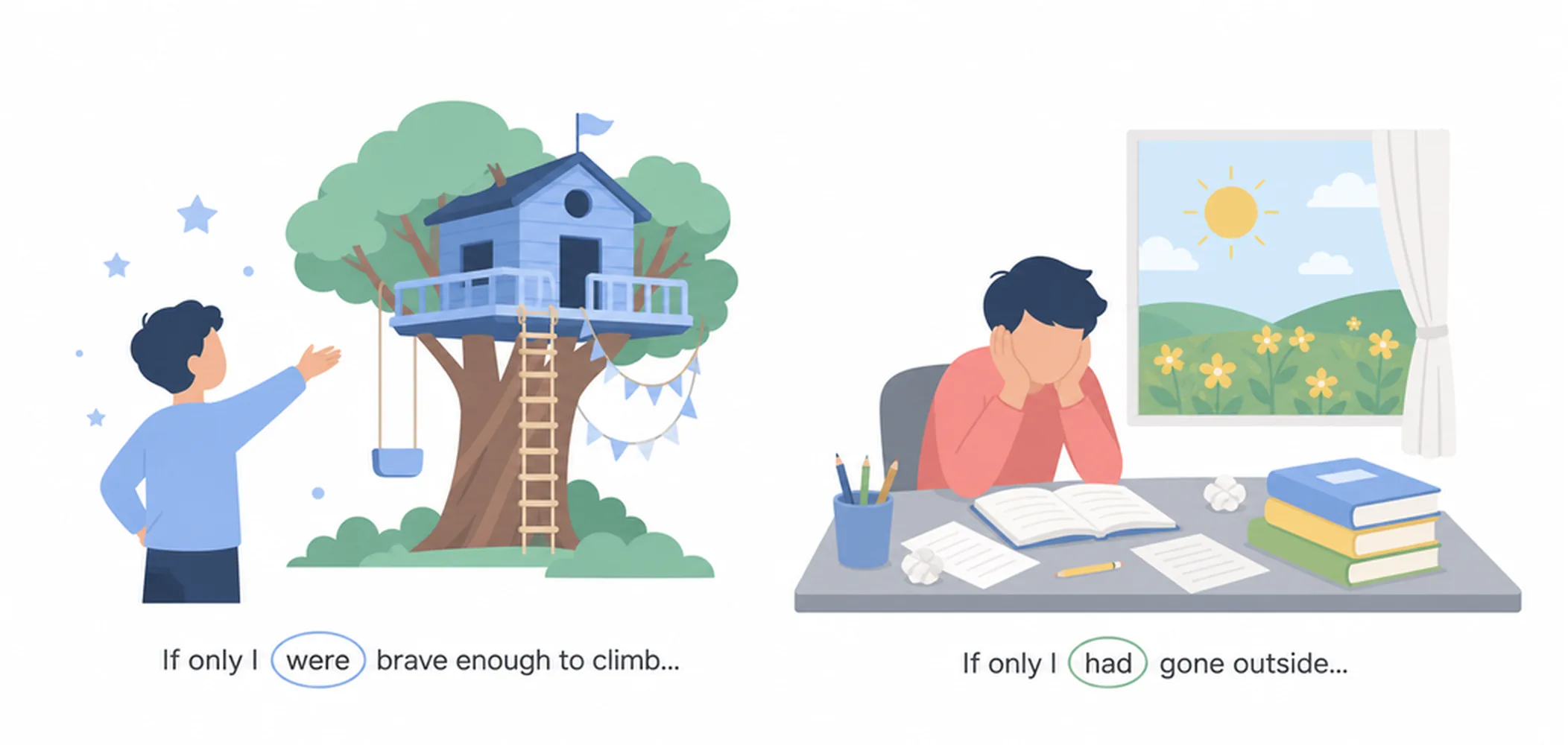
Understanding 'If Only' and the Subjunctive
The phrase 'if only' is used to express regret, longing, or a wish that something were different from reality. It introduces a counterfactual situation—something contrary to what actually happened or exists. In English, 'if only' clauses employ the subjunctive mood, which allows speakers to distance themselves from objective reality and explore hypothetical scenarios. This construction is particularly powerful for conveying emotional intensity: the speaker is not merely hypothesizing, but expressing genuine disappointment or yearning about an unmet condition.
Subjunctive Forms with 'If Only'
When using 'if only', the subjunctive typically appears in past tenses, even when referring to present situations. For present wishes (things you wish were true now), use the past simple: 'If only I had more time.' For past wishes (regrets about what already happened), use the past perfect: 'If only I had studied harder.' The verb 'be' has a special subjunctive form: 'were' appears in all persons in present subjunctive contexts ('If only I were taller'), while 'had been' is used for past subjunctive ('If only I had been there'). This grammatical shift from reality to hypothesis marks the subjunctive mood distinctly.
Emotional Register and Usage
The 'if only' construction is inherently more emotive than other conditional structures. While 'if' alone can be neutral ('If it rains, I'll stay home'), 'if only' carries the weight of unfulfilled desire or regret. This makes it particularly appropriate for personal reflection, creative writing, and expressive speech. At the C1 level, understanding when to employ 'if only' rather than other conditionals demonstrates nuanced command of English. The construction works well in formal writing, literature, and serious conversation, though it can also appear in casual speech when genuine emotion is involved.
If Only vs. I Wish: Key Differences
| Feature | If Only | I Wish |
|---|---|---|
| Form | If only + subject + past simple / past perfect / would + base verb | I wish + subject + past simple / past perfect / would + base verb |
| Meaning | Expresses a strong, often dramatic desire for a situation to be different from reality; implies a sense of longing, regret, or frustration | Expresses a desire for a situation to be different from reality; can convey mild regret, longing, or complaint about a present or past situation |
| Emotional Intensity | Generally stronger and more emphatic; often used when the speaker feels deep regret, desperation, or intense frustration | Neutral to moderately emotional; suitable for everyday regrets, mild complaints, or general wishes without strong dramatic effect |
| When to Use | Use when you want to stress the wish very strongly, especially in writing, literature, or emotional speech. Common for present unreal conditions and past regrets | Use in everyday conversation and writing for general regrets about the present or past, and for expressing annoyance about habits or repeated behaviour (with would) |
| Present / Future Unreal Example | If only I had more time to study! (I don't have enough time — strong regret) | I wish I had more time to study. (I don't have enough time — general regret) |
| Past Regret Example | If only I had listened to her advice! (I didn't listen — strong, dramatic regret) | I wish I had listened to her advice. (I didn't listen — standard regret) |
| Annoyance / Complaint Example (with would) | If only he would stop interrupting me! (Intense frustration about someone's repeated behaviour) | I wish he would stop interrupting me. (Complaint about someone's repeated behaviour — very common in everyday speech) |
| Grammatical Structure (Present Unreal) | If only + subject + past simple e.g. If only she knew the answer. |
I wish + subject + past simple e.g. I wish she knew the answer. |
| Grammatical Structure (Past Unreal) | If only + subject + past perfect e.g. If only they had arrived earlier. |
I wish + subject + past perfect e.g. I wish they had arrived earlier. |
| Can Stand Alone? | Yes — If only! can be used as an exclamation on its own to mean "That would be wonderful but it isn't possible." | No — I wish requires a clause or a noun phrase to complete the sentence and cannot stand alone as an exclamation in the same way |
| Register / Style | Common in literary, formal, and emotional contexts; frequently found in novels, poetry, speeches, and dramatic dialogue | Common in both formal and informal everyday contexts; very natural in spoken English, casual writing, and conversation |
| Key Signal Words / Phrases | if only, exclamation marks for emphasis (e.g. If only I could!), dramatic or literary tone | I wish, he/she/they wish(es), we wish; often followed by but to contrast with reality (e.g. I wish I could come, but I'm busy.) |
| Key Difference: Both if only and I wish use identical subjunctive verb forms (past simple for present/future unreal situations; past perfect for past regrets; would + base verb for complaints about behaviour), making them grammatically interchangeable in most sentences. The critical distinction is one of tone and emphasis: If only carries a noticeably stronger emotional charge — conveying deeper longing, desperation, or regret — and is preferred in literary, dramatic, or emphatic speech. I wish is the more versatile, everyday expression suitable for any level of regret. When in doubt, choose I wish for neutral contexts and if only when you want to communicate heightened emotion or dramatic effect. | ||
Examples






What to Remember
- Use 'if only' to express regret, longing, or wishes that contradict reality or past events.
- 'If only' clauses require subjunctive forms: past tense for present wishes, past perfect for past regrets.
- The subjunctive distances the speaker from reality, creating emotional intensity beyond simple hypothetical statements.
- Use 'if only' + were/had + subject in the clause; do not use 'would' in the condition.
- 'If only' differs from 'if' because it always expresses emotional longing, not neutral hypothetical situations.