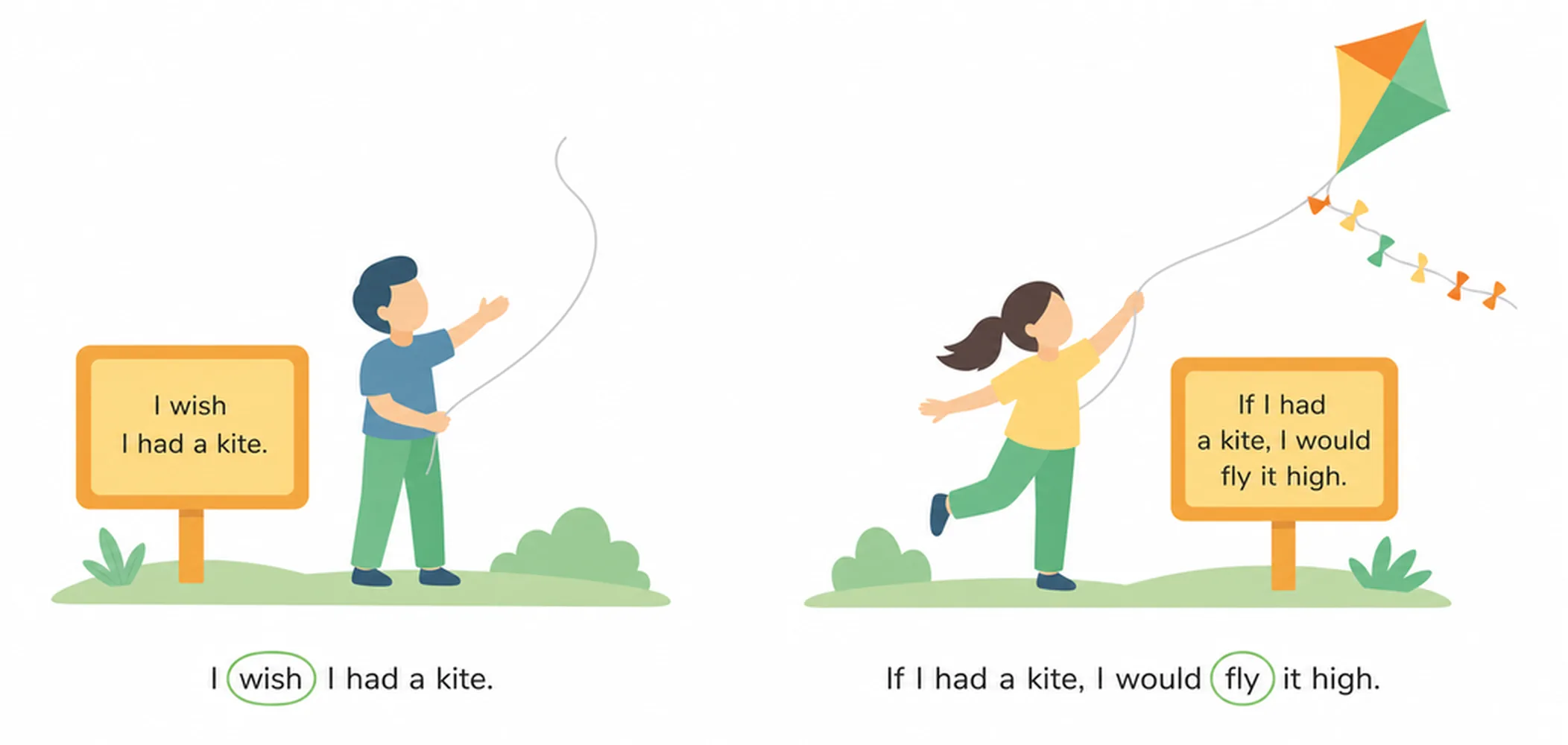
Understanding the Second Conditional with Wish
The second conditional expresses imaginary or hypothetical situations in the present or future. When we use 'wish' with the second conditional, we express regrets about the present reality or desires for things to be different. The structure combines 'wish' with a past tense verb to show that something is not true now, but we want it to be true. For example, if you don't have a car, you might say 'I wish I had a car.' This is different from reality—you don't have one, but you want one.
The Grammar Structure
The structure of the second conditional with wish follows this pattern: wish + subject + past simple verb. Notice that we use past tense even though we are talking about the present situation. This structure allows us to express that the current reality is not what we want.
| Subject | Affirmative | Negative |
|---|---|---|
| I | I wish I knew | I wish I didn't know |
| You | I wish you lived here | I wish you didn't live here |
| He / She / It | I wish he knew | I wish he didn't know |
| We / They | I wish they knew | I wish they didn't know |
For the verb 'to be,' the past simple form is 'were' for all subjects in formal English, though 'was' is sometimes used in informal speech.
Formal: I wish I were taller. / I wish it weren't raining.
Informal: I wish I was taller. / I wish it wasn't raining.
The negative form uses 'did not' or 'didn't' with the past simple verb, as shown in the table above. This grammar structure helps express dissatisfaction with the current situation and conveys a desire for a different present reality.
When and Why We Use It
We use 'wish' with the second conditional to talk about regrets, dissatisfaction, or desires for change. It appears in everyday conversations when we want to express what we want to be different about our lives. For instance, a student might say 'I wish I studied more for the exam' (expressing regret about not studying), or an employee might say 'I wish my boss understood my problems' (expressing a desire for a different situation). This structure is more emotional and personal than simply stating facts.
Wish vs. Second Conditional: How They Work Together
| Feature | Wish + Past Simple | Second Conditional (If + Past Simple) |
|---|---|---|
| Form | Subject + wish + subject + past simple verb e.g. I wish I had a car. |
If + subject + past simple, subject + would + base verb e.g. If I had a car, I would drive to work. |
| When to use | To express a desire or regret about a present situation that is unreal or unlikely. Focus is on the feeling about the situation. | To describe an imaginary present or future situation and its hypothetical result. Focus is on the consequence of the unreal condition. |
| Positive example | I wish I spoke Spanish. (I don't speak Spanish — I want to.) |
If I spoke Spanish, I would get a better job. (Imagining the result of speaking Spanish.) |
| Negative example | She wishes she didn't have so much homework. (She has a lot of homework — she dislikes it.) |
If she didn't have so much homework, she would go out with her friends. (Imagining the result of less homework.) |
| Question example | Do you wish you lived closer to the city? (Asking about a desire regarding a current unreal situation.) |
If you lived closer to the city, would you walk to work? (Asking about a hypothetical result.) |
| Key signal words | wish, if only, really want, desire, regret Often followed by expressions of feeling: I wish things were different. |
if, would, could, might Often includes a result clause: …I would be happier. |
| Shared grammar | Both structures use the past simple (including were for all persons with be) to talk about an unreal present or future situation — not the past. This is sometimes called the subjunctive mood in formal grammar. e.g. I wish I were taller. / If I were taller, I would play basketball. |
|
| 🔑 Key Difference: Both wish + past simple and the second conditional use the past simple to describe hypothetical, unreal present situations. However, wish + past simple expresses a desire or regret about a situation (one clause, focused on feeling), while the second conditional presents an imaginary condition and its result (two clauses — an if-clause and a would-clause). Think of wish as the starting point of a feeling, and the second conditional as the full exploration of what that feeling would lead to. | ||
Examples






What to Remember
- Use 'wish' + past tense verb to express regrets or desires about present situations that aren't true.
- The second conditional shows imaginary or hypothetical situations, often paired with 'wish' for unfulfilled desires.
- Remember: 'I wish I had a car' means you don't have one but want one.
- Use 'were' for all subjects with 'wish' in second conditional, even with 'I' or 'he/she'.
- Don't confuse 'wish' + second conditional (present regret) with first conditional (realistic future possibility).