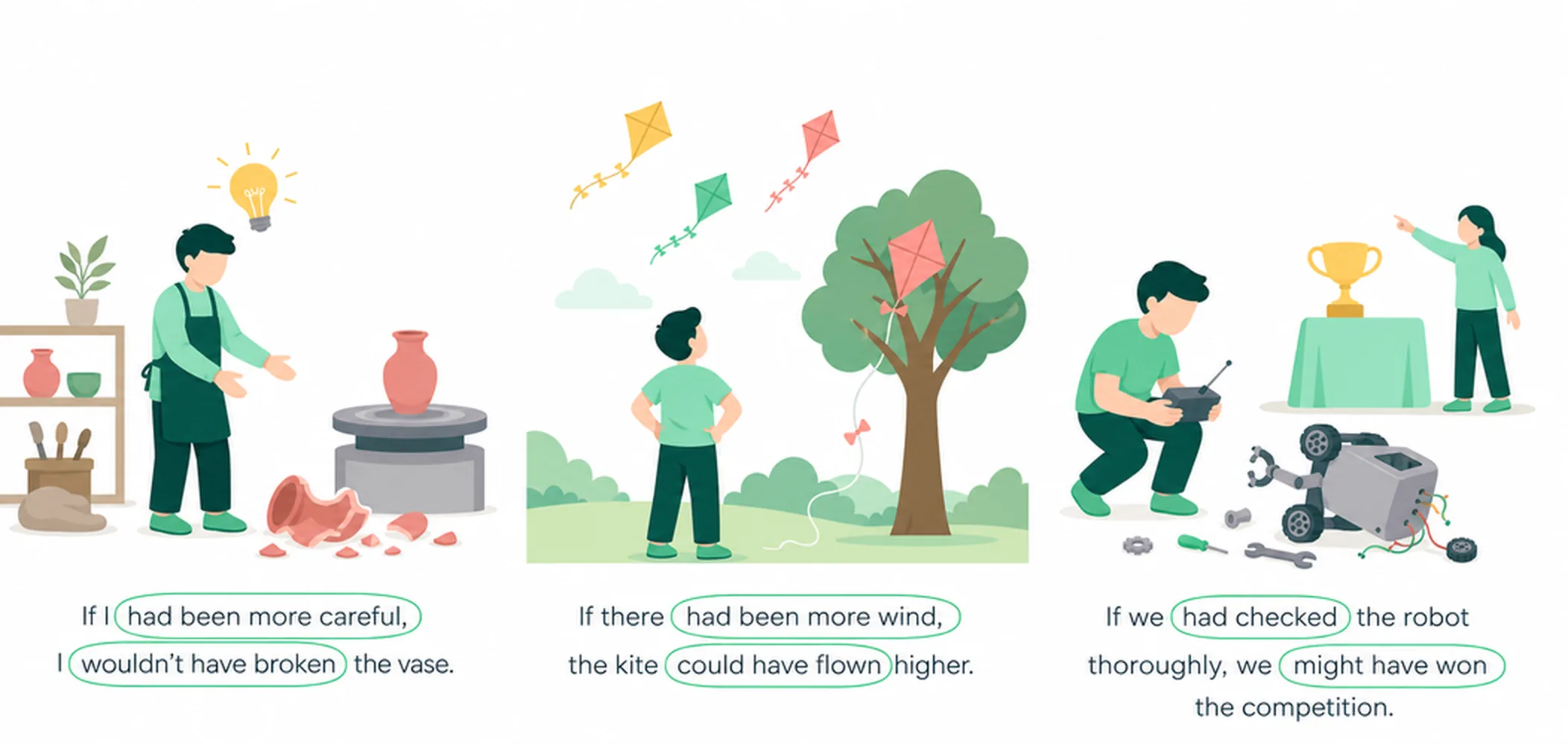
What is the Third Conditional?
The third conditional expresses an imaginary situation in the past that did not happen, and its imaginary result. We use it to talk about regrets, missed opportunities, or to speculate about how things could have been different. The third conditional is often called the 'unreal past' because it deals with situations that are now impossible to change.
For example: 'If I had studied harder, I would have passed the exam.' This means you didn't study hard, and consequently, you didn't pass. Now it's too late to change either situation.
Third Conditional Structure
The third conditional has two parts: the if-clause (condition) and the main clause (result). The if-clause uses 'if + had + past participle,' and the main clause uses 'would/could/might + have + past participle.'
Common Uses
Use the third conditional to express regrets about past actions: 'If I had known the truth, I would have told you immediately.' Use it to speculate about alternative outcomes: 'If she hadn't missed her flight, she would have arrived on time.' You can also use it to express criticism or to imagine how situations could have been prevented: 'If they had followed the instructions, they wouldn't have made so many mistakes.'
Past Timeline: Real vs. Unreal
The third conditional allows us to imagine different outcomes for events that already occurred in the past. Unlike real past events, which are fixed and unchangeable, the third conditional explores unreal or hypothetical situations—what could have happened if circumstances had been different.
| Timeline Type | What It Describes | Key Feature | Example |
|---|---|---|---|
| Real Past | Events that actually happened or did not happen | Fixed; cannot be changed | She did not study for the exam. |
| Unreal Past (Third Conditional) | Imagined alternative outcomes for past events | Hypothetical; exists only in thought | If she had studied, she would have passed. |
The unreal past timeline has two connected parts:
Because both parts are unreal, they depend on each other. The if-clause sets up the imaginary condition, and the main clause shows what would have resulted. Neither actually happened, but together they create a complete hypothetical narrative about the past.
Examples






What to Remember
- Use if + past perfect in the condition clause and would/could/might + have + past participle in the result clause.
- The third conditional describes imaginary past situations that didn't actually happen and their hypothetical outcomes.
- Both clauses use past tense forms; the condition is impossible to change because it's about the past.
- Common mistake: don't mix tenses like "if I studied" with "would have passed"—keep both clauses in past forms.
- Use third conditional to express regrets, missed opportunities, or to speculate how different past choices could have changed things.