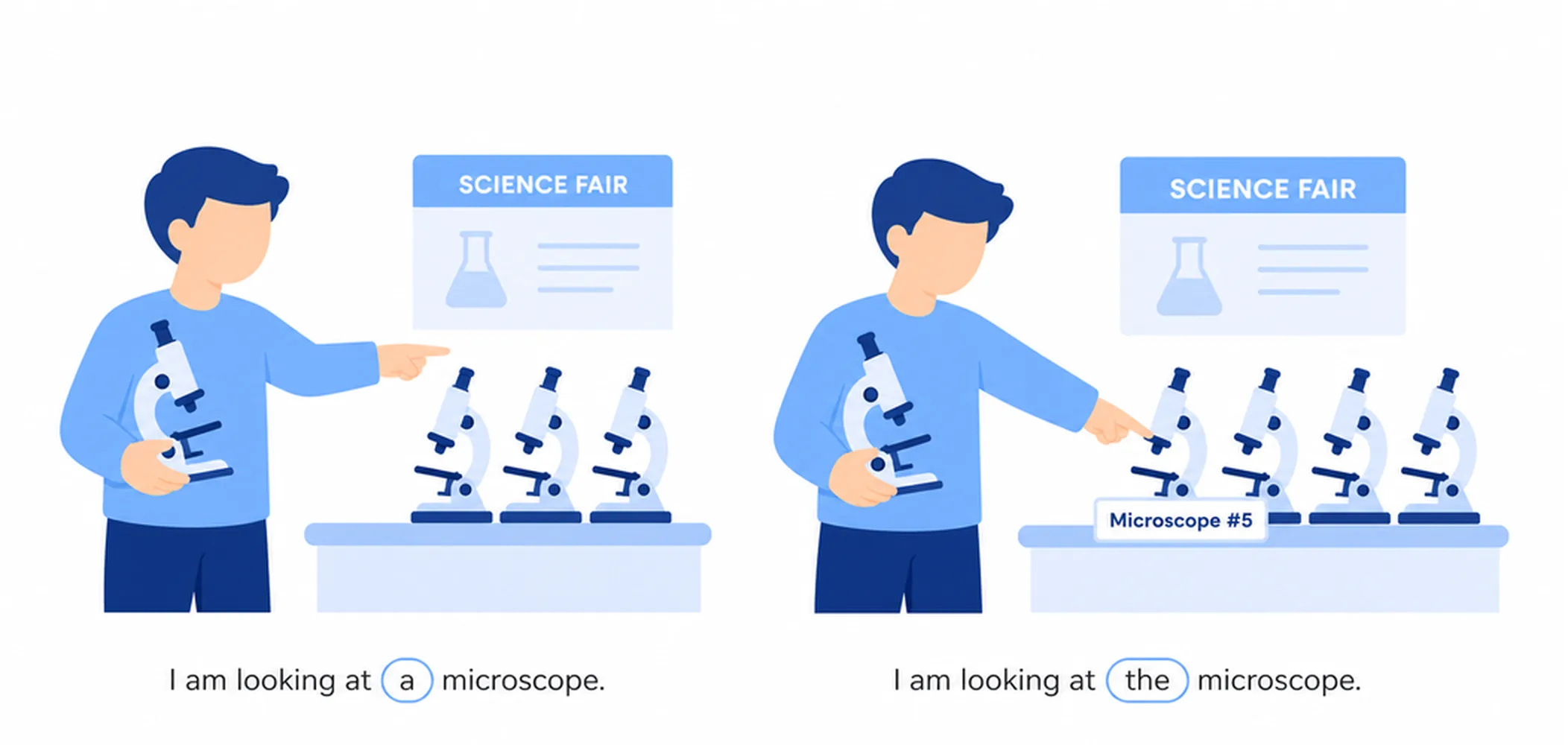
A/An vs The: The Key Difference
In English, we use articles before nouns. The articles are 'a', 'an', and 'the'. They tell us if a noun is new or known. Use 'a' or 'an' when you mention something for the first time. Use 'the' when both you and the listener know which thing you mean. This is the main difference between a/an and the.
When to Use A or An
Use 'a' or 'an' for one thing that is new or general. We use 'a' before consonant sounds and 'an' before vowel sounds. Examples: 'a dog', 'a house', 'an apple', 'an egg'. Both 'a' and 'an' mean 'one thing, but we don't know which one yet'.
When to Use The
Use 'the' when something is specific or known. We use 'the' when we already talked about it, or when it is clear which thing we mean. The listener knows which thing you are talking about. Examples: 'the book', 'the sun', 'the dog in the park'.
Quick Tip
Remember: 'a/an' = new or unknown. 'the' = specific or known. Test: Can the listener say 'which one?' If yes, use 'the'. If it could be any one, use 'a' or 'an'.
A/An vs The: Side-by-Side Comparison
| Category | A / An | The |
|---|---|---|
| Form | A before consonant sounds (a dog, a university) An before vowel sounds (an apple, an hour) |
The is used before all nouns regardless of the starting sound (the dog, the apple, the university) |
| Article Type | Indefinite article — refers to a non-specific or general item | Definite article — refers to a specific or previously identified item |
| When to Use |
• First mention of a noun • One of many — any one will do • Classifying or describing something • Talking about jobs or roles • Introducing a new subject |
• Second or subsequent mention of a noun • Both speaker and listener know which one • Something unique (the sun, the president) • Superlatives and ordinals • Specific groups or locations already established |
| What It Signals | New information — the listener does not yet know which specific item is meant | Shared knowledge — the listener already knows or can identify the specific item |
| Noun Types Allowed | Singular countable nouns only (❌ a water, ❌ a books) |
Singular countable, plural countable, and uncountable nouns (✅ the water, ✅ the books, ✅ the cat) |
| Positive Example |
"I saw a cat in the garden." "She is an engineer." "He bought a new laptop yesterday." |
"I saw a cat. The cat was black." "Please close the door." "The sun rises in the east." |
| Negative Example |
"I don't have a car." "She is not an accountant." "He didn't make a single mistake." |
"I didn't like the movie at all." "She didn't finish the report." "He never uses the elevator." |
| Question Example |
"Can you recommend a good restaurant?" "Is there a pharmacy nearby?" "Do you have a pen I can borrow?" |
"Did you enjoy the party last night?" "Where is the nearest hospital?" "Have you read the book I gave you?" |
| Key Signal Words / Contexts |
• "for the first time" • "once upon a time" • "one day I saw…" • Job titles: a teacher, a doctor • After "there is": there is a problem |
• "as you know…" • "remember the time when…" • Superlatives: the best, the tallest • Ordinals: the first, the second • Unique nouns: the moon, the internet |
| Common Mistakes |
❌ "I need an university." (wrong — 'u' sounds like 'yoo', a consonant sound) ✅ "I need a university." ❌ Using a/an for second mention: "I have a dog. I love a dog." ✅ "I have a dog. I love the dog." |
❌ Using the for a general first mention: "The life is beautiful." ✅ "Life is beautiful." (no article needed for general concepts) ❌ "The honesty is the best policy." ✅ "Honesty is the best policy." |
| Paired Usage Example |
"I bought a book this morning. The book is about history." — A book: first mention, listener doesn't know which one. — The book: second mention, both speaker and listener now know exactly which book. |
|
| Key Difference: Use A / An when introducing something for the first time or referring to any one of many — the listener doesn't know or need to know exactly which one. Use The when both the speaker and the listener already know — or can logically identify — the exact item being discussed. In short: A/An = "one of many, new to you"; The = "that specific one we both know." | ||
Examples






What to Remember
- Use 'a' or 'an' when mentioning a noun for the first time or introducing something new.
- Use 'the' when both speaker and listener know which specific thing you mean.
- Use 'an' before vowel sounds and 'a' before consonant sounds.
- Articles tell the listener if information is new or already known to them.
- Don't use articles before plural nouns or uncountable nouns when speaking generally.