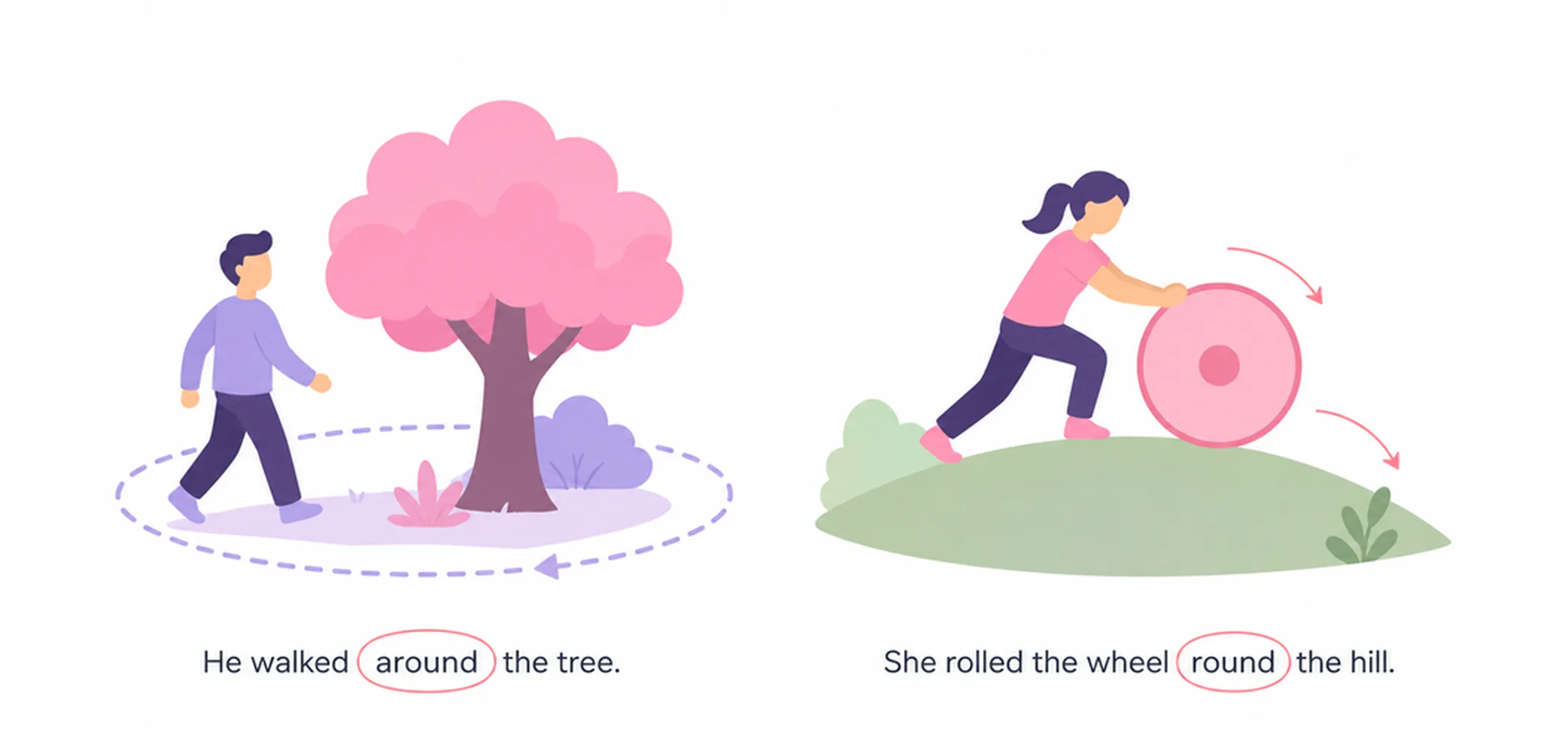
Around vs Round: The Key Difference
Both 'around' and 'round' describe circular or indirect movement. They mean almost the same thing! 'Around' is used everywhere in English, especially in American English. 'Round' is shorter and more common in British English and informal speech. In most cases, you can use 'around' safely in both spoken and written English.
Examples with 'Around'
Here are sentences using 'around' for circular or indirect movement:
Examples with 'Round'
Here are sentences using 'round' for circular or indirect movement:
Common Mistakes
Many learners confuse these words or mix them with similar prepositions. Here are the most common errors:
Quick Comparison
Use 'around' in formal writing and American English. Use 'round' in informal speech and British English. Both are correct for movement in circles or around objects. When in doubt, 'around' is always safe.
Remember the Pattern
Think: 'AROUND' = longer word, more formal, universal use. 'ROUND' = shorter word, more casual, British preference. Both describe going in a circle or along the edge of something.
Around vs Round: Side-by-Side Comparison
| Category | Around | Round |
|---|---|---|
| Form | Preposition / Adverb around |
Preposition / Adverb round |
| Variety of English | Preferred in American English; widely accepted in all varieties of English for movement contexts. | Preferred in British English for movement; less common in American English in this sense. |
| Formality Level | Neutral to slightly formal; appropriate in both written and spoken English across all registers. | Neutral to informal; common in everyday British spoken English; less frequent in formal writing. |
| When to Use | Use when describing movement in a circular path or in multiple directions; standard choice in American English and in international/formal writing. | Use when describing movement in a circular path or to/from a nearby place; the natural choice in everyday British English speech and informal writing. |
| Typical Contexts |
• Moving in a circle or loop • Travelling throughout an area • Turning to face a different direction • Global or international travel descriptions |
• Moving in a circle or loop (British) • Visiting a nearby place ("come round") • Turning a corner • Everyday British conversational movement |
| Positive Example |
"She walked around the lake twice before breakfast." "The Earth moves around the Sun." |
"She walked round the lake twice before breakfast." "He drove round the corner and parked the car." |
| Negative Example |
"They did not walk around the entire city; they only visited one district." "The car didn't go around the obstacle — it stopped." |
"He didn't come round to our house last night after all." "She didn't walk round the whole park — just the top path." |
| Question Example |
"Did you travel around Europe during the summer?" "How many times did they sail around the island?" |
"Did you walk round the whole town centre?" "Are you coming round later this evening?" |
| Key Signal Words / Phrases | travel around, go around, walk around, run around, sail around, fly around, move around, turn around, spin around, look around | come round, go round, walk round, drive round, turn round, look round, show someone round, get round (an obstacle) |
| Interchangeability | In movement contexts, around is generally interchangeable with round in British English. Always correct in American English. | In movement contexts, round is generally interchangeable with around in British English. However, round is rarely used for movement in American English. |
| 🔑 Key Difference: Both around and round can describe movement in a circular path or throughout an area, and in British English they are largely interchangeable in this sense. The main distinction is regional: American English strongly prefers around for all movement contexts, while British English uses round naturally and frequently — especially in conversational phrases like "come round" or "drive round the corner." When writing for an international or American audience, around is the safer, universally understood choice. | ||
Examples






What to Remember
- Both 'around' and 'round' describe circular or indirect movement and mean almost the same thing.
- 'Around' is the safer choice for all English contexts, especially American English and formal writing.
- 'Round' is shorter and more commonly used in British English and informal or casual speech.
- Use 'around' or 'round' before a noun to show movement in a circle or indirect path.
- 'Around' works in both American and British English, while 'round' is mainly British or conversational.