The Key Difference: Into vs In
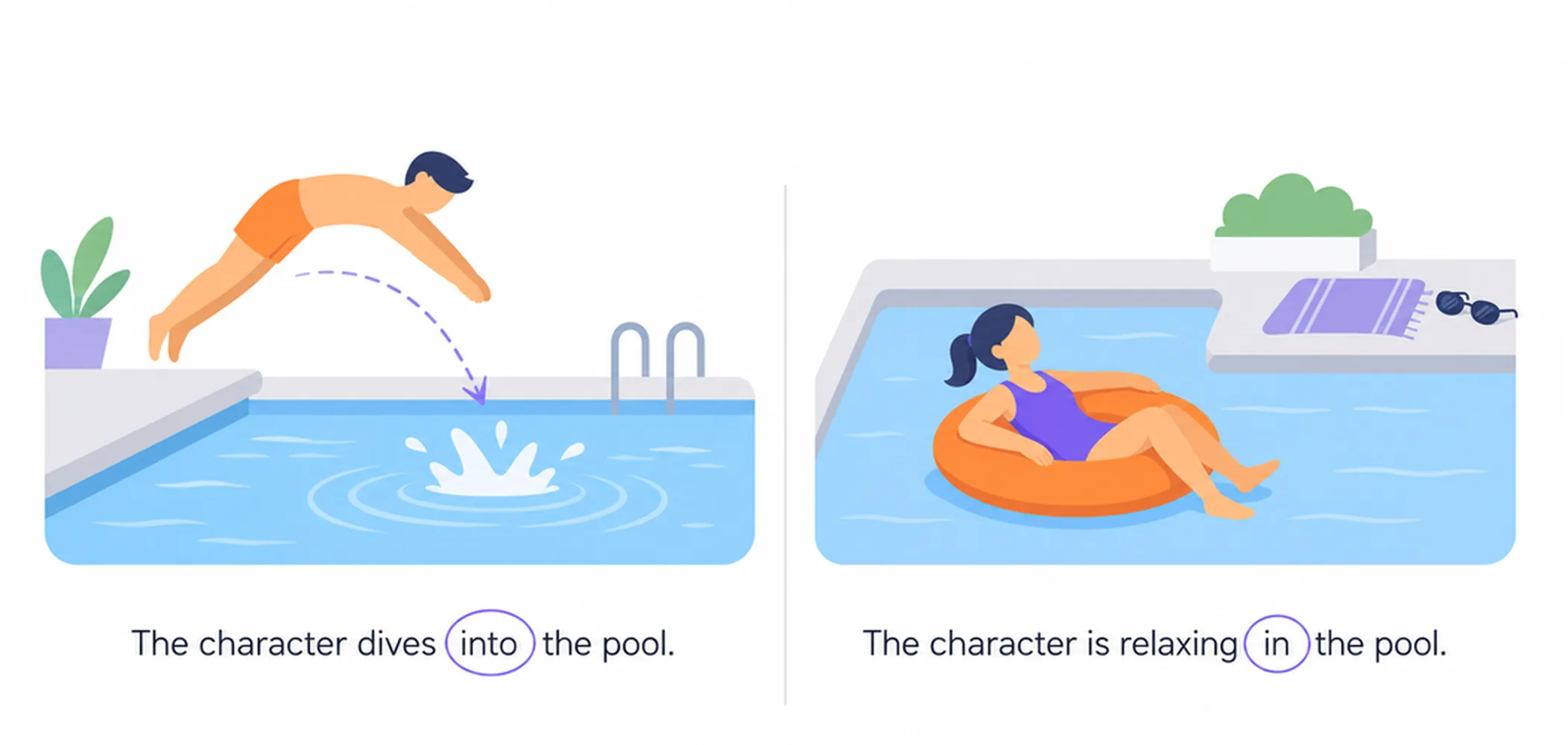
Into and in are both prepositions, but they show different ideas. Use into when something moves from outside to inside—it shows movement and direction. Use in when something is already inside or at a location—it shows position or place. Think of into as movement toward, and in as being at a place.
Into: Movement and Direction
Into describes movement from outside to inside, or from one place to another place. It answers the question 'where is something going?' When you use into, something is moving or changing position. Into is dynamic—it shows action and change.
In: Position and Location
In describes where something is already located. It answers the question 'where is something now?' When you use in, something is not moving—it is already in that place. In is static—it shows a fixed position or location.
Quick Memory Trick
Remember: into = movement (like entering a door). In = already there (like sitting in a chair). If you can add the word 'move' or 'go,' use into. If the thing is already in that place, use in.
Into vs In: Side-by-Side Comparison
| Dimension | Into | In |
|---|---|---|
| Form | Preposition (one word: into) | Preposition (one word: in) |
| Primary Function | Expresses movement or direction toward the inside of something; shows transition from outside to inside | Expresses position or location; shows that something is already situated inside or within a place |
| Question Answered | Where is something going? — focuses on the destination of movement | Where is something? — focuses on a static position or current state |
| Type of Action | Dynamic — describes a process or change; implies motion, entry, or transformation | Static — describes a state or condition; implies rest, containment, or existence within a space |
| When to Use | Use when a person or object is moving or entering a place, container, or state; when there is a clear directional change | Use when a person or object is already located somewhere; when describing where something exists at a given moment |
| Positive Example | She walked into the room. He jumped into the pool. Pour the milk into the glass. |
She is in the room. He is swimming in the pool. The milk is in the glass. |
| Negative Example | ❌ She walked in the room. (unclear movement; sounds like she walked while inside) ❌ He jumped in the pool. (suggests he was already there) |
❌ She is into the room. (grammatically incorrect for describing position) ❌ The keys are into the drawer. (wrong — no movement occurring) |
| Question Example | Did the cat jump into the box? When did you walk into the building? |
Is the cat in the box? Are you still in the building? |
| Typical Usage Context | With verbs of motion (walk, run, jump, fall, dive, enter, put, pour, throw); also used metaphorically for transformation (turn into, grow into) | With stative verbs or states of being (be, sit, stay, live, work, remain); used for locations, time periods, and enclosed spaces |
| Key Signal Words | walk, run, jump, fall, dive, go, enter, put, throw, pour, turn, transform, crash, bump, move | be, sit, stay, remain, live, work, exist, keep, store, found, located, held |
| 🔑 Key Difference: The core distinction is movement vs. position. Into signals that something or someone is actively moving from outside to inside — it describes a journey or transition toward a destination. In signals that something is already located within a place — it describes a static state with no implied movement. A simple test: if you can substitute "entering", use into; if you can substitute "located inside", use in. | ||
Examples






What to Remember
- Use into when something moves from outside to inside a place or container.
- Use in when something is already inside or stays at a location.
- Into shows movement and direction; in shows position or where something is.
- Don't use into for positions that aren't moving—use in instead.
- Think: into = entering a place; in = being inside a place.