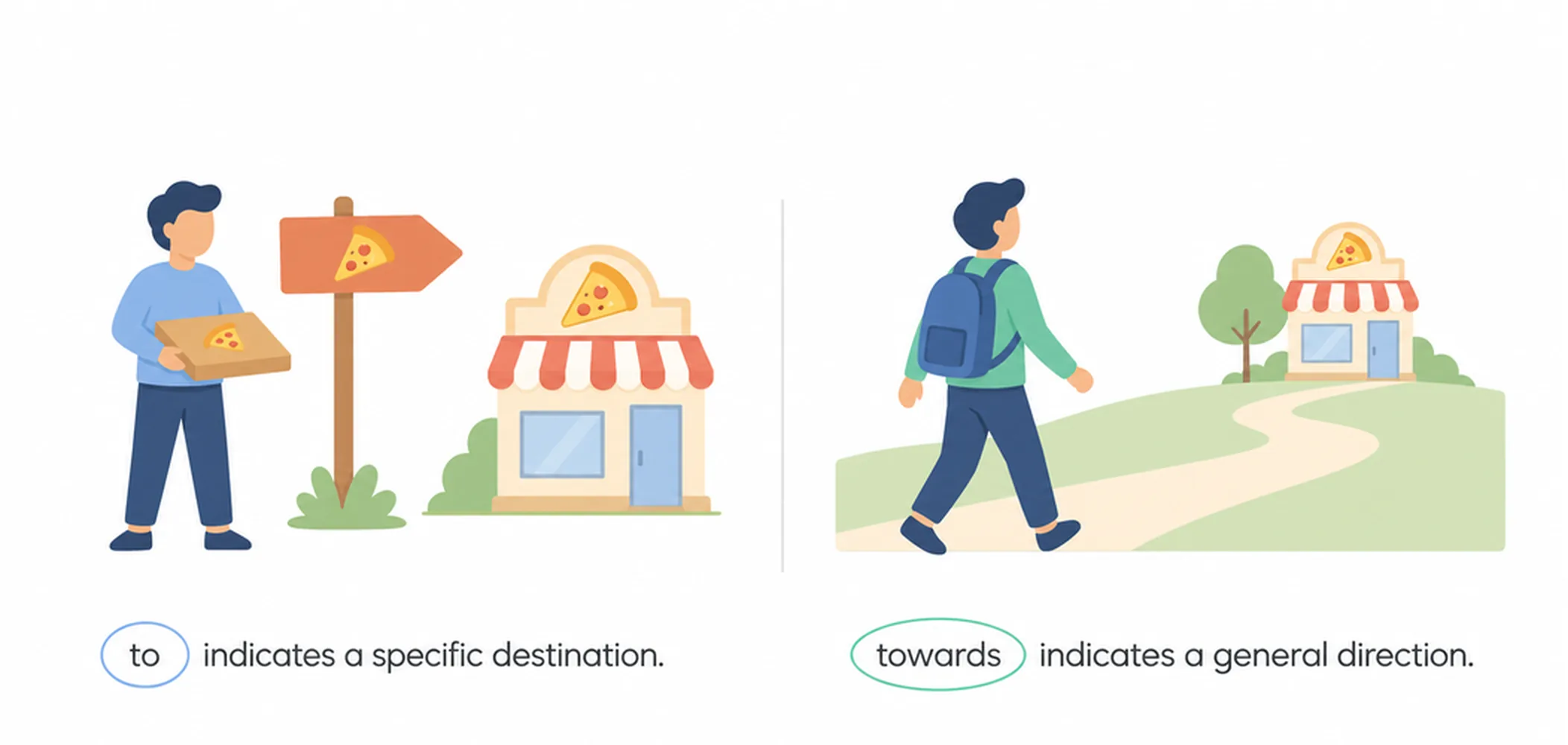
The Key Difference
Both 'to' and 'towards' show movement, but they are different. Use 'to' when you arrive at or reach a place. Use 'towards' when you move in the direction of something, but maybe you don't arrive there. 'To' is more definite. 'Towards' is more about the direction of movement.
How to Remember
Think of 'to' as the final destination. Think of 'towards' as just the direction. If you are going somewhere and you will definitely arrive, use 'to'. If you are walking in a direction but maybe you will stop before arriving, use 'towards'.
To vs Towards — Side-by-Side Comparison
| Criteria | To | Towards |
|---|---|---|
| Form | Preposition; sometimes also used as part of an infinitive verb structure (e.g., to run) | Preposition only; never used before an infinitive verb |
| Core Meaning | Indicates movement or direction with a clear, definite destination in mind; implies arrival or reaching the endpoint | Indicates movement or orientation in the general direction of something; does not imply arrival at the destination |
| Arrival at Destination | Yes — strongly implies the subject reaches or intends to reach the destination | No — the subject is simply moving in that direction; arrival is not guaranteed or implied |
| Definiteness | Definite and specific; the destination or endpoint is clear and fixed | Indefinite and approximate; used when the goal or destination is vague, general, or not yet reached |
| When to Use | Use when describing movement with a specific destination; expressing purpose, relationship, or direction with a fixed endpoint | Use when describing movement in a general direction, an attitude or feeling directed at something/someone, or progress toward a goal |
| Positive Example | "She walked to the store." (She arrived at the store.) "He drove to Paris." (He reached Paris.) |
"She walked towards the store." (She was heading in that direction, but may not have arrived.) "He drove towards Paris." (He was heading that way.) |
| Negative Example | "She did not go to the party." (She did not arrive at the party.) | "He showed no kindness towards her." (Used to describe attitude — negative feeling directed at someone.) |
| Question Example | "Did you go to the office today?" | "Is this a step towards a solution?" |
| Typical Usage Contexts |
• Physical travel with a definite endpoint • Telling time (five to three) • Expressing purpose (the key to success) • Relationships (kind to others) • Infinitive verb form (to go, to run) |
• Movement in a general direction without confirmed arrival • Attitudes or feelings directed at someone (hostile towards) • Progress or contribution (saving towards a goal) • Approximate location or time (towards the end of the day) |
| Key Signal Words / Phrases | go to, travel to, return to, come to, walk to, the road to, the answer to, listen to | move towards, head towards, attitude towards, contribution towards, step towards, feeling towards, lean towards |
| British vs. American English | Used in both British and American English with the same meaning and frequency | Towards is preferred in British English; toward (without the "s") is more common in American English — both are correct |
| 🔑 Key Difference: Use "to" when the destination or endpoint is definite and arrival is implied or completed — "I went to the market" means you got there. Use "towards" when describing movement or orientation in a general direction without implying arrival, or when expressing attitudes and contributions — "I walked towards the market" only means you were heading that way. In short: "to" = destination reached; "towards" = direction of movement or attitude. | ||
Examples

She walked to the library after school.
Arrived at the destination · Common usage

She is going to school right now.
Will arrive at the place · Present continuous

The bus goes to the city centre.
Final destination · Route description

He walked towards the park but stopped at the café.
Direction only, didn't arrive · Narrative

She moved towards the door when she heard a noise.
Direction of movement · Action in progress

The car moved slowly towards the mountain.
Moving in a direction · Descriptive
When to use it
Arriving at Places
Use 'to' when you travel to a destination and arrive there.
"I drive to work every morning."
Direction and Movement
Use 'towards' when you move in a direction but may not arrive there.
"He walked towards me but then turned away."
Travel Plans
Use 'to' for flights, trains, and trips to clear destinations.
"The flight to Paris leaves at 10 a.m."
Signal words
arrived at
reached
went to
came to
direction
moved in the direction of
walked towards
ran towards
Common Mistakes
✕
Wrong
I walked towards the supermarket and bought milk.
✓
Correct
I walked to the supermarket and bought milk.
Use 'to' when you arrived and did something at that place.
✕
Wrong
The plane flies to the clouds.
✓
Correct
The plane flies towards the clouds.
Use 'towards' when movement is in a direction but doesn't reach the final destination.
✕
Wrong
She ran towards school because she was late.
✓
Correct
She ran to school because she was late.
Use 'to' for a definite destination, especially when the person will arrive there.
KEY TAKEAWAYS
What to Remember
- Use 'to' when you actually arrive at or reach your final destination.
- Use 'towards' when moving in a direction without necessarily reaching the endpoint.
- 'To' is definite and shows you complete the movement to a place.
- 'Towards' is less definite and focuses on direction rather than arrival.
- Don't use 'towards' if you definitely reach your destination—use 'to' instead.