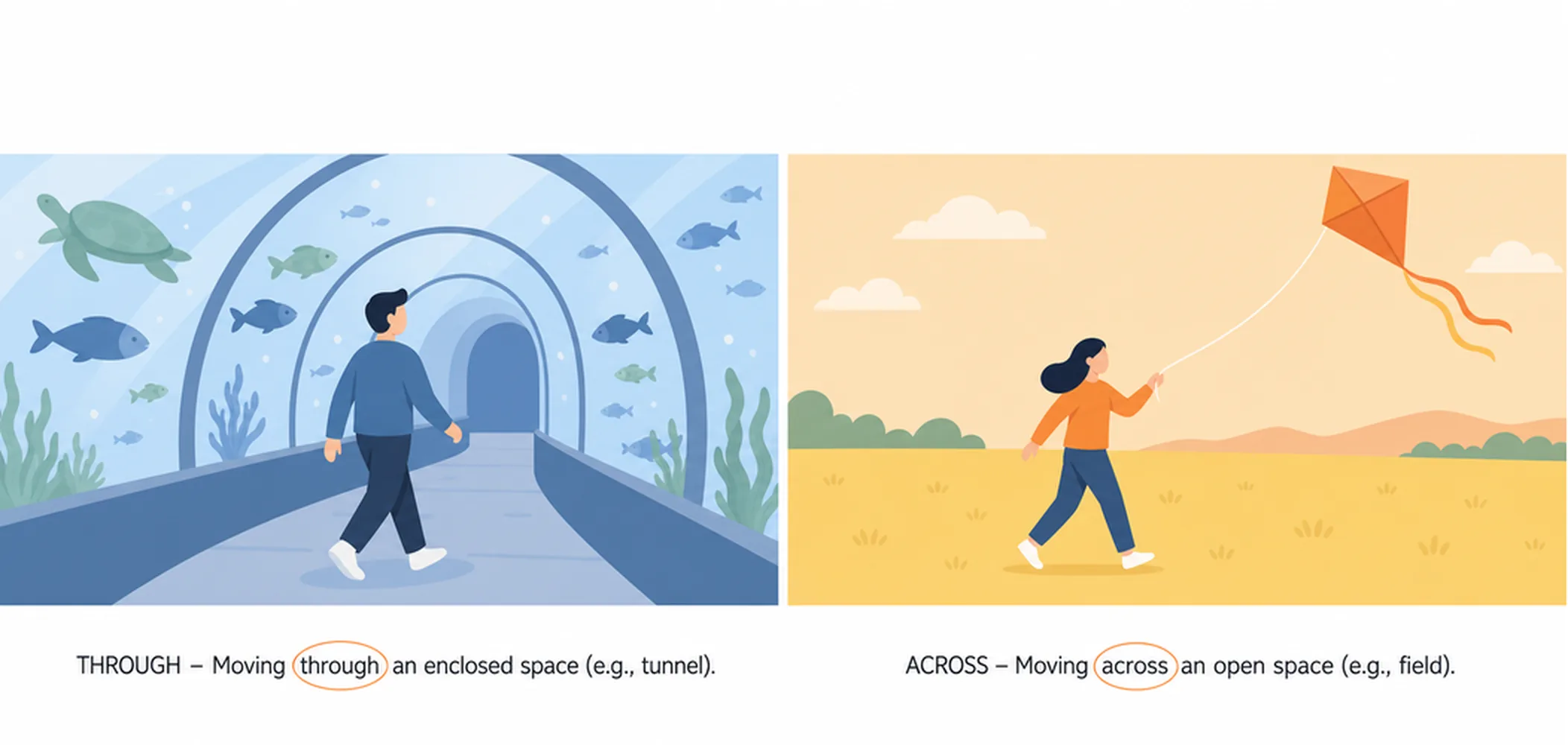
Key Difference: Through vs Across
Both 'through' and 'across' show movement, but they describe different directions. Use 'across' when you move from one side to the other side of something (side to side). Use 'through' when you move inside or within something, from one end to the other (inside movement). Think of 'across' as movement on a surface, and 'through' as movement in a space.
Through vs Across: Side-by-Side Comparison
| Dimension | Through | Across |
|---|---|---|
| Movement Type | Movement that passes inside something, entering one side and exiting the other — motion within a 3D space or enclosed environment | Movement that goes from one side to the other of a flat or open surface — motion over or along a 2D plane or open area |
| Surface vs Space | Involves passing within a space, tunnel, crowd, or solid medium — the subject is surrounded or enclosed during the movement | Involves travelling over a surface, open area, or boundary — the subject moves on top of or along a flat dimension |
| Typical Objects / Contexts | Tunnels, forests, crowds, walls, windows, pipes, doors, rooms, water, darkness — places you move inside or within | Rivers, roads, fields, bridges, floors, tables, borders, countries — flat or open spaces you move over or from side to side of |
| Positive Example | "The train passed through the tunnel." (enclosed, surrounding space) "She walked through the forest." |
"The train passed across the bridge." (open, flat surface) "She walked across the field." |
| Negative Example | ❌ "He swam through the river." — incorrect if the river is an open, flat body of water being crossed from bank to bank | ❌ "She walked across the tunnel." — incorrect because a tunnel is an enclosed 3D space, not a flat surface |
| Question Example | "Did the bullet go through the wall?" (Was it inside / within the solid material?) |
"Did you walk across the street?" (Did you go from one side of the flat surface to the other?) |
| Visual Description | Picture an arrow moving inside a cylinder or box — the subject is surrounded by the environment during travel 🕳️➡️ | Picture an arrow moving on top of a flat line or plane — the subject is above or upon the surface during travel ➡️🟦 |
| Key Signal Words | Enclosed, inside, within, surrounded, penetrate, pass inside, 3D volume (tunnel, forest, crowd, pipe, window, doorway) | Surface, flat, open, from side to side, boundary, span, 2D plane (road, river, field, floor, country, bridge) |
| Can They Overlap? | Yes — in some contexts both are grammatically possible but carry different meanings. "Walking through the water" implies being immersed in it; "walking across the water" implies moving over its surface. | |
| Key Difference: Use through when something moves inside or within a three-dimensional space, enclosed area, or solid medium — the subject is surrounded by the environment during movement. Use across when something moves over or along a two-dimensional surface or open area — the subject travels from one side or edge to the other without being enclosed. A simple test: if the moving object is inside something, use through; if it is on top of or spanning something flat, use across. | ||
Formula
✔ Positive
Subject
+
verb
+
across
+
noun
She walked across the bridge.
Examples
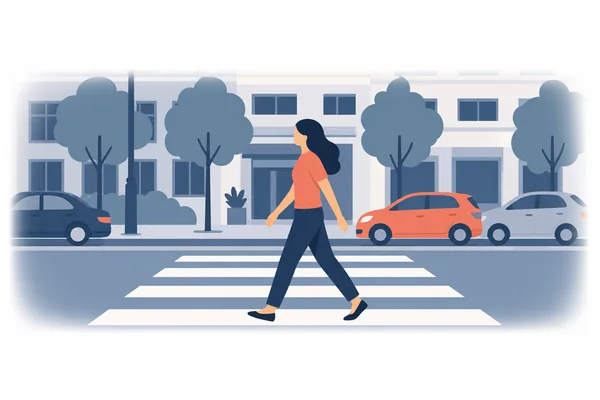
She walked across the street.
Movement from one side to the other · Preposition
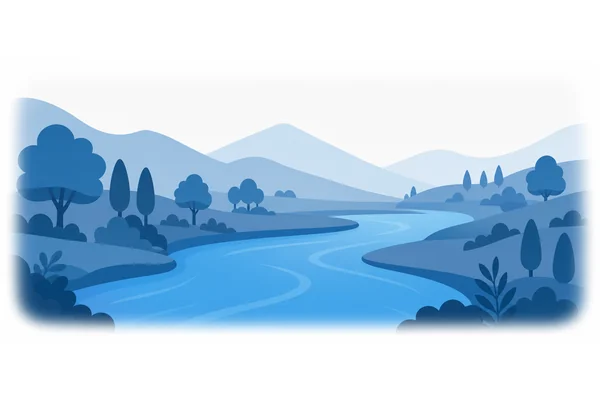
The river flows across the valley.
Surface movement, side to side · Preposition
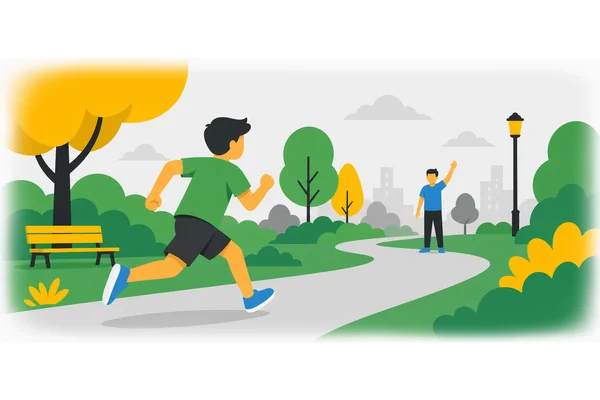
He ran across the park to meet his friend.
Crossing an open area · Preposition

We walked through the forest.
Movement inside/within something · Preposition
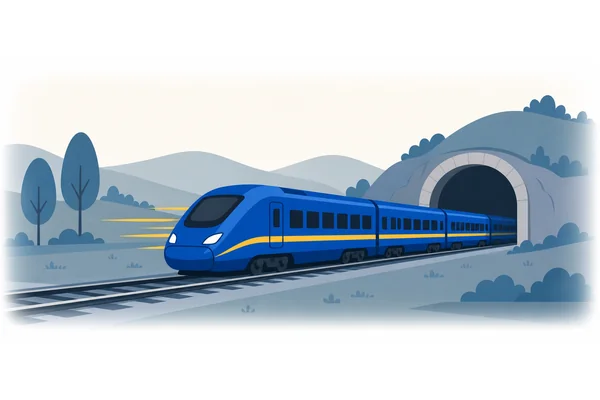
The train goes through the tunnel.
Movement from one end to the other inside · Preposition

I read through the book yesterday.
Movement within (figurative) · Preposition
When to use it
Crossing Streets & Roads
Use 'across' when moving from one side of a street to the other. This is a basic safety context.
"Always look both ways before you walk across the road."
Moving in Forests & Woods
Use 'through' when walking or traveling inside a forest or wooded area.
"The hikers walked through the dark forest for hours."
Travel Through Tunnels
Use 'through' for movement inside a tunnel, building, or enclosed space.
"The subway train traveled through the tunnel under the city."
Signal words
across: bridge, street, river, ocean, field, road, desert
through: forest, tunnel, building, door, window, wall, park
Common Mistakes
✕
Wrong
She walked through the street.
✓
Correct
She walked across the street.
A street is a flat surface. Use 'across' for side-to-side movement.
✕
Wrong
We went across the forest.
✓
Correct
We went through the forest.
A forest has space inside. Use 'through' for movement within an area.
✕
Wrong
The path goes through the bridge.
✓
Correct
The path goes across the bridge.
A bridge connects two sides. Use 'across' for side-to-side movement.
KEY TAKEAWAYS
What to Remember
- Use 'across' for side-to-side movement from one side to the other side of something.
- Use 'through' for movement inside or within a space from one end to another.
- Think of 'across' as movement on a surface and 'through' as movement in a space.
- 'Across' describes movement over or on top of something like a bridge or street.
- 'Through' describes movement inside something like a tunnel, forest, or building with interior movement.