What Are Cleft Sentences?
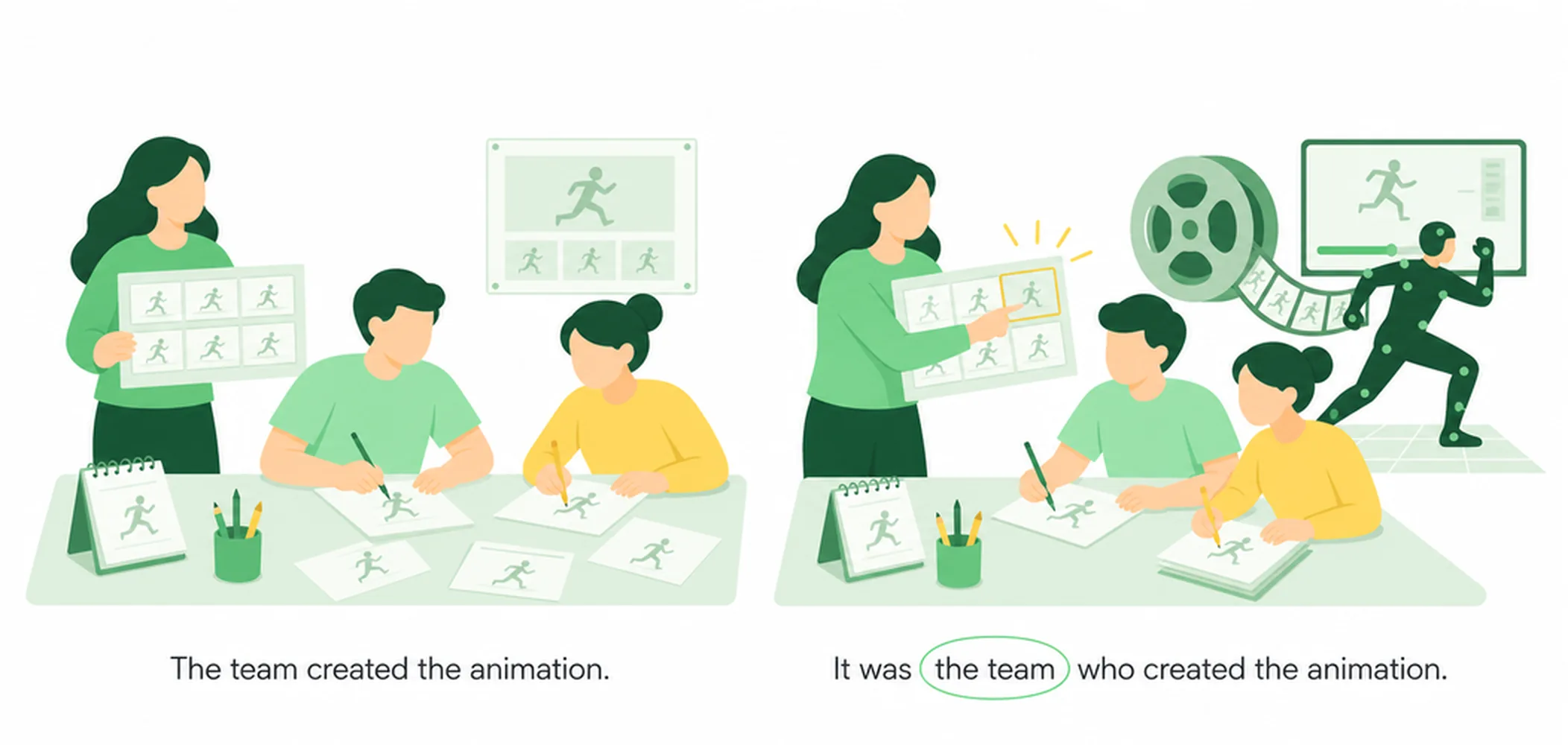
A cleft sentence is a way to emphasize or highlight one particular part of a sentence. It splits a simple sentence into two parts using the structure "It is/was... that..." or "What... is/was...". Instead of saying something directly, you rearrange it to draw attention to the word or phrase you want to emphasize. This technique is common in both spoken and written English, especially when you want to make your message clearer or more forceful.
The Two Main Types of Cleft Sentences
The first type is the "It-cleft", which uses the pattern "It is/was + [emphasized element] + that + rest of sentence". This is the most common form and works well for emphasizing subjects, objects, and adverbials. The second type is the "Wh-cleft", which uses "What + clause + is/was + [emphasized element]". Wh-clefts are often more concise and are frequently used in spoken English. Both types allow you to put focus on exactly what you want your listener or reader to notice.
When and Why Use Cleft Sentences
Use cleft sentences when you want to emphasize something important, add contrast, or clarify what you mean. They are especially useful in debates, presentations, and storytelling. Without a cleft sentence, your meaning might seem less clear or less interesting. Remember that cleft sentences are more formal than regular sentences, so use them when you want to make a strong point or when the emphasis is important for understanding.
It-Cleft vs Wh-Cleft: Side-by-Side Comparison
| Dimension | It-Cleft | Wh-Cleft (Pseudo-cleft) |
|---|---|---|
| Form | It + be + [focused element] + that/who + rest of clause Example pattern: It is/was … that/who … |
[Wh-clause] + be + [focused element] Example pattern: What … is/was … |
| Emphasis Type | Places heavy stress on a specific noun, pronoun, adverbial, or adjectival phrase by isolating it between It is and the that-clause | Places emphasis on a broader idea or action, often stressing a verb phrase, action, or entire proposition rather than a single noun |
| Structure Position of Focus | The focused element appears in the middle of the sentence, between it is/was and that/who | The focused element appears at the end of the sentence, after the linking verb be |
| When to Use | Use to pinpoint who, what, where, or when something happened; useful for correcting misconceptions or contradicting previous information | Use to introduce, summarise, or highlight an action or idea; often used to build up to a key point or to explain what something involves |
| Positive Example | It was Sarah who solved the problem. It is on Tuesdays that we hold the meetings. |
What Sarah did was solve the problem. What we do on Tuesdays is hold the meetings. |
| Negative Example | It was not John who broke the window. It isn't money that makes people happy. |
What he didn't do was apologise. What the plan lacks is proper funding. |
| Question Example | Was it the manager who approved the report? Is it here that you found it? |
Is what you're suggesting a complete redesign? Isn't what matters most the outcome? |
| Key Signal Words | It is / It was / It will be … that / who / which / where / when | What … is / What … was / The thing that … is / All … is |
| Formality Level | Neutral to formal; widely used in both spoken and written English, including academic and journalistic writing | Slightly more formal or rhetorical; common in written English, speeches, and academic prose; less frequent in casual conversation |
| Common Errors | Omitting that/who after the focused element; using the wrong relative pronoun (e.g., which for people instead of who) | Confusing the tense of be with the main verb; forgetting to use the base form of the verb after what … is |
| Key Difference: It-clefts spotlight a specific element (a person, time, place, or thing) by slotting it between It is/was and a that/who-clause, making it ideal for pinpointing or correcting facts. Wh-clefts (pseudo-clefts) use a what-clause as the subject to build up to and emphasise an action, idea, or broader concept, making them better suited for explaining or introducing important information. Both constructions split a simple sentence into two clauses to create focus, but they differ in what they emphasise and where the emphasis falls within the sentence. | ||
Examples




What to Remember
- A cleft sentence emphasizes one part by splitting it using "It is/was... that..." structure.
- The "It-cleft" focuses attention on a specific word or phrase in the sentence.
- The "What-cleft" uses "What... is/was..." to highlight the action or object in emphasis.
- Both cleft structures rearrange information but keep the same basic meaning as original.
- Cleft sentences are stronger and more forceful than simple sentences for emphasis effect.