What is an It-Cleft Sentence?
An it-cleft sentence is a special way to emphasize or highlight one part of a sentence. It starts with "It is" or "It was," followed by the information you want to emphasize. This structure helps you draw attention to a specific detail. For example, instead of saying "I met him on Monday," you can say "It was on Monday that I met him" to stress when the meeting happened.
It-Cleft with Time and Place
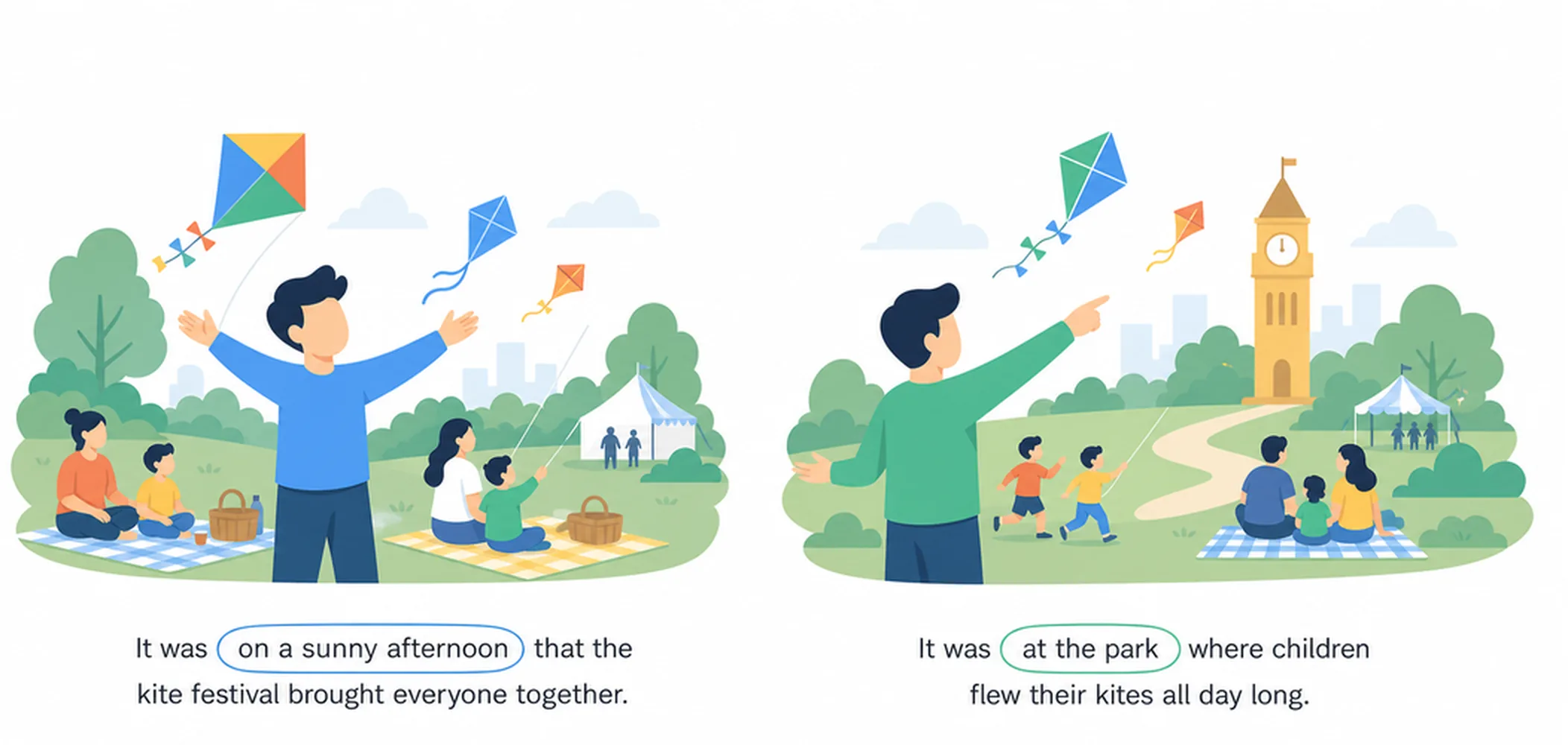
It-cleft sentences work especially well when you want to emphasize time or place information. With time, you use the pattern "It was [time] that..." or "It is [time] that..." With place, you use "It is [place] that..." or "It was [place] that..." This structure is useful in storytelling, explanations, and when you want to correct someone or make a point clear. You often see it in spoken English and writing when emphasis is important.
Why Use It-Cleft Sentences?
It-cleft sentences help you organize your ideas by putting the most important information first. They are common in English conversations and writing. Using it-cleft sentences makes your communication more natural and helps listeners or readers understand what you think is most important about what you are saying. This structure is especially useful when you want to answer questions starting with "When?" or "Where?"
It-Cleft with Time vs. Place: Side-by-Side Comparison
| Aspect | It-Cleft with Time | It-Cleft with Place |
|---|---|---|
| Form |
It + be + [time expression] + that/when + [clause] e.g. It was in 1969 that humans first walked on the moon. |
It + be + [place expression] + that/where + [clause] e.g. It was in Paris that they first met. |
| When to Use | Use to emphasise when an event happened — to highlight a specific point or period in time as the most important piece of information in the sentence. | Use to emphasise where an event happened — to foreground a specific location or setting as the most important piece of information in the sentence. |
| Positive Example |
It was last summer that she finally learned to drive. (Emphasises the time: last summer.) |
It was in the old library that he found the missing document. (Emphasises the place: in the old library.) |
| Negative Example |
It was not until midnight that the guests finally arrived. (Negation stresses the lateness of the time.) |
It was not in London but in Edinburgh that the deal was signed. (Negation corrects a mistaken place.) |
| Question Example |
Was it in the morning that you heard the noise? (Questioning the specific time.) |
Was it at the station that you last saw him? (Questioning the specific place.) |
| Key Signal Words | when, in [year/month], on [day], at [time], last/next [period], not until, during, after, before | where, in [city/country], at [venue], on [street], here, there, near, inside, outside, at the … |
| Relative Word Used |
Typically that or when: It was in 2005 that/when they moved abroad. |
Typically that or where: It was in Rome that/where they got married. |
| Focus of Emphasis | Answers the implied question "When did it happen?" — corrects, confirms, or introduces a time detail as new or contrasted information. | Answers the implied question "Where did it happen?" — corrects, confirms, or introduces a location detail as new or contrasted information. |
| Common Mistakes |
Confusing tense of be: use was/were for past events and is/are for present/general truths. ✗ It is yesterday that he called. ✓ It was yesterday that he called. |
Omitting the preposition that belongs with the place expression. ✗ It was Paris that they met. ✓ It was in Paris that they met. |
| Key Difference: Both it-cleft constructions share the same core structure (It + be + [focused element] + that/when/where + clause) and serve the same pragmatic purpose of highlighting one element above all others. The crucial distinction lies in what type of information is being foregrounded: a time it-cleft places a temporal expression in the focus position to answer or emphasise when something occurred, while a place it-cleft places a locative expression in the focus position to answer or emphasise where something occurred. Choosing the correct relative connector (when vs. where vs. the neutral that) signals to the listener which dimension — time or place — is being singled out for emphasis. | ||
Examples






What to Remember
- It-cleft sentences emphasize one part of a sentence using "It is/was" + the emphasized information + "that."
- Time expressions in it-clefts follow the pattern: "It was [time] that [subject] [verb]" to highlight when something happened.
- Place expressions in it-clefts follow the pattern: "It was [place] that [subject] [verb]" to highlight where something happened.
- The emphasized information comes immediately after "It is/was," making it the focus of the sentence.
- Use it-cleft sentences to draw attention to specific details rather than stating facts neutrally or directly.