What Are Wh-cleft Sentences?
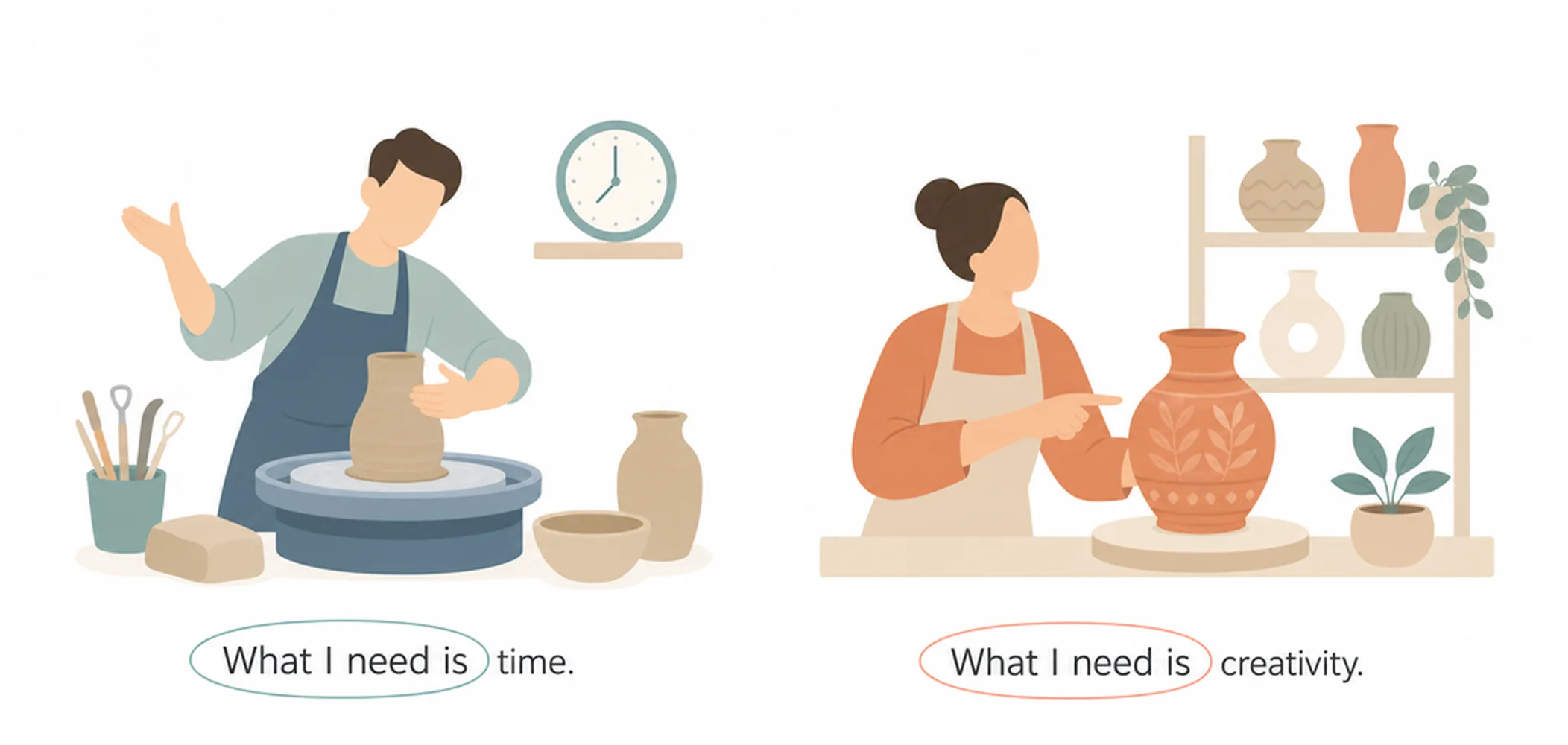
A wh-cleft sentence is a special sentence structure that emphasizes or focuses attention on one part of your message. It starts with a question word (what, where, when, who, how) followed by a clause, and then a main clause with 'is' or 'was'. The most common form uses 'what'. For example, instead of saying 'I need a vacation,' you can say 'What I need is a vacation' to emphasize that a vacation is what you really want.
When and Why Use Wh-cleft Sentences
Use wh-cleft sentences when you want to emphasize a particular piece of information and make it stand out. They are very useful in conversations, writing, and presentations when you want your listener or reader to focus on something specific. They sound more natural and emphatic than just repeating the same sentence with stress on one word. Wh-cleft sentences are common in English and help you express your ideas with more clarity and impact.
Basic Pattern and Structure
The basic pattern is: Wh-word + clause + 'is/was' + focused element. The clause after the wh-word is usually a relative clause that describes the main focus. For instance: 'What makes me happy is spending time with family.' Here, 'what makes me happy' is the relative clause, and 'spending time with family' is the focused element. You can also use other verbs besides 'is,' but 'is' or 'was' are most common.
Wh-cleft vs. Normal Sentence: Side-by-Side Comparison
| Feature | Ordinary Sentence | Wh-Cleft with WHAT | Wh-Cleft with WHERE | Wh-Cleft with WHEN | Wh-Cleft with WHO | Wh-Cleft with HOW |
|---|---|---|---|---|---|---|
| Form | Subject + Verb + Object/Complement | What + clause + is/was + focused element | Where + clause + is/was + focused element | When + clause + is/was + focused element | Who + clause + is/was + focused element | How + clause + is/was + focused element |
| When to Use | Neutral statement; no particular element is emphasised | To emphasise a thing, action, or idea (the object or complement) | To emphasise a place or location | To emphasise a time or moment | To emphasise a person or agent | To emphasise a manner, method, or process |
| Positive Example | I need a long holiday. | What I need is a long holiday. | She paints in her garden. → Where she paints is in her garden. | He felt happiest as a child. → When he felt happiest was as a child. | Tom solved the problem. → Who solved the problem is Tom. | They succeeded by working together. → How they succeeded was by working together. |
| Negative Example | I don't want more advice. | What I don't want is more advice. | She doesn't work well in a noisy office. → Where she doesn't work well is in a noisy office. | He wasn't focused in the morning. → When he wasn't focused was in the morning. | Nobody helped us. → Who helped us was nobody. | They didn't fail by giving up. → How they didn't fail was by refusing to give up. |
| Question Example | Do you really need a new car? | What you really need is a new car? | Where she works best is from home? | When he felt worst was during the exams? | Who wrote the report is Maria? | How they won was through preparation? |
| Key Signal Words | None; standard word order | what … is/was; often followed by a noun, infinitive, or gerund phrase | where … is/was; followed by a prepositional place phrase | when … is/was; followed by a time expression | who … is/was; followed by a person or proper noun | how … is/was; followed by a manner phrase or gerund |
| Key Difference: An ordinary sentence distributes information evenly, with no single element highlighted above the rest. A wh-cleft sentence splits (or "cleaves") the same information into two parts—a subordinate wh-clause that sets the background context, and a focused complement after the linking verb is/was that carries the new, emphasised information. The choice of wh-word signals what type of element is being foregrounded: what targets things or actions, where targets places, when targets times, who targets people, and how targets manner or method. This structure is especially common in spoken English and formal writing when a speaker or writer wants to correct a misconception, clarify, or add rhetorical weight to a specific piece of information. | ||||||
Examples





What to Remember
- A wh-cleft sentence emphasizes information by starting with a question word (what, where, when, who, how) plus a clause.
- The structure always uses 'is' or 'was' between the wh-clause and the main clause that follows.
- 'What' is the most common question word used in wh-cleft sentences for emphasis and focus.
- Use wh-cleft sentences to draw attention to specific information you want to highlight in your message.
- The information after 'is/was' receives emphasis, so place the most important detail at the end of the sentence.