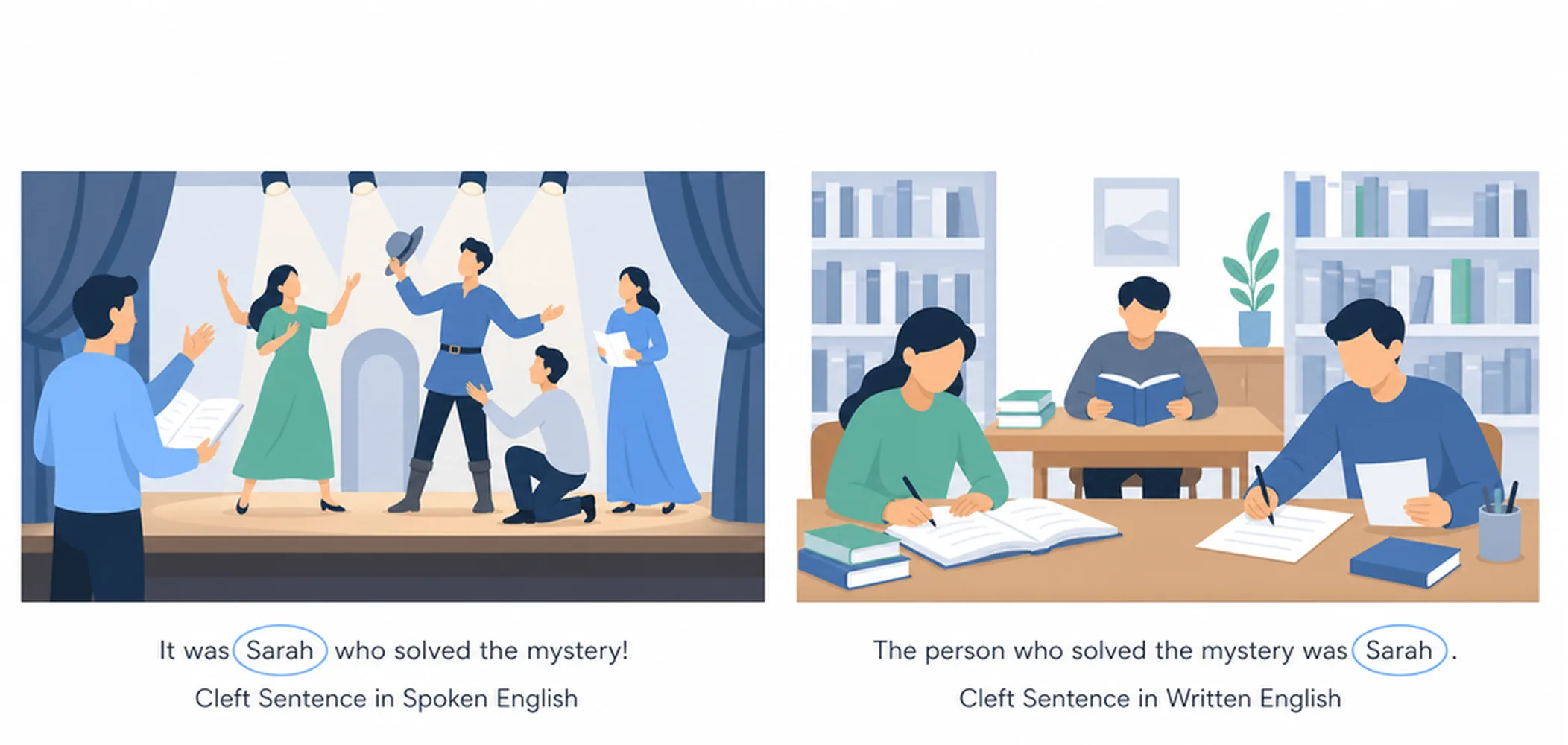
Cleft Sentences: Spoken vs Written English
Cleft sentences are a special way to emphasize (highlight) one part of a sentence. They split a simple sentence into two parts to focus attention on something important. In spoken English, cleft sentences are very common and sound natural. In written English, especially formal writing, they are used less often but still appear in articles, emails, and professional communication. The main difference is frequency and style: spoken English uses cleft sentences casually and frequently, while written English uses them more selectively and formally.
Cleft Sentences with 'It'
The most common cleft sentence form starts with 'It is/was...' and is used in both spoken and written English. This form emphasizes the subject, object, or other element by placing it after the verb. In speech, this structure feels natural and conversational. In writing, it adds emphasis and can improve clarity, though it is sometimes considered less formal than other structures.
Cleft Sentences with 'What'
Another common cleft form uses 'What' at the beginning and is popular in informal spoken English. This structure is especially useful for emphasis in conversations. In written English, it appears more in informal genres like blog posts, personal emails, and casual articles. Formal academic writing tends to avoid this structure because it can sound too casual or conversational.
When to Use Each Form
Choose 'It is/was...' cleft sentences when you want to sound balanced and work in both formal and informal contexts. Use 'What' cleft sentences in casual conversation or informal writing to emphasize what matters most. In formal business emails, reports, and academic writing, use cleft sentences carefully—they can add emphasis, but too many may seem repetitive or informal.
Spoken vs Written English: Side-by-Side Comparison
| Dimension | Spoken English | Written English |
|---|---|---|
| Form | Predominantly it-clefts ("It was John who called") and wh-clefts / pseudo-clefts ("What I need is a break"). Contractions and reduced forms are common (e.g., "It's the noise that bothers me"). | Full it-clefts, wh-clefts, all-clefts ("All she wanted was recognition"), and reverse wh-clefts ("A break is what I need"). Forms are rarely contracted; syntax tends to be more elaborate. |
| Frequency | Very high. Cleft sentences occur naturally and frequently in everyday conversation as a spontaneous focus-marking device, often without conscious planning. | Moderate to high in formal and academic writing; less frequent in informal writing (e.g., text messages). Usage is deliberate and rhetorical rather than spontaneous. |
| Formality Level | Informal to neutral. Clefts blend naturally into casual dialogue and do not sound stilted or overly literary in conversational settings. | Neutral to highly formal. Especially prevalent in academic papers, journalism, legal documents, and literary prose where precise emphasis and cohesion are required. |
| Primary Function | To signal focus, correct misunderstandings, or introduce new information in real time ("It was yesterday I saw her, not today"). Prosody (stress and intonation) works alongside the cleft structure. | To manage information flow, create cohesion across paragraphs, foreground key arguments, and guide the reader's attention without the aid of spoken stress or intonation. |
| Typical Contexts | Casual conversation, interviews, debates, podcasts, classroom talk, telephone calls, storytelling among friends. | Academic essays, newspaper editorials, business reports, literary fiction, legal briefs, formal letters, scientific journal articles. |
| Positive Example | "It's Maria who handles the bookings." / "What I love is the atmosphere here." | "It is the persistent underinvestment in infrastructure that poses the greatest long-term risk." / "What the data reveal is a widening inequality gap." |
| Negative Example | "It's not Pete who took it — it was Dave." / "What I don't want is any more excuses." | "It is not economic growth alone that determines well-being." / "What the reform does not address is systemic bias within institutions." |
| Question Example | "Was it really him who said that?" / "Is this what you were looking for?" | "Is it not transparency that citizens most urgently demand?" / "Was it the policy itself that failed, or its implementation?" |
| Key Signal Words / Structures | It's … who/that …; What I … is …; The thing is …; The one who … is …; frequent use of contraction it's. | It is … that/which …; What … is/are …; All that … is …; … is what …; full form it is preferred over contraction. |
| Prosody / Punctuation Role | Emphasis is reinforced by spoken stress and rising or falling intonation on the focused element, making the cleft structure sometimes redundant but still natural. | Punctuation (commas, em-dashes) and sentence position must do the work that intonation does in speech; the cleft structure carries the entire emphatic burden alone. |
| Discourse / Cohesion Role | Used reactively to respond to what a previous speaker has said, repair misunderstandings, or highlight contrasts in rapid turn-taking. | Used proactively to link paragraphs, recap previous points, anticipate reader objections, and create a clear argumentative thread throughout extended text. |
| Flexibility of Cleft Type | Dominated by it-clefts and wh-clefts; other types (all-clefts, reverse clefts) are rare and can sound unnatural in casual speech. | Full range of cleft types is exploited for stylistic variety; writers deliberately choose among them to control rhythm, emphasis, and register. |
Examples






What to Remember
- Cleft sentences split one idea into two parts using "it" to emphasize one element of the sentence.
- "It is/was + emphasized word/phrase + that + rest of sentence" is the basic structure for cleft sentences.
- Spoken English uses cleft sentences naturally and frequently, while formal written English uses them less but still appropriately.
- Cleft sentences focus attention on one important part by moving it to the beginning after "it is/was."
- Common mistake: do not use cleft sentences in very formal academic writing; save them for casual or semi-formal contexts.