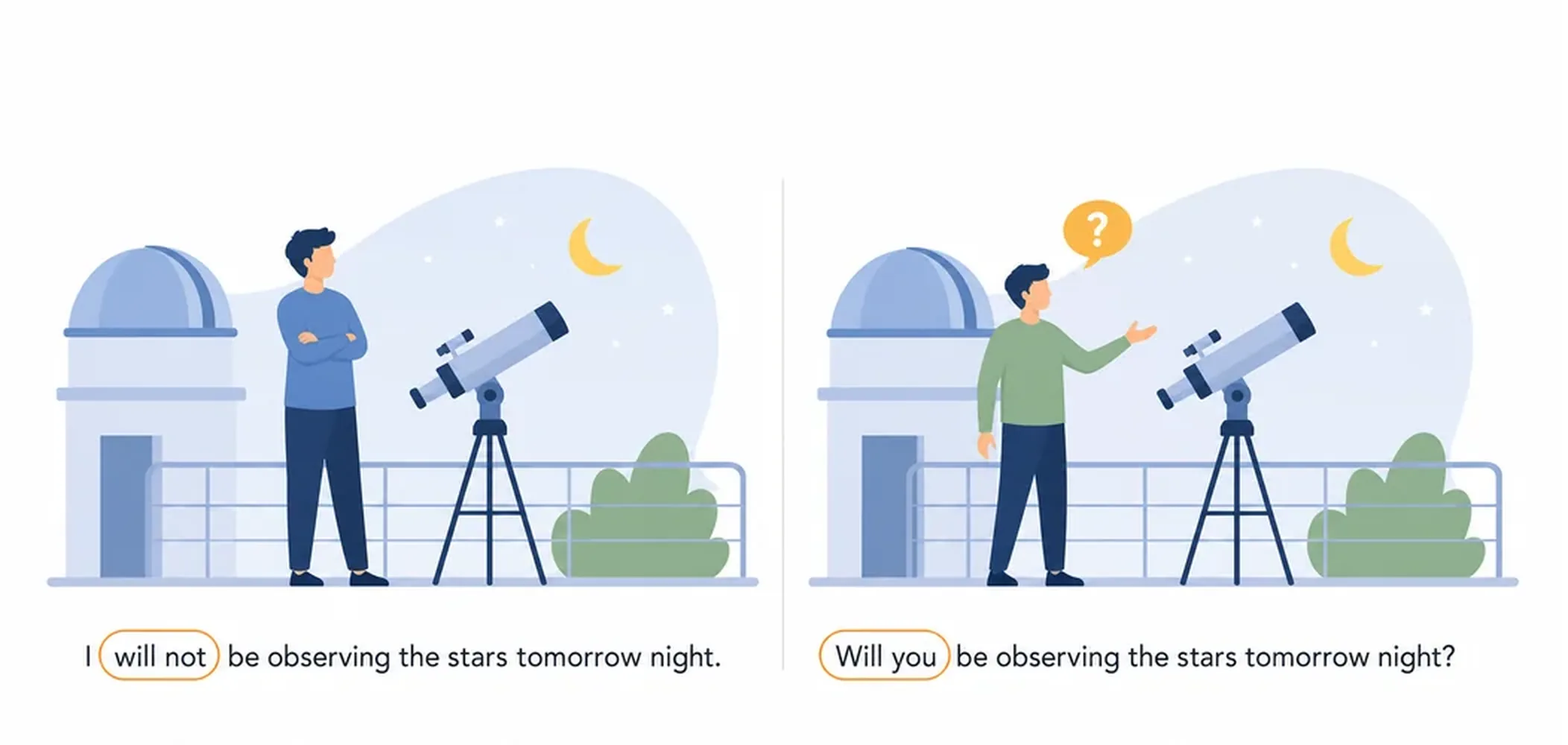
Future Continuous: Negative and Question Forms
The future continuous describes actions that will be in progress at a specific moment in the future. To ask questions or make negations, you need to adjust the auxiliary verbs 'will be' and the present participle. This article focuses on the correct word order and structure for both negative statements and questions.

Negative and Question Forms: Structure
| Form | Structure |
|---|---|
| Affirmative | Subject + will + be + verb-ing + Object / Complement |
| Negative | Subject + will not / won't + be + verb-ing + Object / Complement |
| Yes / No Question | Will + Subject + be + verb-ing + Object / Complement? |
| Wh- Question | Wh-word + will + Subject + be + verb-ing + Object / Complement? |
Examples
Affirmative
She will be working late tonight.
Negative
They won't be travelling this summer.
Yes / No Question
Will you be joining us for dinner?
Wh- Question
What will you be doing next week?
Examples

She won't be working during the summer holidays.
Negative statement · Future activity

Will you be joining us for dinner this evening?
Yes/No question · Social invitation

They won't be using the old system after the update.
Negative statement · Technology context

Where will she be living next year?
Wh- question · Future plans

He won't be available for calls during his vacation.
Negative statement · Professional context

How long will you be staying at the hotel?
Wh- question · Duration
When to use it
Asking About Future Activities
Use question forms to inquire about what someone will be doing at a specific future time.
"Will you be attending the conference next month?"
Stating Future Unavailability
Use negative forms to explain what you or others won't be doing in the future.
"I won't be available for meetings on Friday afternoon."
Seeking Details About Future Plans
Use wh- questions to get specific information about future ongoing actions.
"What will they be working on during the project?"
Signal words
tomorrow
next week/month/year
at this time tomorrow
while
when
tonight
this evening
Common Mistakes
✕
Wrong
She will not be working next week.
✓
Correct
She won't be working next week. (or: She will not be working next week.)
Both are correct; 'won't' is the contracted form preferred in speech and informal writing.
✕
Wrong
Will be you working tomorrow?
✓
Correct
Will you be working tomorrow?
In questions, the subject comes after the auxiliary verb 'will', not after 'be'.
KEY TAKEAWAYS
What to Remember
- The future continuous uses 'will be' + present participle (-ing form) to describe ongoing future actions.
- For negatives, place 'not' after 'will' to form 'will not be' or the contraction 'won't be'.
- In questions, invert 'will' and the subject: 'Will you be working?' not 'You will be working?'
- Use the future continuous for actions in progress at a specific future moment, not completed actions.
- Avoid adding extra auxiliaries; use only 'will be' plus the -ing verb form, nothing more.