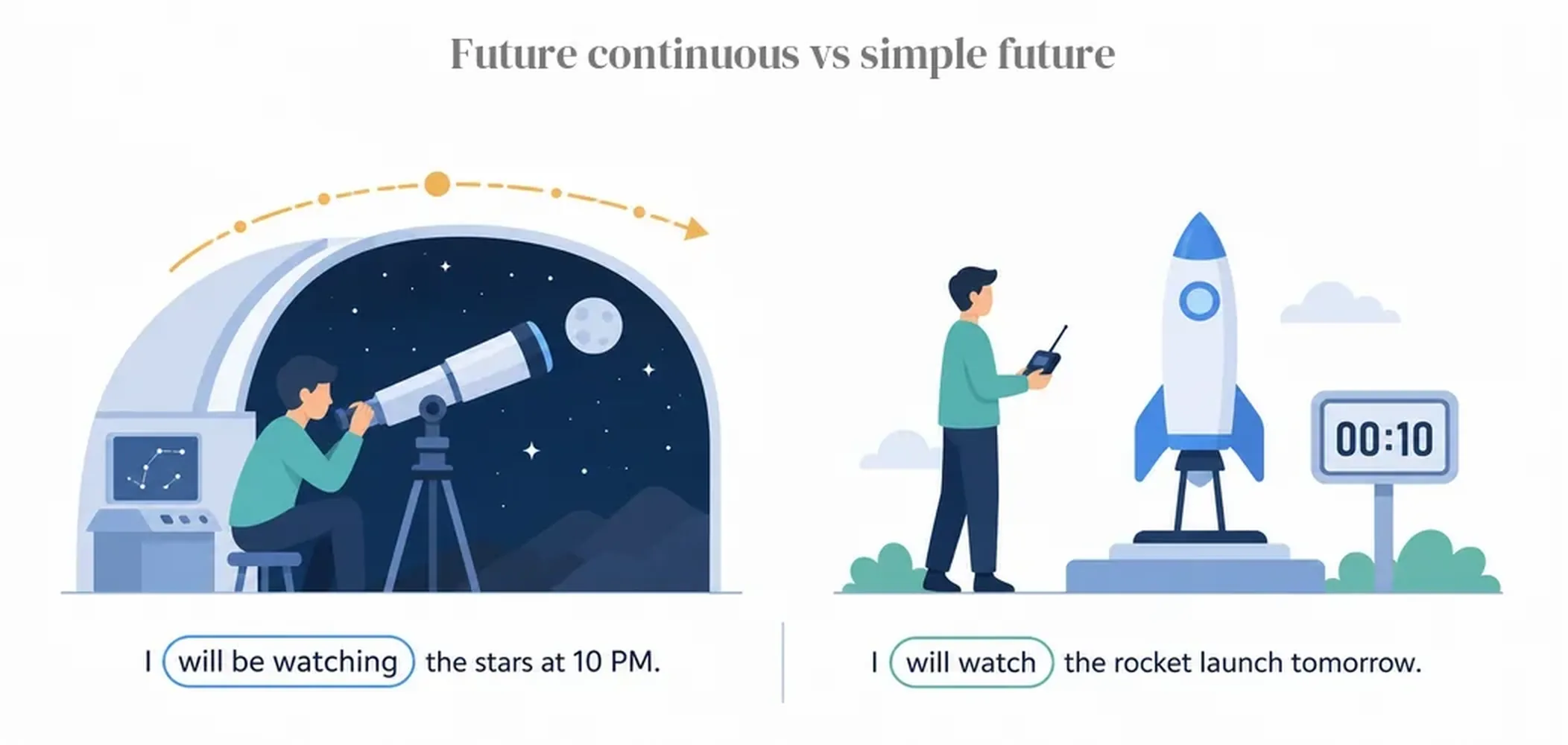
Key Difference
The future continuous (will be + -ing) describes an action that will be in progress at a specific moment in the future. The simple future (will + base verb) describes an action that will happen or be completed at a future time. Think of it this way: the future continuous emphasizes the duration or ongoing nature of an action, while the simple future focuses on the action itself without regard to how long it takes.

When to Use Future Continuous
Use the future continuous when you want to show that an action will be happening during a specific time in the future. This tense is useful for describing what will be occurring at an exact moment, what will happen over a period of time, or for making polite inquiries about someone's planned activities. The focus is on the action in progress, not on when it starts or finishes.
When to Use Simple Future
Use the simple future to talk about predictions, intentions, decisions, or actions that will occur in the future. This is the most common way to express future events in English. With the simple future, you are stating what will happen without emphasizing whether the action is ongoing or instantaneous—the focus is simply on the completion or occurrence of the action at some point ahead.
Future Continuous vs Simple Future: Side-by-Side Comparison
| Dimension | Simple Future | Future Continuous |
|---|---|---|
| Form | Subject + will + base verb e.g. will work |
Subject + will be + verb-ing e.g. will be working |
| When to use | • Spontaneous decisions made at the moment of speaking • Predictions based on opinion or belief • Promises, offers, requests, and threats • Facts about the future |
• An action that will be in progress at a specific point in the future • Planned or expected future events already arranged • Polite enquiries about someone's plans • Parallel actions happening simultaneously in the future |
| Positive example | She will call you tomorrow. | She will be calling you at noon tomorrow. |
| Negative example | He will not attend the meeting. | He will not be attending the meeting at that time. |
| Question example | Will you help me with this? | Will you be using the car this evening? |
| Time focus | A single point or complete action in the future — the action is seen as a whole | A period or ongoing moment in the future — the action is seen as in progress at a specific time |
| Key signal words | tomorrow, next week/month/year, soon, in the future, one day, tonight | at this time tomorrow, at 6 o'clock, this time next week, still, while, when, all day long |
| Key Difference: The Simple Future treats a future action as a complete, single event — focusing on what will happen. The Future Continuous treats a future action as an ongoing process at a particular moment — focusing on what will be happening at that time. In practice, "I will call you at 8" means the call starts at 8, while "I will be calling you at 8" means the call is already in progress at 8. | ||
Examples






What to Remember
- Use future continuous (will be + -ing) for actions in progress at a specific future moment.
- Use simple future (will + base verb) for completed actions or events at a future time.
- Future continuous emphasizes duration and ongoing nature; simple future focuses on the action itself.
- Don't use future continuous for single completed actions or scheduled events; use simple future instead.
- Both tenses can describe future moments, but choose based on whether the action is ongoing or complete.