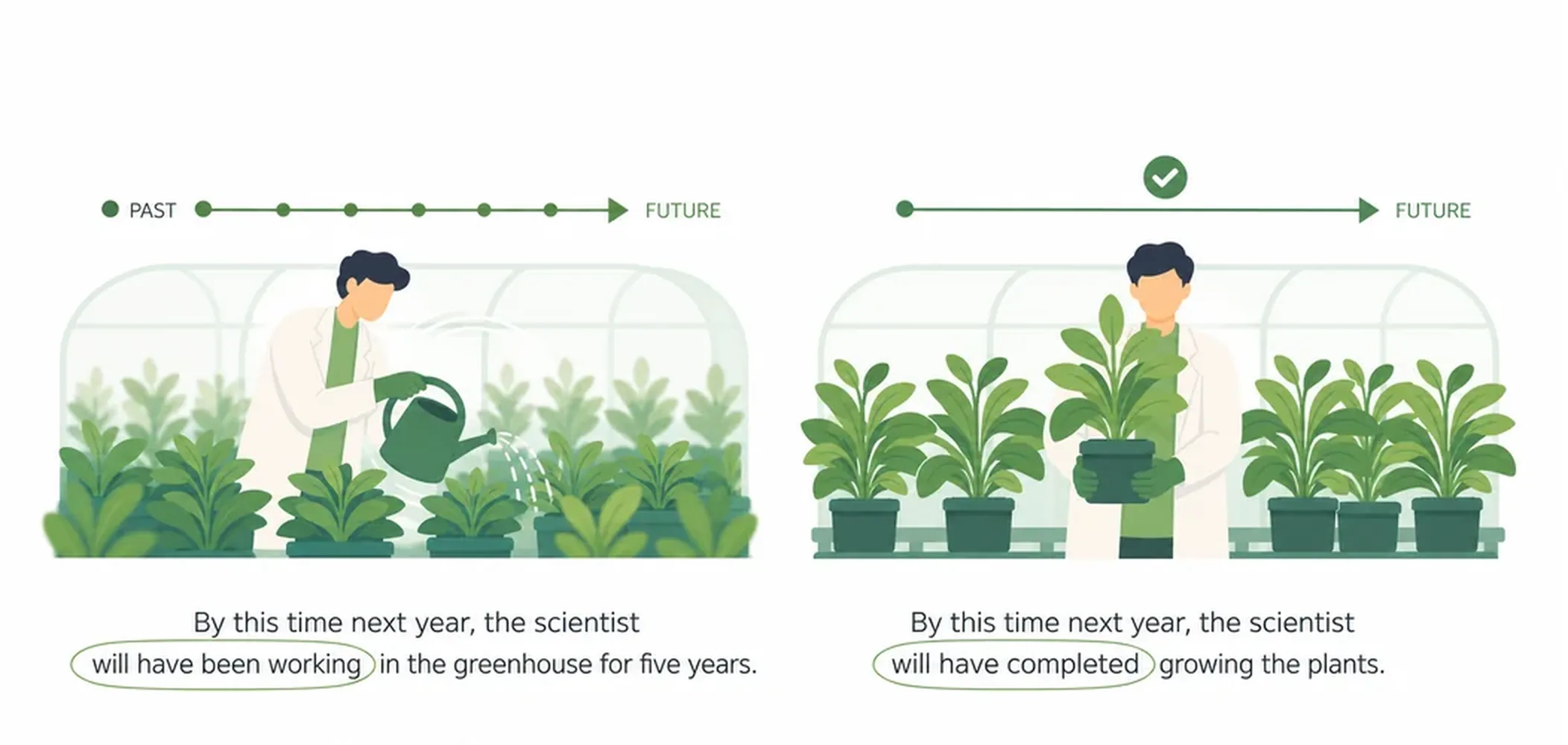
Key Difference: Completion vs Duration
Both future perfect and future perfect continuous describe actions that will be completed before a specific moment in the future. The crucial distinction lies in emphasis: the future perfect focuses on the completion or result of an action, while the future perfect continuous emphasizes the duration or continuity of that action leading up to the future moment. This subtle but significant difference affects how native speakers convey temporal relationships and the importance they place on the period of activity itself.

Future Perfect vs Future Perfect Continuous: Side-by-Side Comparison
| Dimension | Future Perfect Continuous | Future Perfect |
|---|---|---|
| Form | will + have + been + verb-ing e.g. will have been working |
will + have + past participle e.g. will have worked |
| Primary Emphasis | The duration or ongoing nature of an action leading up to a future point | The completion of an action before a specific future point |
| When to Use |
• To stress how long an activity will have been going on by a future moment • To show a continuous process whose effects or tiredness will be felt at a future time • When the action may still be in progress at the reference point |
• To say that an action will be finished before a specific future time or event • To focus on the result or achievement, not the process • With stative verbs (know, own, believe, etc.) that cannot take continuous form |
| Positive Example | By Friday, she will have been studying for three weeks. | By Friday, she will have finished her report. |
| Negative Example | By midnight, he will not have been sleeping long enough to feel rested. | By midnight, he will not have slept at all. |
| Question Example | Will they have been waiting for long by the time we arrive? | Will they have left by the time we arrive? |
| Key Signal Words & Phrases | for + period of time, by (then / that time / next year), how long, all day / all week | by (then / that time / next year), before, already, once, as soon as |
| Stative Verbs | ❌ Cannot be used with stative verbs (know, like, own, understand, etc.) | ✅ Can be used with stative verbs e.g. By then, I will have known her for ten years. |
| Result vs. Process | Focuses on the process and its duration; the action may or may not be fully complete | Focuses on the result; the action is definitely complete before the reference point |
| 🔑 Key Difference: Use the Future Perfect Continuous when you want to highlight how long an action will have been in progress up to a future moment (emphasising duration and effort). Use the Future Perfect when you want to stress that an action will be completed before a specific future point (emphasising the finished result). A useful test: if you can naturally add "for + a period of time" and the focus is on the ongoing effort, choose the continuous form; if the focus is on achievement or completion, choose the simple form. | ||
Examples

By next month, she will have completed her degree.
Future Perfect · Focus on completion
①she completes her degree
→
②next month arrives

The company will have launched three new products by year-end.
Future Perfect · Countable result
①company launches three new products
→
②year-end arrives

By next month, he will have earned his MBA.
Future Perfect · Achievement
①he completes his MBA
→
②next month arrives

By the time you arrive, I will have been preparing dinner for two hours.
Future Perfect Continuous · Focus on duration
①preparing dinner for two hours
→
②you arrive

She will have been working at this company for 15 years by her retirement.
Future Perfect Continuous · Length of employment
①She starts working at the company
→
②Her retirement arrives (15 years later)
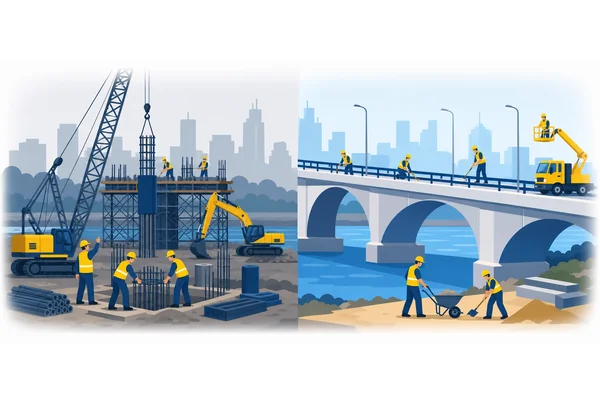
By next summer, they will have been building the bridge for five years.
Future Perfect Continuous · Ongoing process
①they start building the bridge
→
②next summer (five years later)
When to use it
Highlighting Completion
Use future perfect when you want to emphasize that an action will be finished or a goal achieved by a specific time.
"By graduation, I will have completed all my degree requirements."
Emphasizing Duration
Use future perfect continuous when the length or continuity of the action is more significant than its completion.
"By next spring, we will have been planning this event for six months."
Contrasting Results vs Process
Choose future perfect for countable results or achievements; choose continuous when describing how long someone has been engaged in an activity.
Future perfect: "She will have published five papers." Continuous: "She will have been researching cancer for a decade."
Signal words
by
by the time
by then
before
by next week/month/year
in the next X days/weeks
by the end of
within X time
Common Mistakes
✕
Wrong
By 2025, I will have been living in London for ten years.
✓
Correct
By 2025, I will have lived in London for ten years.
Use future perfect, not continuous, when stating a completed duration without emphasizing the ongoing nature of the time period.
✕
Wrong
By Friday, the team will have been finishing the presentation.
✓
Correct
By Friday, the team will have finished the presentation.
Future perfect continuous requires ongoing relevance. 'Finishing' is a momentary action, so future perfect is appropriate.
✕
Wrong
She will have written three novels by 2026 for 20 years.
✓
Correct
She will have been writing novels for 20 years by 2026.
When emphasizing the duration of an activity rather than discrete results, use future perfect continuous.
KEY TAKEAWAYS
What to Remember
- Use future perfect continuous to emphasize how long an action will have been happening.
- Use future perfect to emphasize completion or result of an action by a future point.
- Future perfect continuous requires "will have been" plus the present participle form of the verb.
- Both forms describe completed actions before a future moment, but differ in their emphasis.
- Avoid confusing duration (continuous) with completion (perfect) when choosing between these two similar tenses.