Understanding the Future Perfect
The future perfect tense describes an action that will be completed before a specific point in the future. It emphasises the completion or accomplishment of an action by a certain time, rather than simply stating that something will happen. This tense is particularly useful when you need to establish a temporal relationship between two future events, with one clearly finishing before the other begins. At the C1 level, mastery of the future perfect enables you to express sophisticated temporal nuance and construct complex narratives about anticipated outcomes.

The future perfect is constructed with the auxiliary verb 'will have' followed by the past participle of the main verb. For negative statements, insert 'not' between 'will' and 'have'. Questions invert the subject and 'will'. The structure remains consistent across all persons and numbers, making it straightforward despite its complex meaning. Understanding this formation is essential, as it distinguishes the future perfect from the simple future and other compound tenses.
Key Uses and Contextual Applications
The future perfect serves multiple rhetorical and practical purposes. It conveys predictions about completion by a deadline, expresses assumptions about what will have transpired by a future moment, and narrates anticipated sequences of events. It also appears frequently in professional contexts—project planning, contractual obligations, and temporal guarantees—where precision about completion deadlines is critical. Additionally, the future perfect can express logical deduction about the present or past when used with temporal markers like 'by now' or 'by then,' adding interpretive depth to its application. This versatility makes it indispensable for advanced English users.
Future Perfect vs Simple Future
| Dimension | Future Perfect | Simple Future |
|---|---|---|
| Form | will + have + past participle e.g. will have finished |
will + base verb e.g. will finish |
| Meaning & Focus | Emphasises the completion of an action before a specific point or another event in the future. The action is viewed as already done from that future vantage point. | Describes an action or event that will happen at some point in the future. Focus is on the action itself, not its completion relative to another moment. |
| When to Use |
• To show one future action is completed before another future moment • To make predictions about what will already be done by a deadline • To express duration up to a future point |
• To make general predictions about the future • To express spontaneous decisions made at the moment of speaking • To state future facts or scheduled events |
| Positive Example | "By Friday, she will have submitted her report." → The submission is complete before Friday arrives. |
"She will submit her report on Friday." → The submission happens on Friday; completion is not implied. |
| Negative Example | "They will not have finished the construction by next month." → The completion will not occur before that deadline. |
"They will not finish the construction next month." → The action simply will not happen during that time. |
| Question Example | "Will you have packed your bags before we leave?" → Asking whether packing will be done ahead of departure. |
"Will you pack your bags tomorrow?" → Asking whether the action will take place at all. |
| Key Signal Words | by (the time), by then, before, already, by + date/time, once | tomorrow, soon, next week/month/year, in + time period, one day |
| Duration Aspect | "By December, I will have been working here for ten years." (Future perfect continuous for ongoing duration) |
"I will work here for ten years." (States a future fact; no reference point for completion) |
| 🔑 Key Difference: The future perfect always implies a reference point — it looks back from a future moment to confirm that an action will already be complete. The simple future simply projects an action forward in time with no requirement that it be finished by any particular moment. If you can add "by the time…" or "before…" naturally to your sentence and the completion matters, choose the future perfect. If you are just stating what will happen, use the simple future. | ||
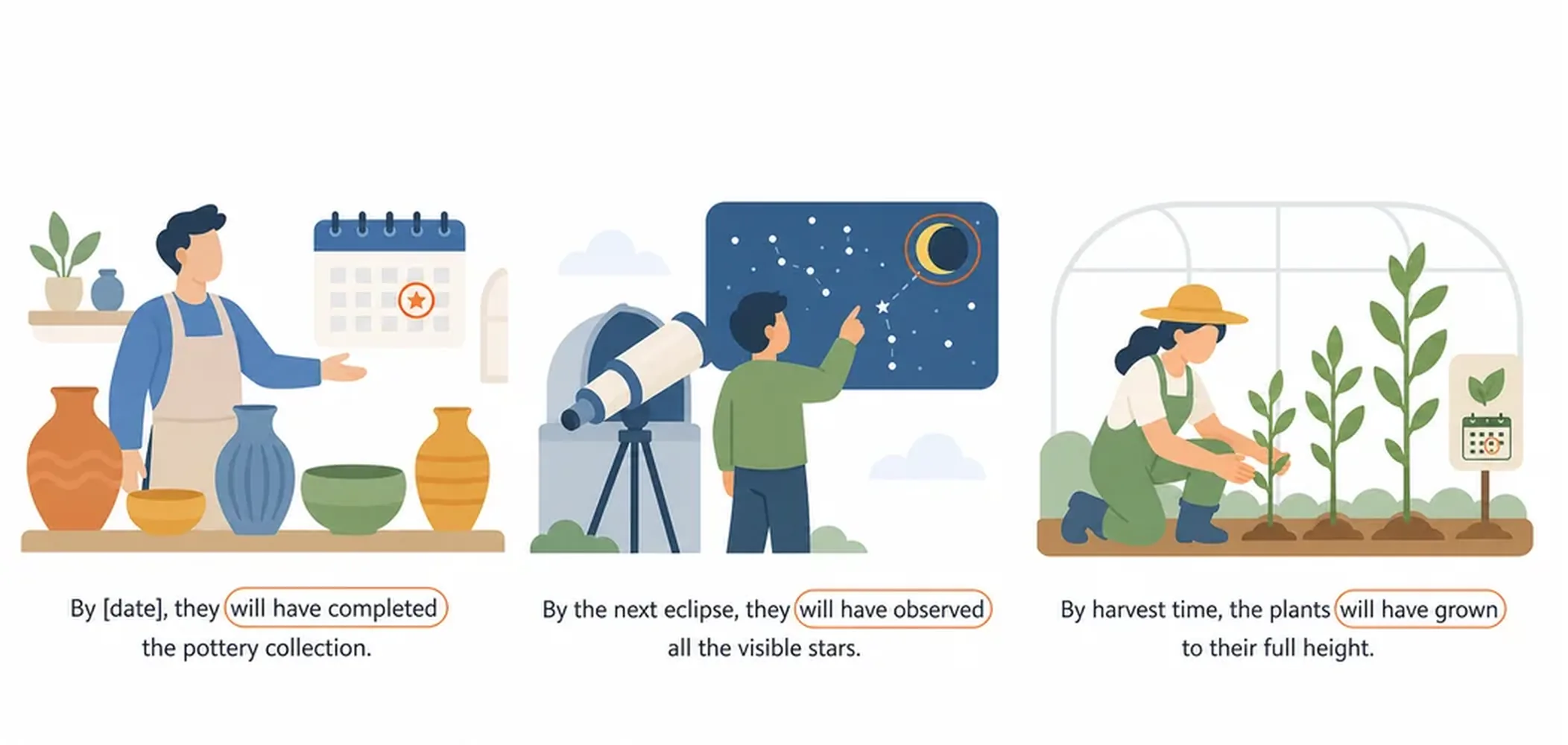
Examples






What to Remember
- The future perfect describes actions completed before a specific future point in time.
- Form it with will have + past participle for all subjects without exception.
- Use it to show one future action finishing before another future action starts.
- The future perfect emphasises completion and accomplishment, not just the occurrence of events.
- Avoid confusing it with simple future; future perfect stresses the finished state by then.