Understanding the Fundamental Distinction
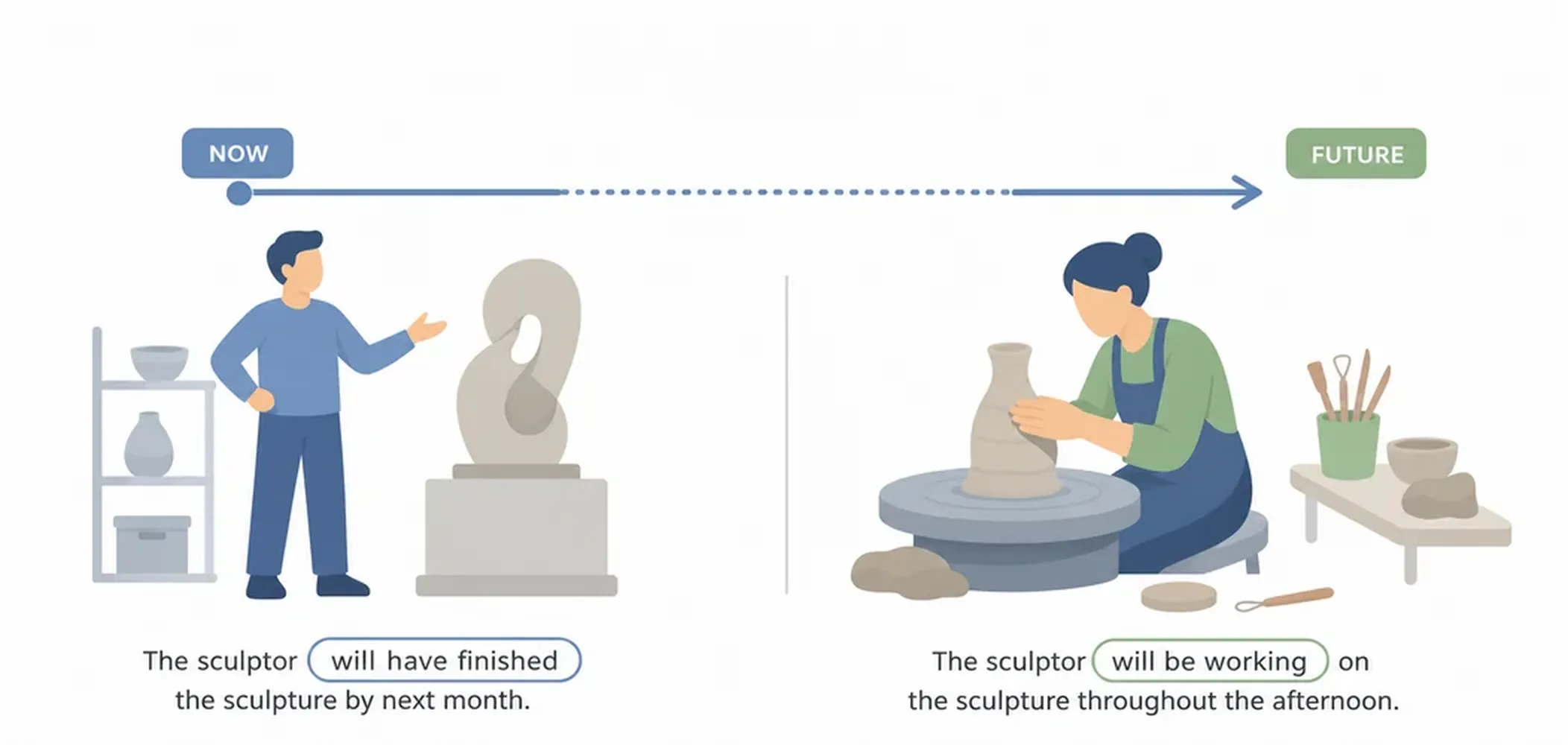
The future perfect and future continuous represent two distinct perspectives on future temporality. The future perfect emphasizes completion: it positions an action as finished by a specific point in the future, creating a sense of accomplishment or milestone. Conversely, the future continuous emphasizes duration: it captures an action in progress at a particular moment or during a specified period ahead. This distinction becomes crucial when precision about aspectual meaning is required, particularly in formal contexts, professional communication, or when nuance significantly alters the intended message. The choice between these forms shapes how listeners perceive the temporal relationship between the reference point and the predicted event.

Future Perfect: Completed Actions
The future perfect (will have + past participle) situates an action as concluded before a defined future moment. This temporal framing is essential when you wish to emphasize that something will be entirely finished, often establishing a benchmark against which other future events may be measured or contextualized.
Future Perfect vs Future Continuous: Side-by-Side Comparison
| Dimension | Future Perfect | Future Continuous |
|---|---|---|
| Form | will + have + past participle (e.g. will have finished) |
will + be + present participle (-ing) (e.g. will be working) |
| When to use | To talk about an action that will be completed before a specific point in the future. Emphasises the result or completion of the action. | To talk about an action that will be in progress at a specific point in the future. Emphasises the ongoing nature of the action. |
| Focus | Completion / achievement of an action by a future deadline | Duration / continuity of an action at a future moment |
| Time reference | A future moment by which something will already be done (deadline-based) | A future moment at which something will be happening (snapshot in time) |
| Positive example | By 9 o'clock, she will have finished the report. | At 9 o'clock, she will be finishing the report. |
| Negative example | They will not have arrived by the time you leave. | He will not be waiting for us when we get there. |
| Question example | Will you have completed the project by Friday? | Will you be working on the project this Friday? |
| Key signal words | by, by the time, before, already, yet, by then, by next [time period] | at this time tomorrow, still, while, all day, in the middle of, at [specific time] |
| 🔑 Key Difference: The future perfect (will have + past participle) stresses that an action will be completed and done before a future point — the focus is on the end result. The future continuous (will be + -ing) stresses that an action will be in progress at a future point — the focus is on the ongoing activity. Compare: "By noon I will have eaten lunch" (finished) vs. "At noon I will be eating lunch" (still happening). | ||
Examples






What to Remember
- Use future perfect to show an action completed by a specific future point in time.
- Future perfect uses "will have" + past participle; future continuous uses "will be" + present participle.
- Future perfect emphasizes completion and achievement; future continuous emphasizes duration and ongoing action.
- Choose future perfect when focusing on results; choose future continuous when focusing on the activity itself.
- Avoid confusing the two: future perfect answers "will be finished?" while future continuous answers "will be happening?"