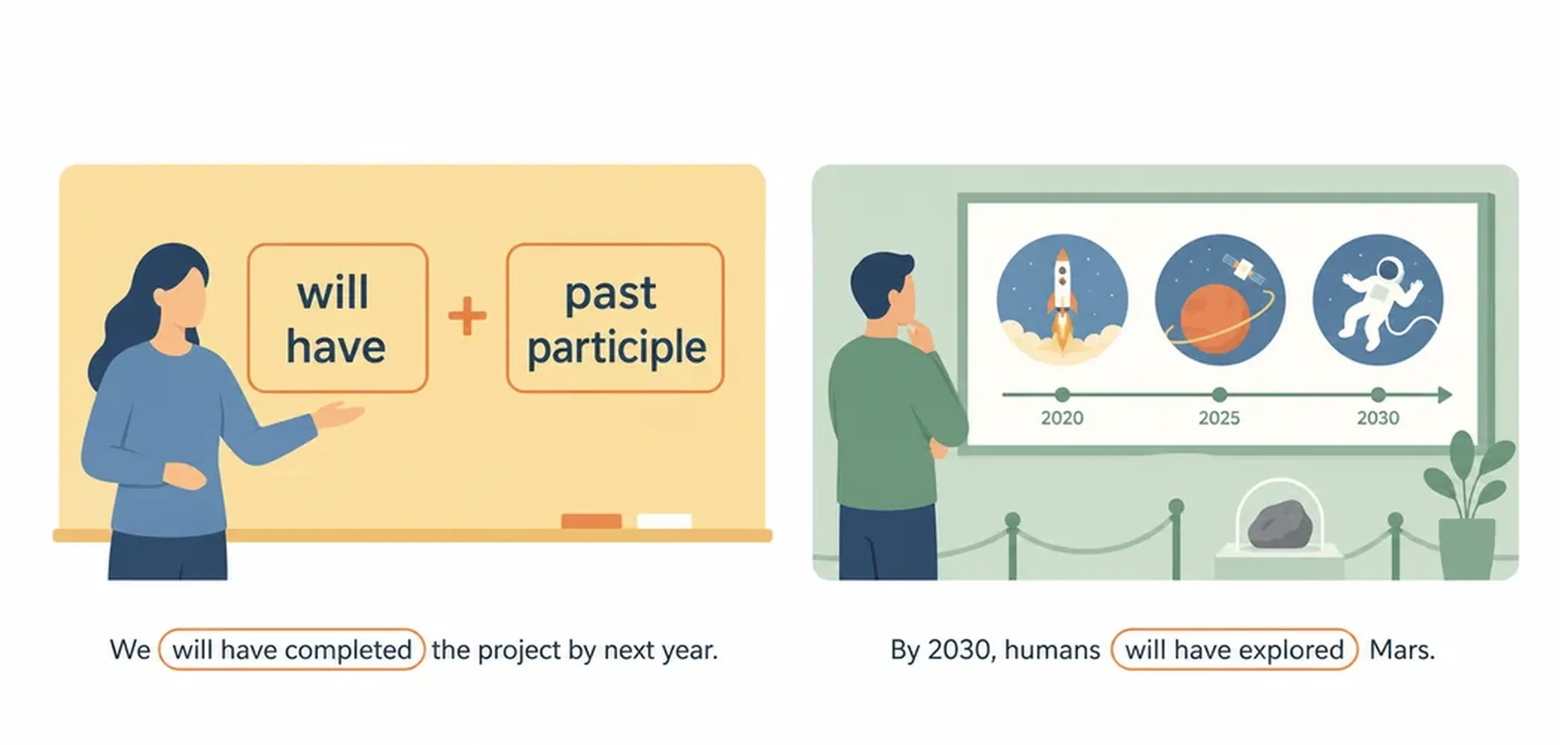
Understanding the Future Perfect
The future perfect tense expresses an action that will be completed before a specific point in the future. It emphasises the completion and duration of an action, distinguishing it from the simple future. This tense is particularly valuable in academic writing, professional communication, and narrative contexts where temporal relationships between future events require precision. Mastery of the future perfect demonstrates sophisticated command of English temporal structures, essential for C1-level proficiency.

How to Form the Future Perfect
The future perfect tense is formed using the auxiliary verb will, followed by have, and then the past participle of the main verb. Below is the complete conjugation table showing affirmative, negative, and question forms.
| Subject | Affirmative | Negative | Question |
|---|---|---|---|
| I | will have finished | will not (won't) have finished | Will I have finished? |
| You | will have finished | will not (won't) have finished | Will you have finished? |
| He / She / It | will have finished | will not (won't) have finished | Will he / she / it have finished? |
| We | will have finished | will not (won't) have finished | Will we have finished? |
| They | will have finished | will not (won't) have finished | Will they have finished? |
She will have finished the report by Friday.
They will not have arrived by midnight.
Will you have completed your assignment by tomorrow?
Examples





What to Remember
- Form the future perfect using "will have" + past participle of the main verb.
- The future perfect indicates completion before a specific future time or event.
- Use by + time expression to show the deadline for completion.
- Distinguish future perfect from simple future: perfect emphasizes completion, simple future does not.
- Avoid using present perfect or simple future when expressing a completed future action.