Understanding the Past Perfect Continuous
The past perfect continuous (also called past perfect progressive) describes an action that began in the past, continued for a duration, and was still ongoing when another past event occurred. It emphasizes the duration and continuity of the action. Structurally, it combines the past perfect auxiliary 'had been' with the present participle (-ing form) of the main verb. This tense bridges two points in the past, establishing a clear temporal relationship: the action in the past perfect continuous preceded and led up to another completed past action.

When to Use Past Perfect Continuous
Use the past perfect continuous to show that one action in the past was in progress when another past action interrupted or occurred. This is particularly useful in narrative writing, explanations of cause and effect, and when establishing context. It's essential for distinguishing between actions of different durations and for explaining why something happened the way it did. The tense is common in academic writing, complex storytelling, and professional contexts where temporal precision matters.
Past Perfect Continuous vs. Simple Past
The key distinction lies in emphasis: the past perfect continuous foregrounds the duration and continuity of an action, while the simple past merely reports that an action happened. For example, 'She had been working on the project' stresses the ongoing effort, whereas 'She worked on the project' simply states a fact. The past perfect continuous naturally accommodates explanatory depth and nuance that C1 learners need for sophisticated expression. When the duration is irrelevant or you need brevity, the simple past suffices; when you need to establish temporal layering and causality, the past perfect continuous is more precise.
Past Perfect Continuous — Examples
Past Perfect Continuous — Examples
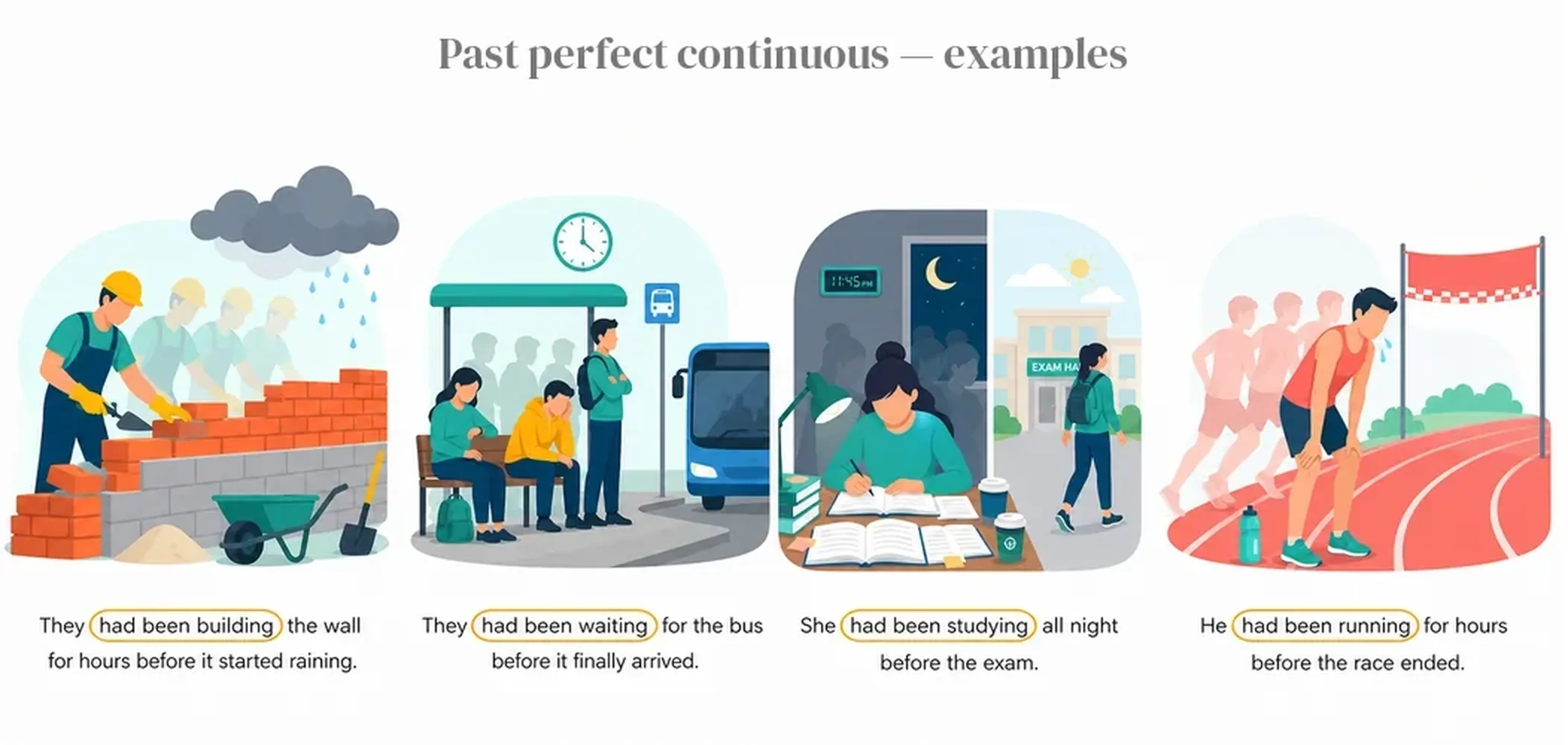
The past perfect continuous (had + been + verb-ing) describes an action that was ongoing in the past up to — or just before — a specific point or event in the past. The examples below are grouped by typical use case.
She had been studying for six hours before she finally took a break.
They had been waiting at the airport for nearly three hours when the flight was cancelled.
He had been living in Paris for two years before he moved to Rome.
Her eyes were red because she had been crying all afternoon.
The children were exhausted because they had been playing outside since morning.
The ground was wet; it had been raining heavily for most of the night.
I had been reading the report when the phone suddenly rang.
We had been discussing the project for an hour before the manager arrived with new instructions.
You could tell from his dirty hands that he had been gardening all morning.
She told me she had been working on the novel for three years.
The doctor said the patient had been experiencing symptoms for several weeks.
He hadn't been sleeping well for weeks, so the doctor recommended rest.
Had you been expecting the news, or did it come as a complete surprise?
Examples





What to Remember
- Form the past perfect continuous with 'had been' plus the present participle (-ing form) of the verb.
- The past perfect continuous shows an action that started in the past and continued until another past event.
- Use this tense to emphasize how long an action lasted before a specific moment in the past.
- The past perfect continuous action must finish before the simple past event occurs in the sentence.
- Don't confuse the past perfect continuous with simple past; use it when duration and continuity matter most.