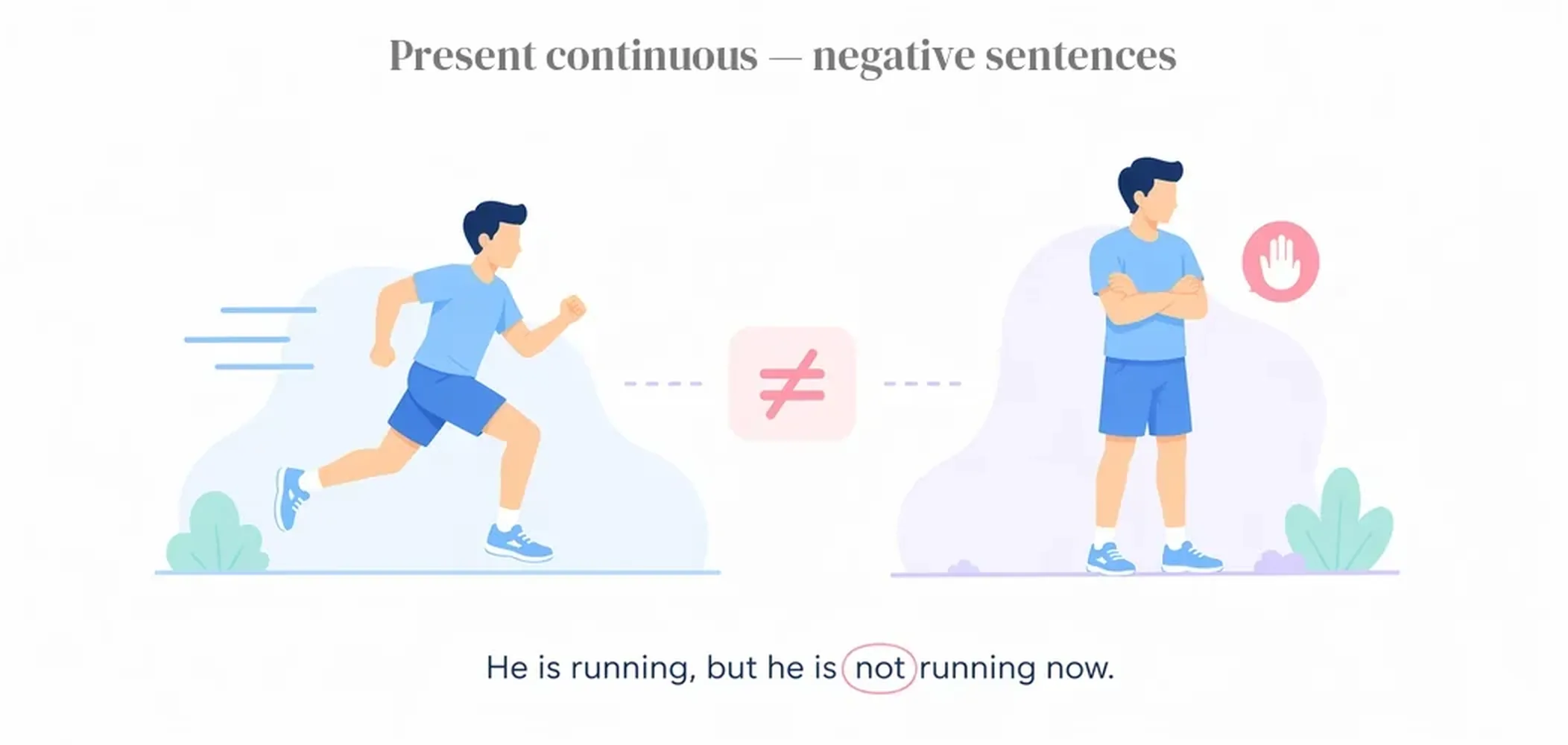
Present Continuous Negative Sentences
The present continuous tense describes actions happening right now. To make a negative sentence, we use the auxiliary verb "be" (am, is, are) with "not" and add -ing to the main verb. This article shows you the exact formula and gives you plenty of examples to practise.

Negative Present Continuous — Example Sentences
Subject: I
I am not watching television right now — I'm reading a book.
Full form: am not. Used to contrast what is NOT happening at this moment with what IS happening instead.
I 'm not feeling well today, so I'm staying at home.
Contracted form: 'm not. Describes a temporary state happening around now. Note: am not has no common contracted form other than 'm not.
Subject: You
You are not listening to me — please put your phone down!
Full form: are not. Describes an action NOT in progress at the moment of speaking, often used as a complaint or observation.
You aren't making sense — can you explain that again?
Contracted form: aren't. Common in everyday spoken English. Refers to something happening (or not happening) in the current situation.
Subject: He / She / It
He is not working at the moment — he is on holiday until Friday.
Full form: is not. Describes a temporary situation around the present time, not just at this exact second.
She isn't studying medicine anymore — she changed her course last year.
Contracted form: isn't. Can refer to a longer temporary situation or a changing state, not necessarily just the current moment.
The printer isn't working — could you call IT support?
Subject it with contracted form isn't. Used to describe a machine or object in a temporary non-functioning state right now.
Subject: We
We are not moving to a new office — the plans have been cancelled.
Full form: are not. Present continuous used here for a planned future event that is now being denied or cancelled.
We aren't going to the party tonight — we're both too tired.
Contracted form: aren't. Negative present continuous used to talk about a fixed plan that has changed or been rejected.
Subject: They
They are not playing very well in this match — they have already made three mistakes.
Full form: are not. Describes an action in progress (a match) during which the negative behaviour is observed.
They aren't building the new school on that site anymore — they chose a different location.
Contracted form: aren't. Describes a temporary ongoing project that has been stopped or redirected.
Mixed subjects — Everyday contexts
My sister is not sleeping well these days because of the heat.
Full form: is not. "These days" shows this is a temporary, ongoing situation around the present, not just this moment.
The children aren't eating their vegetables — maybe the food is too spicy.
Contracted form: aren't. Action not in progress right now, observed and commented on in the present moment.
The economy is not improving as quickly as the government had hoped.
Full form: is not. Used with abstract subjects to describe a slow-changing or developing situation at the present time.
I 'm not enjoying this film at all — do you want to switch it off?
Contracted form: 'm not. Expresses a negative experience in progress at this very moment. Enjoy is used in continuous here informally to stress the ongoing experience.
Examples





What to Remember
- Use am/is/are + not + verb-ing for negative present continuous sentences.
- Remember that "not" comes after the auxiliary verb be, never before it.
- The main verb always needs the -ing ending in negative present continuous forms.
- Common mistake: don't say "I am not going" as "I not am going."
- Contractions like "isn't," "aren't," and "I'm not" are commonly used in spoken English.