Four Ways to Talk About the Future
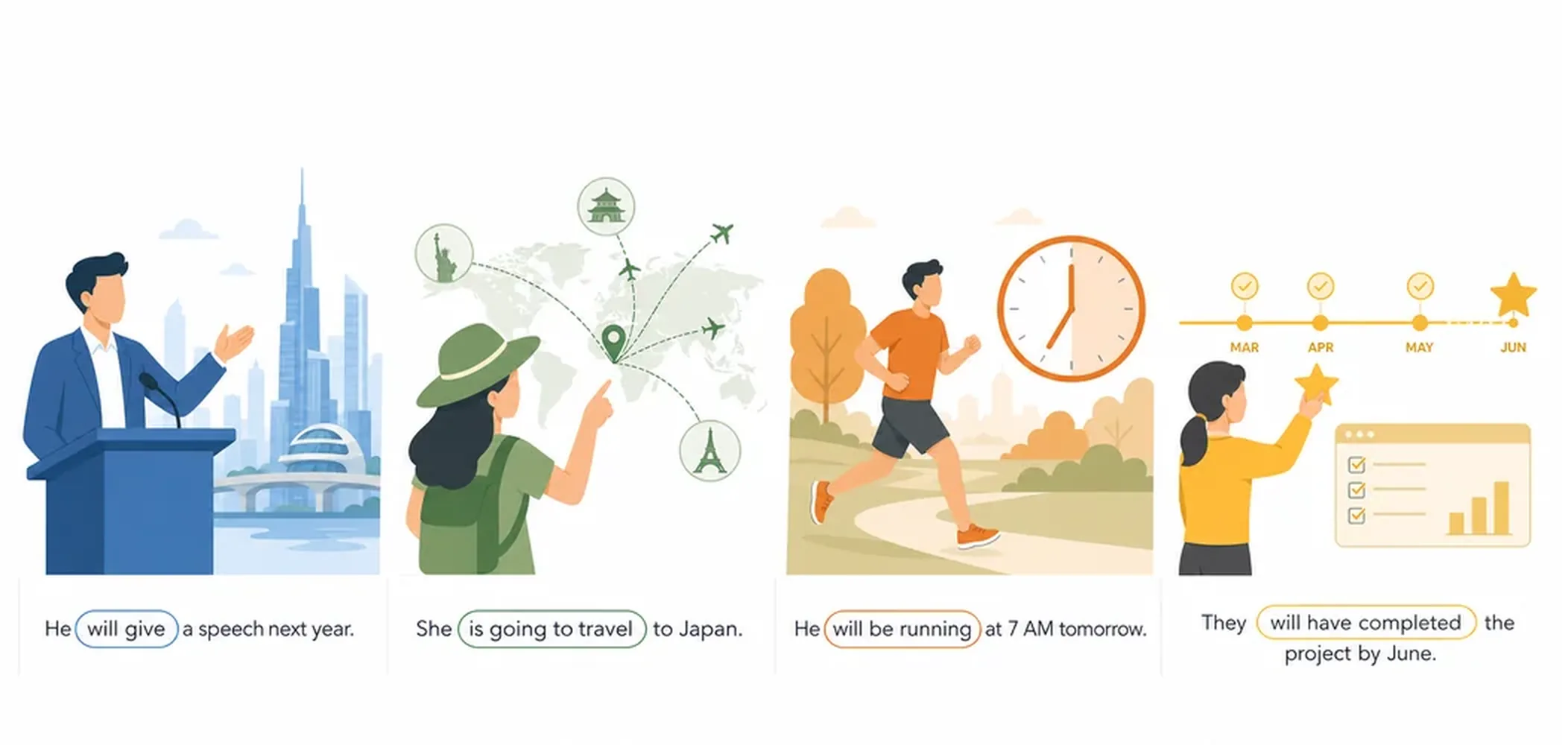
English has multiple ways to express future actions, and choosing the right one depends on how certain you are, how planned the action is, and when you're talking about it. Will is used for predictions and spontaneous decisions. Going to expresses planned intentions or logical predictions based on present evidence. Present continuous describes scheduled events, and future perfect shows completion before a specific future point. Understanding these distinctions will make your English sound more natural and precise.

Will vs. Going to
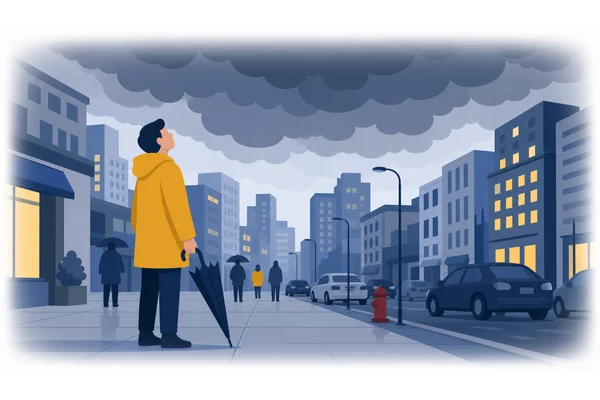
Will and going to both describe future events, but they differ in certainty and planning. Use will for spontaneous decisions, predictions, and promises that haven't been planned. Use going to for actions you've already decided on, plans you've made, or predictions based on clear present evidence (what you can see right now). For example: 'I'll help you move' (spontaneous offer) versus 'I'm going to help you move tomorrow' (pre-arranged plan).
Present Continuous vs. Going to for Plans
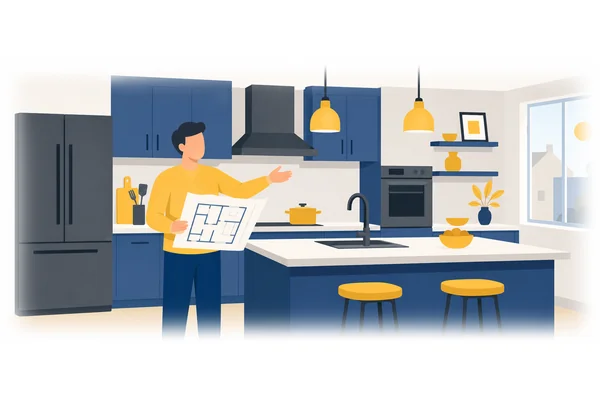
Present continuous and going to both express planned future actions, but present continuous is used when you have a definite arrangement—a specific time and place are often involved. Going to is more flexible and refers to your intention or decision without necessarily having confirmed all the details. Compare: 'We're meeting John at 3 PM tomorrow' (definite arrangement) with 'We're going to discuss the project next week' (intention, but not fully arranged yet).
Future Perfect: The Completed Picture
Future perfect describes an action that will be completed before a specific point in the future. It's particularly useful for showing the relationship between two future events or emphasizing completion. Use it when you want to highlight that something will be done by a certain time. Example: 'By next Friday, we will have finished the report' emphasizes that the report will be complete before that deadline arrives. The other tenses don't show this sense of completion.
Common Signal Words by Tense
Different tenses often pair with specific time expressions. Will frequently appears with 'probably,' 'definitely,' 'I think,' and 'I'm sure.' Going to uses 'definitely,' 'probably,' and clear time markers. Present continuous pairs with specific times: 'at 3 PM,' 'next Tuesday,' 'tomorrow at noon.' Future perfect uses 'by,' 'by the time,' 'in three weeks,' and 'before' to mark the deadline for completion.
Future Tenses at a Glance: Side-by-Side Comparison
| Dimension | Will | Going To | Present Continuous | Future Perfect |
|---|---|---|---|---|
| Form | will + base infinitive (e.g. will go) |
am/is/are + going to + base infinitive (e.g. is going to go) |
am/is/are + present participle (-ing) (e.g. is going) |
will + have + past participle (e.g. will have gone) |
| When to Use | Spontaneous decisions, predictions without evidence, offers, promises, and general facts about the future. | Pre-planned intentions, predictions based on present evidence, decisions already made before speaking. | Fixed, confirmed arrangements — especially social plans with another person; time and place already set. | An action that will be completed before a specific point in the future; emphasises completion. |
| Positive Example | "I'll call you back in five minutes." | "She is going to start a new job next month." | "We are meeting the clients at 3 p.m. tomorrow." | "By Friday, they will have finished the report." |
| Negative Example | "I won't be able to attend the meeting." | "He is not going to apply for that position." | "They aren't travelling to Paris this weekend." | "She won't have completed the course by June." |
| Question Example | "Will you help me with this task?" | "Are they going to announce the results today?" | "Are you seeing the doctor tomorrow?" | "Will you have saved enough money by December?" |
| Certainty Level | Medium — based on belief or assumption; no concrete evidence required. | Medium–High — based on visible evidence or a prior decision already made. | High — the arrangement is confirmed and settled; very unlikely to change. | High in completion — speaker is confident the action will be done by a deadline. |
| Planning Stage | Unplanned / spontaneous decision made at the moment of speaking. | Planned before speaking, but details (time, place) may not be fully arranged. | Fully arranged — specific time, place, and often other parties are confirmed. | Focus is on the completion of an action relative to a future deadline, not the planning stage. |
| Key Signal Words | probably, I think, I expect, I'm sure, I hope, I believe, perhaps, maybe | look!, watch out!, I've decided to, I've already planned to, the evidence shows… | tonight, tomorrow, this weekend, next week, on Monday, at 6 o'clock | by (then/tomorrow/next year), before, by the time, by the end of… |
| 🔑 Key Difference: Use will for spontaneous decisions and general predictions; use going to when a decision or plan was made before speaking, or when there is clear present evidence for a prediction; use the present continuous only when an arrangement is fully confirmed with specific details (time, place, people); and use the future perfect when you want to emphasise that an action will be completed before a particular point in the future. The main contrast lies in when the decision is made (will vs. going to), how concrete the arrangement is (going to vs. present continuous), and whether completion by a deadline is the focus (future perfect vs. all others). | ||||
Examples







What to Remember
- Use will for predictions and spontaneous decisions made at the moment of speaking.
- Use going to for planned intentions or predictions based on present evidence and situations.
- Use present continuous for scheduled events with definite times, especially regarding travel and appointments.
- Use future perfect to describe actions completed before a specific point in the future.
- Choosing the correct tense depends on certainty level, planning stage, and the specific timeframe involved.