Understanding the Three Present Tenses
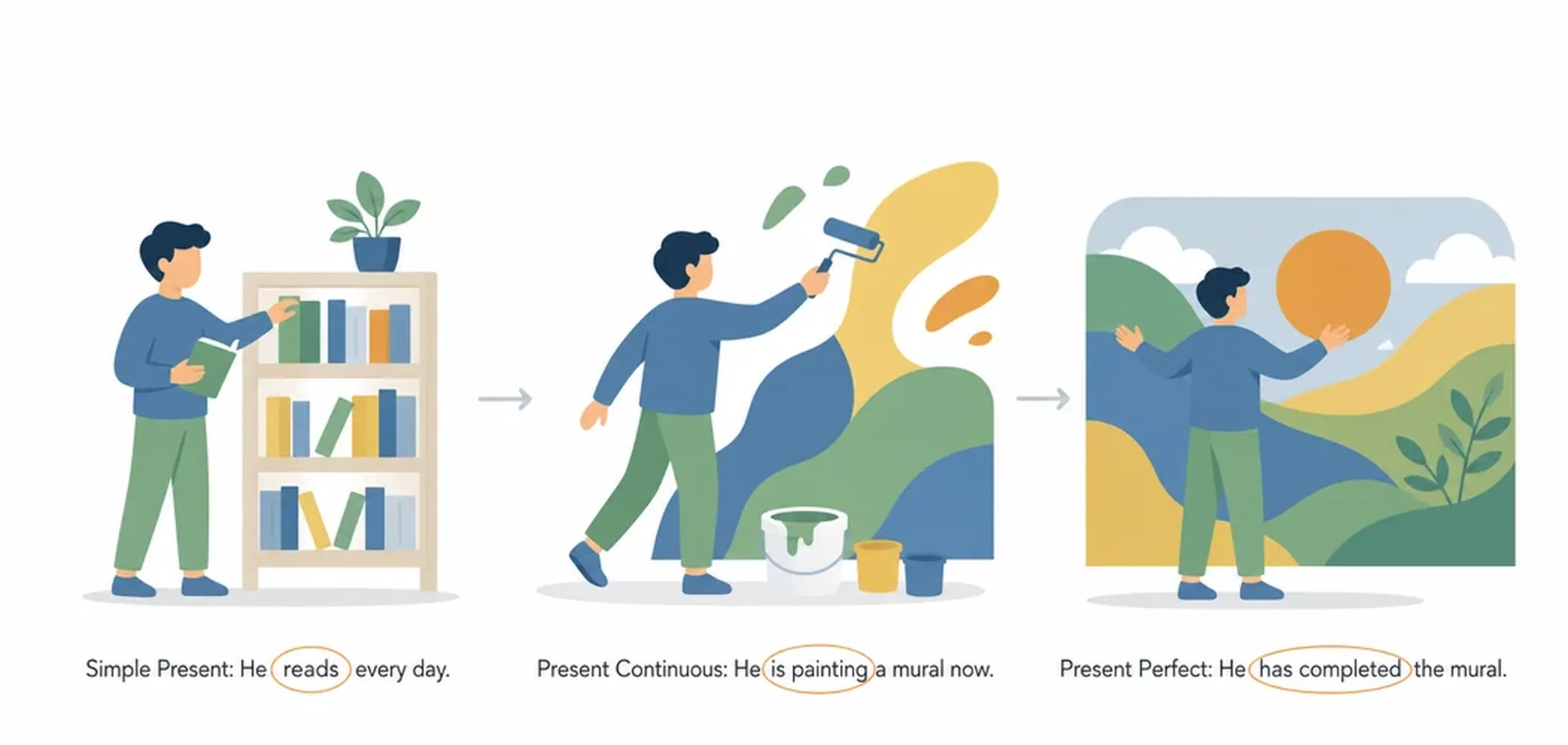
English has three main present tenses, each serving a distinct purpose. The present simple describes permanent situations, habits, and general truths. The present continuous focuses on actions happening right now or around the present moment. The present perfect connects past actions to the present by emphasizing their relevance or completion. Choosing the correct tense depends on whether you're describing what is generally true, what is actively happening, or what has recently been completed.

When to Use: Present Simple
Use the present simple for habitual actions, permanent states, general facts, and schedules. This tense expresses what is normally or always true. It's the most neutral and factual of the three present tenses.
When to Use: Present Continuous
Use the present continuous for actions happening at this exact moment or around now. This tense emphasizes that an action is in progress, temporary, or unfinished. It creates a sense of immediacy and activity.
When to Use: Present Perfect
Use the present perfect when an action completed in the past has relevance to the present. This tense emphasizes the result or consequence of a finished action, not when it happened. It's ideal for recent completions, accumulated experience, or changes since a past time.
Quick Memory Aid
Think of it this way: Simple = always/never, Continuous = right now, Perfect = just finished. This mental image helps you choose the correct tense in real-time conversations and writing.
Present Simple vs. Continuous vs. Perfect: Side-by-Side Comparison
| Dimension | Present Simple | Present Continuous | Present Perfect |
|---|---|---|---|
| Form | Base verb (+ -s/-es for he/she/it) e.g. I work / She works |
am/is/are + verb-ing e.g. I am working / She is working |
have/has + past participle e.g. I have worked / She has worked |
| When to use | Habits, routines, general truths, permanent states, and scheduled future events | Actions happening right now, temporary situations, changing trends, and fixed future arrangements | Past actions with a present result, life experiences (unspecified time), and actions continuing up to now |
| Time focus | Timeless / repeated present | Right now / around this moment | Past action → present relevance |
| Positive example | She drinks coffee every morning. | She is drinking coffee right now. | She has drunk three cups today. |
| Negative example | She doesn't drink tea. | She isn't drinking tea at the moment. | She hasn't drunk any tea today. |
| Question example | Does she drink coffee every day? | Is she drinking coffee right now? | Has she drunk coffee today? |
| Key signal words | always, usually, often, sometimes, never, every day/week/year, on Mondays | now, right now, at the moment, currently, today, still, look!, listen! | already, yet, just, ever, never, so far, recently, lately, since, for, today (with result) |
| Core function | States facts and describes what is generally or repeatedly true | Describes an action actively in progress or a temporary situation around now | Connects a past event to its current consequence or relevance |
| 🔑 Key Difference: Use the Present Simple for what is always or habitually true ("I run every day"); use the Present Continuous for what is actively happening at or around this very moment ("I am running right now"); and use the Present Perfect when a past action still matters or has a visible result in the present ("I have run 5 km — so I'm tired now"). The key question to ask yourself is: Am I talking about a habit? → Simple. Is it happening right now? → Continuous. Does a past event affect the present? → Perfect. | |||
Examples








What to Remember
- Use present simple for habits, permanent situations, and facts that are always true.
- Use present continuous for actions happening now or around the present moment.
- Use present perfect to connect past actions to the present moment with relevance.
- Don't confuse present continuous with present simple; continuous shows actions in progress.
- Present perfect emphasizes completion or recent relevance, not the specific time of action.