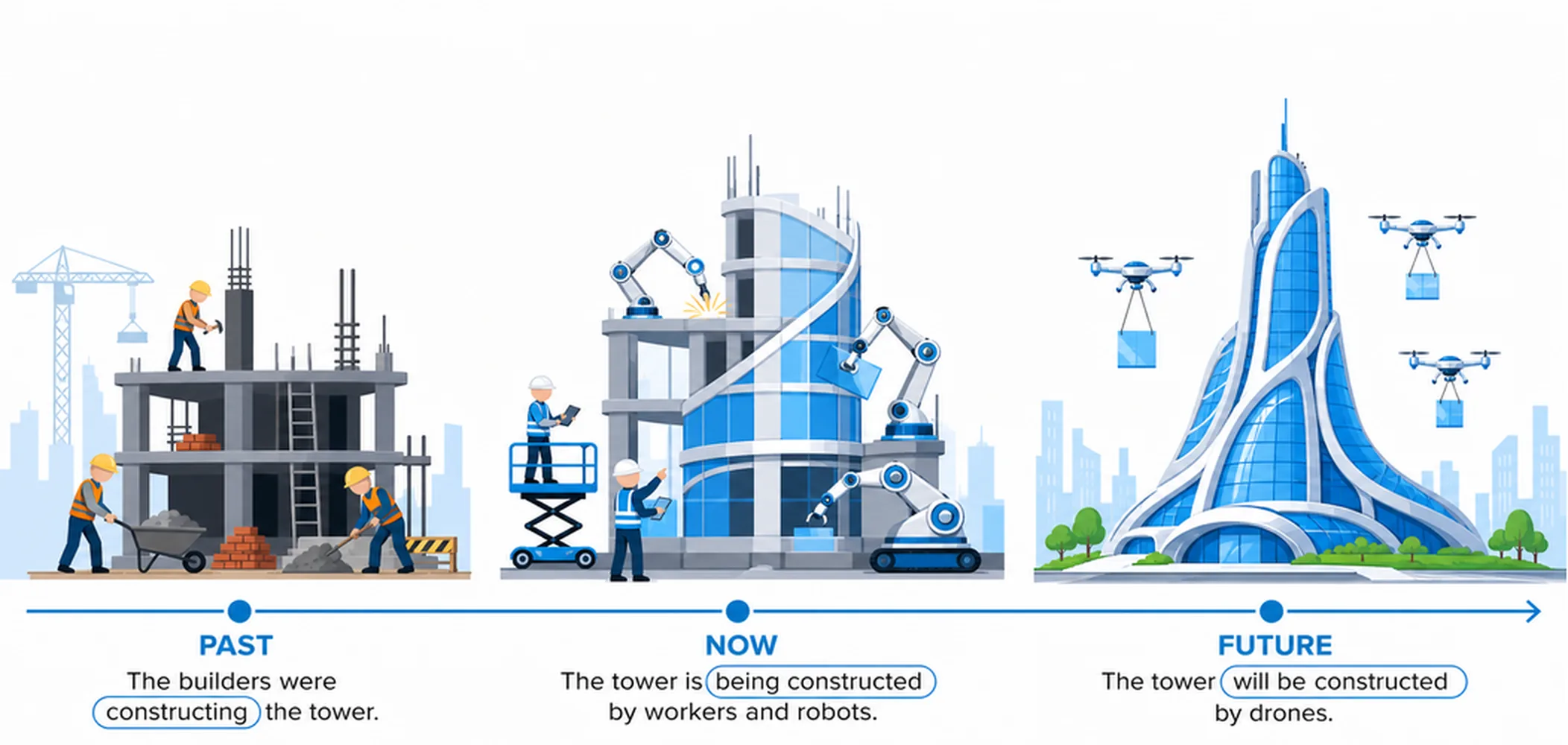
What is Passive Voice in Future Tenses?
The passive voice in future tenses is used when an action will happen in the future, but we focus on what receives the action rather than who performs it. Instead of saying "The company will build a new office," we can say "A new office will be built by the company." This is especially useful when the person or thing performing the action is unknown, unimportant, or obvious from context.
How to Form Future Passive Voice
Future passive voice has two main forms. The key is using the future auxiliary (will or going to) with "be" and the past participle form of the main verb.
| Structure | Form |
|---|---|
| With "will" | Subject + will + be + past participle |
| With "going to" | Subject + am/is/are + going to + be + past participle |
The report will be completed tomorrow.
The meeting is going to be held on Friday.
When to Use Future Passive Voice
Use future passive voice when the action is more important than who does it, when the agent (the person doing the action) is unknown, or when you want to be formal or indirect. It is common in announcements, plans, formal writing, and professional communication. For example, in news: "The decision will be announced next week" or in instructions: "Your luggage will be collected at 8 AM."
Future Passive Voice Conjugation Table
Will (Simple Future Passive)
| Subject | Affirmative | Negative | Question |
|---|---|---|---|
| I | I will be invited |
I will not be invitedI won't be invited |
Will I be invited? |
| you (singular) | you will be invited |
you will not be invitedyou won't be invited |
Will you be invited? |
| he / she / it | he / she / it will be invited |
he / she / it will not be invitedhe / she / it won't be invited |
Will he / she / it be invited? |
| we | we will be invited |
we will not be invitedwe won't be invited |
Will we be invited? |
| you (plural) | you will be invited |
you will not be invitedyou won't be invited |
Will you be invited? |
| they | they will be invited |
they will not be invitedthey won't be invited |
Will they be invited? |
Going To (Planned / Intended Future Passive)
| Subject | Affirmative | Negative | Question |
|---|---|---|---|
| I | I am going to be invitedI'm going to be invited |
I am not going to be invitedI'm not going to be invited |
Am I going to be invited? |
| you (singular) | you are going to be invitedyou're going to be invited |
you are not going to be invitedyou aren't going to be invited |
Are you going to be invited? |
| he / she / it | he / she / it is going to be invitedhe's / she's / it's going to be invited |
he / she / it is not going to be invitedhe / she / it isn't going to be invited |
Is he / she / it going to be invited? |
| we | we are going to be invitedwe're going to be invited |
we are not going to be invitedwe aren't going to be invited |
Are we going to be invited? |
| you (plural) | you are going to be invitedyou're going to be invited |
you are not going to be invitedyou aren't going to be invited |
Are you going to be invited? |
| they | they are going to be invitedthey're going to be invited |
they are not going to be invitedthey aren't going to be invited |
Are they going to be invited? |
Irregular Past Participle Examples
| Verb Form | Affirmative | Negative | Question |
|---|---|---|---|
| write → written | it will be written |
it will not be written |
Will it be written? |
| build → built | they will be built |
they will not be built |
Will they be built? |
| take → taken | she is going to be taken |
she is not going to be taken |
Is she going to be taken? |
| give → given | we are going to be given |
we are not going to be given |
Are we going to be given? |
- Structure — Will passive: Subject + will + be + past participle. The auxiliary will does not change for any person or number.
- Structure — Going to passive: Subject + am/is/are + going to + be + past participle. The verb be must agree with the subject: am (I), is (he/she/it), are (you/we/they).
- Use will for spontaneous decisions, predictions, or promises. Use going to for planned or scheduled future events.
- Irregular past participles must be memorised; they do not follow the standard -ed pattern (e.g., write → written, build → built, take → taken, give → given, see → seen, know → known).
- By-agent (the doer) can be added optionally: The report will be written by the team.
- Contraction note: will not → won't; am not has no standard contraction in positive questions (aren't I? is used informally).
Examples





What to Remember
- Use passive voice in future tenses when the action matters more than who performs it.
- With "will," use: Subject + will + be + past participle (e.g., The house will be painted).
- With "going to," use: Subject + is/are + going to + be + past participle.
- Use passive voice when the performer is unknown, unimportant, or clear from context.
- Don't forget the "be" verb; it's essential in both will and going to future passive forms.