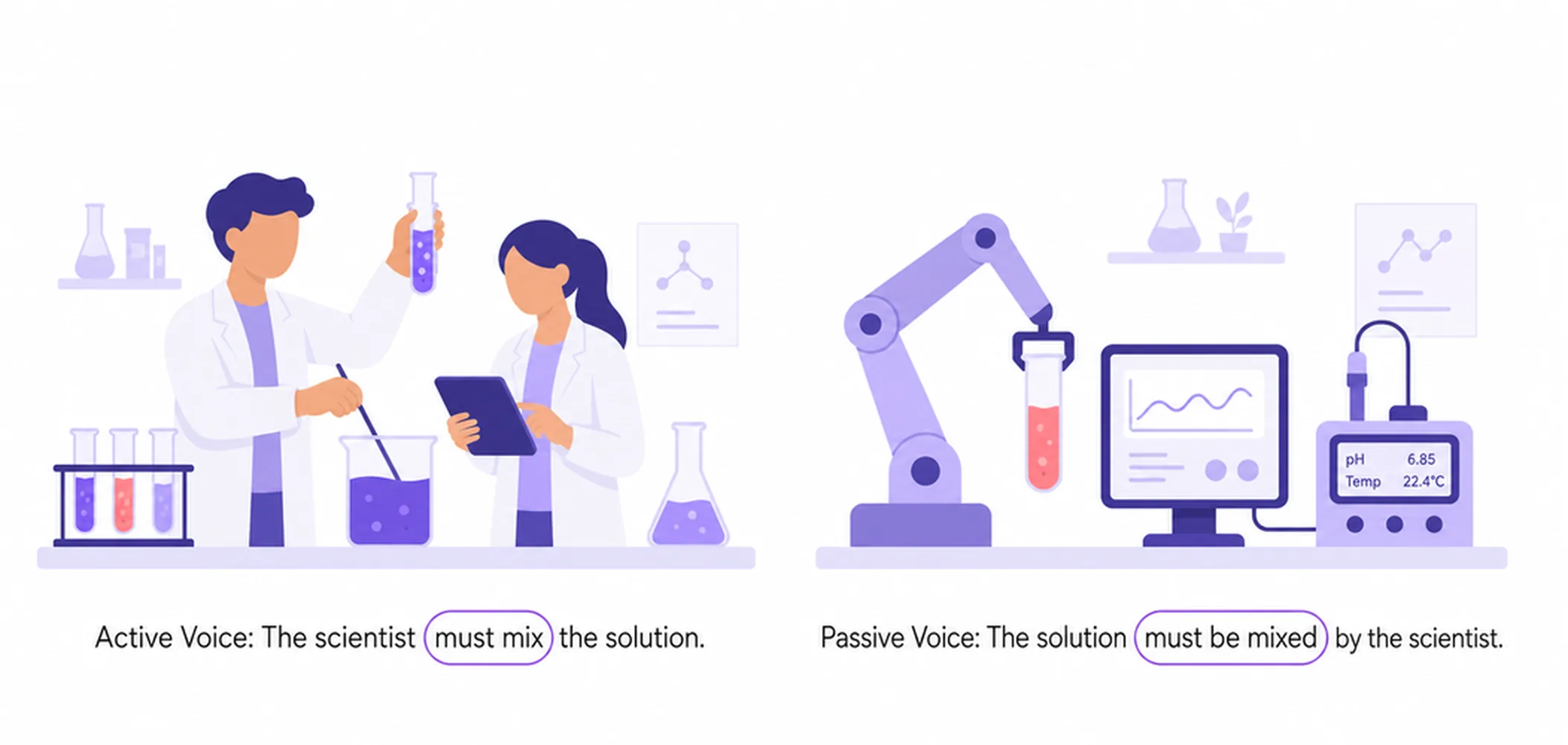
What is Passive Voice with Modal Verbs?
Passive voice with modal verbs combines two grammar structures: modal verbs (can, must, should, will, may, might) and the passive voice. Instead of saying who performs an action, we focus on the action itself or what receives it. The basic structure is: modal verb + be + past participle. This is especially useful when the person doing the action is unknown, unimportant, or obvious from context.
How to Form Passive Voice with Modal Verbs
The formula is simple: modal verb + be + past participle (verb in -ed or irregular form). The modal verb stays in its base form—you do not conjugate it.
Different modal verbs express different meanings:
| Modal Verb | Meaning | Example |
|---|---|---|
| Must | Obligation or strong certainty | The contract must be signed today. |
| Should | Recommendation or mild obligation | The proposal should be reviewed carefully. |
| Can | Ability or possibility | This task can be done quickly. |
| May / Might | Permission or possibility | The decision may be postponed until next week. |
The past participle always remains the same regardless of the subject, ensuring consistency in your passive constructions.
When to Use Passive Voice with Modal Verbs
Use this structure when you want to emphasize the action rather than who performs it, or when the performer is unknown or unimportant. It is common in formal writing like instructions, rules, and professional communication. For instance, 'The application should be submitted online' is more natural than 'You should submit the application online' in formal contexts. It also sounds more polite and impersonal, which is useful in workplaces and academic settings.
Passive Voice with Modal Verbs: Full Form Table
| CAN — Passive Voice | |||
|---|---|---|---|
| Pronoun | Positive | Negative | Question |
| I | I can be helped |
I cannot be helped |
Can I be helped? |
| you | you can be helped |
you cannot be helped |
Can you be helped? |
| he / she / it | he can be helped |
he cannot be helped |
Can he be helped? |
| we | we can be helped |
we cannot be helped |
Can we be helped? |
| you (plural) | you can be helped |
you cannot be helped |
Can you be helped? |
| they | they can be helped |
they cannot be helped |
Can they be helped? |
Note: can expresses ability or possibility. Negative contraction: can't be + past participle. Be never changes form after a modal verb. |
|||
| MUST — Passive Voice | |||
|---|---|---|---|
| Pronoun | Positive | Negative | Question |
| I | I must be told |
I must not be told |
Must I be told? |
| you | you must be told |
you must not be told |
Must you be told? |
| he / she / it | she must be told |
she must not be told |
Must she be told? |
| we | we must be told |
we must not be told |
Must we be told? |
| you (plural) | you must be told |
you must not be told |
Must you be told? |
| they | they must be told |
they must not be told |
Must they be told? |
Note: must not be (mustn't be) expresses prohibition (it is forbidden). Irregular past participle used here: told (tell → told → told). Must has no past tense form; use had to be for the past. |
|||
| SHOULD — Passive Voice | |||
|---|---|---|---|
| Pronoun | Positive | Negative | Question |
| I | I should be seen |
I should not be seen |
Should I be seen? |
| you | you should be seen |
you should not be seen |
Should you be seen? |
| he / she / it | it should be seen |
it should not be seen |
Should it be seen? |
| we | we should be seen |
we should not be seen |
Should we be seen? |
| you (plural) | you should be seen |
you should not be seen |
Should you be seen? |
| they | they should be seen |
they should not be seen |
Should they be seen? |
Note: should expresses advice or recommendation. Irregular past participle: seen (see → saw → seen). Contraction: shouldn't be + past participle. |
|||
| WILL — Passive Voice | |||
|---|---|---|---|
| Pronoun | Positive | Negative | Question |
| I | I will be chosen |
I will not be chosen |
Will I be chosen? |
| you | you will be chosen |
you will not be chosen |
Will you be chosen? |
| he / she / it | he will be chosen |
he will not be chosen |
Will he be chosen? |
| we | we will be chosen |
we will not be chosen |
Will we be chosen? |
| you (plural) | you will be chosen |
you will not be chosen |
Will you be chosen? |
| they | they will be chosen |
they will not be chosen |
Will they be chosen? |
Note: will expresses future certainty. Irregular past participle: chosen (choose → chose → chosen). Contractions: I'll be + past participle / won't be + past participle. |
|||
| MAY — Passive Voice | |||
|---|---|---|---|
| Pronoun | Positive | Negative | Question |
| I | I may be asked |
I may not be asked |
May I be asked? |
| you | you may be asked |
you may not be asked |
May you be asked? |
| he / she / it | he may be asked |
he may not be asked |
May he be asked? |
| we | we may be asked |
we may not be asked |
May we be asked? |
| you (plural) | you may be asked |
you may not be asked |
May you be asked? |
| they | they may be asked |
they may not be asked |
May they be asked? |
Note: may expresses possibility or permission. Irregular past participle: asked (ask → asked → asked). May has no past tense form in passive; use might be + past participle for past possibility. |
|||
Examples






What to Remember
- Use modal verb + be + past participle to form passive voice with modals.
- Modal verbs (can, must, should, will, may, might) stay in their base form before "be."
- The past participle is always required; use -ed endings or irregular forms correctly.
- Use passive with modals when the doer is unknown, unimportant, or obvious from context.
- Never add "be" after the modal verb in negatives; insert "not" after the modal instead.