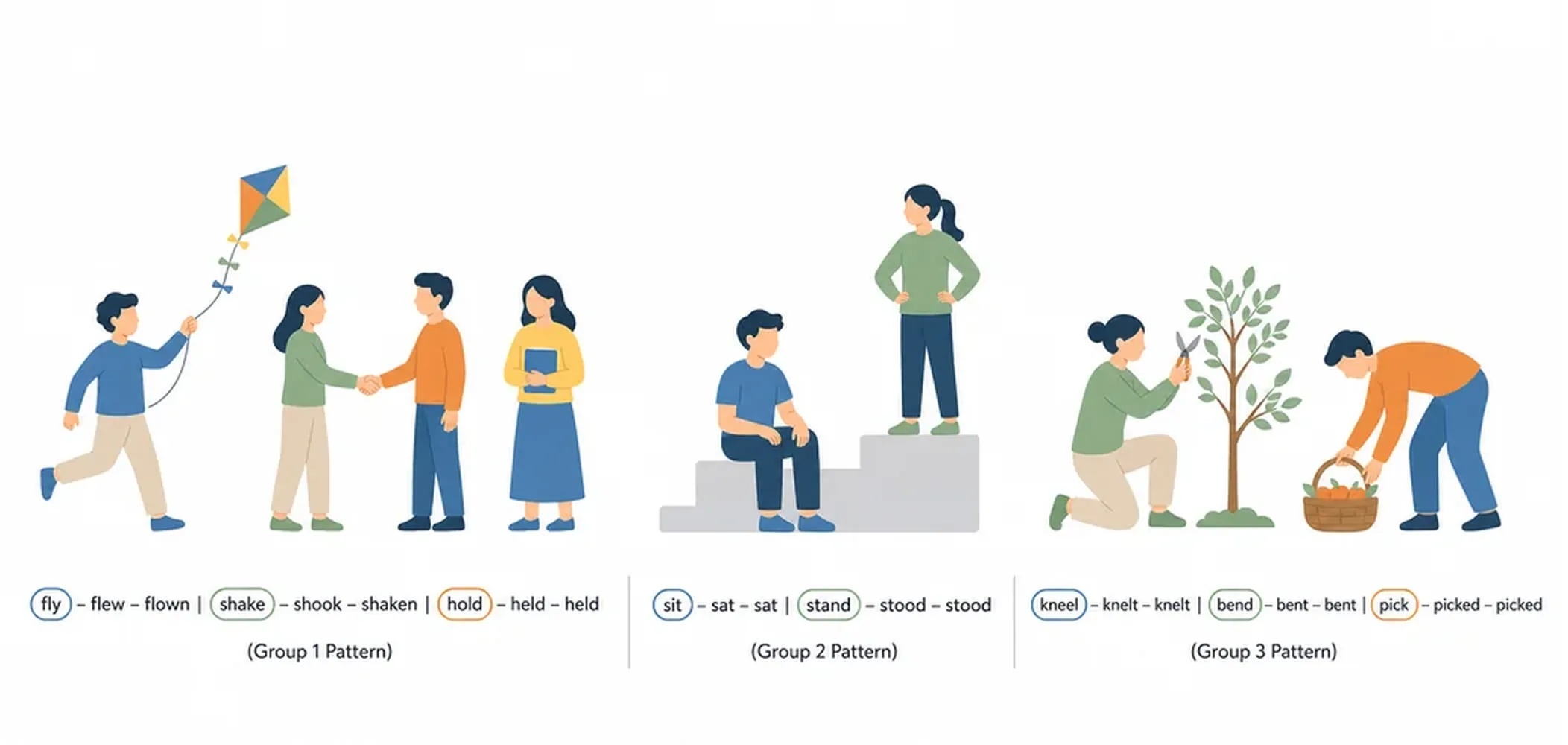
Grammar A2 Regular vs Irregular Verbs

Irregular verbs grouped by pattern

Irregular verbs grouped by pattern

What Are Irregular Verb Patterns?

Irregular verbs do not follow the standard -ed ending rule for past tense. However, many irregular verbs follow similar patterns. When you group them by pattern, they become easier to learn and remember. Instead of learning each verb separately, you can study groups of verbs that change in the same way.

Common Irregular Verb Patterns

One important pattern is vowel change: the base form, past tense, and past participle use different vowels. Examples include sing-sang-sung and drink-drank-drunk. Another pattern is the -t ending: some verbs like keep and sleep change to kept and slept (not keeped or sleeped). A third pattern shows no change at all: cut, put, and shut stay the same in all forms. Learning these patterns helps you predict the correct form.

Why Patterns Help You Learn

Grouping irregular verbs by pattern reduces the number of forms you need to memorize. When you see a new verb, you can often guess the correct past tense if you know the pattern it follows. This makes learning English more efficient and gives you confidence when using irregular verbs in speaking and writing.

Irregular Verbs Grouped by Pattern

Pattern Group Base Form Past Tense Past Participle Note
Same All Forms
(A – A – A)
cut cut cut All three forms are identical; no change at all
hit hit hit
let let let
put put put
set set set
spread spread spread
Past = Participle
(A – B – B)
bring brought brought Past tense and past participle are the same; base form differs
buy bought bought
find found found
hold held held
say said said
sell sold sold
–t Ending
(A – B–t – B–t)
feel felt felt Vowel changes and –t replaces –ed; past = participle
keep kept kept
leave left left
sleep slept slept
mean meant meant
Vowel Change i → a → u
(A – B – C)
begin began begun Classic i/a/u vowel shift; all three forms differ
drink drank drunk
ring rang rung
sing sang sung
sink sank sunk
Formula
Formula
Base form + + Past tense (vowel change) + + Past participle
sing → sang → sung

Examples

I drink coffee every morning, but yesterday I drank tea.
Vowel change pattern · Everyday usage
She sang a beautiful song at the concert last night.
Vowel change pattern · Past tense
We kept the secret because you asked us to keep it quiet.
-t ending pattern · Daily conversation
The butcher cut the meat into small pieces this morning.
No change pattern · Specific context
He swam across the pool, and then he swam back again.
Vowel change pattern · Physical activity
I put my keys on the table because I always put them there.
No change pattern · Repeated action
When to use it
Storytelling & Past Events
When you tell stories about what happened, you use irregular verbs in past tense. Knowing verb patterns helps you speak and write about your experiences naturally.
"I went to the market, bought fresh fish, and cooked dinner for my family."
Everyday Conversation
In daily conversations, irregular verbs appear constantly. Recognizing patterns makes it easier to understand what others say and respond quickly.
"What did you drink this morning?" "I drank orange juice and ate a sandwich."
Writing & Description
When you write about past events in emails, messages, or essays, you need correct irregular verb forms. Grouping verbs by pattern prevents spelling mistakes.
"I kept my promise and finished the work on time as I promised."
Learning Efficiency
Instead of memorizing each irregular verb separately, learning patterns lets you predict many verbs at once. This reduces study time and increases confidence.
If you know swim-swam-swum, you can guess that drink-drank-drunk follows the same pattern.
Signal words
yesterday last week in the past ago before previously already just once when
Common Mistakes
Wrong
I drank coffee yesterday, and I drink coffee today.
Correct
I drank coffee yesterday, and I am drinking coffee today.
Use present continuous with 'today' to show an action happening now.
Wrong
She keeped the book on the shelf.
Correct
She kept the book on the shelf.
Keep is irregular and ends in -t, not -ed. The past tense is kept.
Wrong
He swinged on the rope.
Correct
He swung on the rope.
Swing follows the vowel change pattern: swing-swung-swung, not swinged.
Wrong
They cutted the paper into pieces.
Correct
They cut the paper into pieces.
Cut has no change pattern. The past tense stays the same: cut.
KEY TAKEAWAYS

What to Remember

  • Irregular verbs don't follow the standard -ed ending rule for past tense forms.
  • Many irregular verbs follow similar patterns, making them easier to learn in groups.
  • Vowel change is a common pattern where the base, past, and participle differ.
  • Examples of vowel change verbs include sing-sang-sung and drink-drank-drunk.
  • Some irregular verbs use a -t ending instead of -ed in the past tense.
← Previous
Top 100 irregular verbs — list
Next →
How to remember irregular verbs