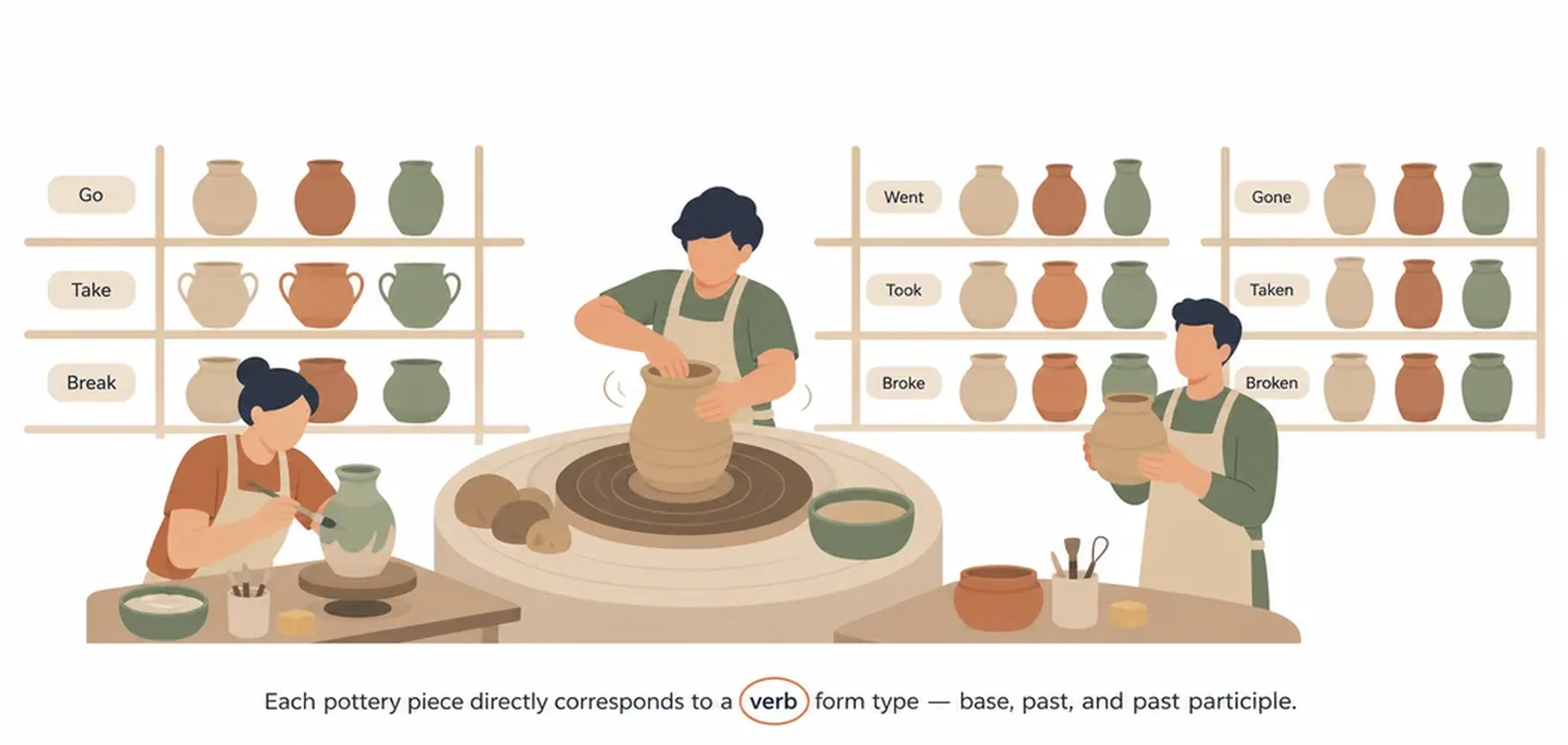
What are irregular verbs?
Most English verbs are regular. This means they follow the same pattern in the past tense: we add -ed to the base form. For example, walk becomes walked, and play becomes played. Irregular verbs are different. They do not follow this simple -ed pattern. Instead, they change their form in special ways. For example, go becomes went (not goed), and eat becomes ate (not eated). Irregular verbs are very common in English, especially the most important ones like be, have, do, and say.
Why are irregular verbs important?
You need to learn irregular verbs because you use them every day. They are the verbs you hear and read most often. The top 100 irregular verbs include the most common words you will encounter in conversations, books, and movies. Some irregular verbs change completely in the past tense (go → went), while others stay almost the same (cut → cut). Learning these verbs is essential for A2 level English. Many of them are already in your speaking and writing, so it is important to know their forms correctly.
How to use this list
The best way to learn irregular verbs is to practise them regularly. Read the forms, say them aloud, and write them down. Group similar verbs together to remember them better. For example, some verbs follow the pattern: begin → began → begun. Try using each verb in sentences every day. Start with the verbs in red on our list—these are the 20 most important ones. Then gradually learn the others. Do not try to memorize all 100 at once. Focus on using them in real sentences, and they will become automatic.
Top 100 Irregular Verbs List
| # | Base Form | Simple Past | Past Participle |
|---|---|---|---|
| 1 | be | was / were | been |
| 2 | have | had | had |
| 3 | do | did | done |
| 4 | say | said | said |
| 5 | go | went | gone |
| 6 | get | got | got / gotten |
| 7 | make | made | made |
| 8 | know | knew | known |
| 9 | think | thought | thought |
| 10 | take | took | taken |
| 11 | see | saw | seen |
| 12 | come | came | come |
| 13 | know | knew | known |
| 14 | give | gave | given |
| 15 | find | found | found |
| 16 | tell | told | told |
| 17 | put | put | put |
| 18 | become | became | become |
| 19 | leave | left | left |
| 20 | feel | felt | felt |
| 21 | bring | brought | brought |
| 22 | begin | began | begun |
| 23 | seem | seemed | seemed |
| 24 | help | helped | helped |
| 25 | talk | talked | talked |
| 26 | turn | turned | turned |
| 27 | start | started | started |
| 28 | show | showed | shown |
| 29 | hear | heard | heard |
| 30 | let | let | let |
| 31 | mean | meant | meant |
| 32 | set | set | set |
| 33 | meet | met | met |
| 34 | run | ran | run |
| 35 | pay | paid | paid |
| 36 | sit | sat | sat |
| 37 | speak | spoke | spoken |
| 38 | lie | lay | lain |
| 39 | lead | led | led |
| 40 | read | read | read |
| 41 | allow | allowed | allowed |
| 42 | add | added | added |
| 43 | spend | spent | spent |
| 44 | grow | grew | grown |
| 45 | open | opened | opened |
| 46 | walk | walked | walked |
| 47 | win | won | won |
| 48 | offer | offered | offered |
| 49 | remember | remembered | remembered |
| 50 | love | loved | loved |
| 51 | consider | considered | considered |
| 52 | appear | appeared | appeared |
| 53 | buy | bought | bought |
| 54 | wait | waited | waited |
| 55 | serve | served | served |
| 56 | die | died | died |
| 57 | send | sent | sent |
| 58 | expect | expected | expected |
| 59 | build | built | built |
| 60 | stay | stayed | stayed |
| 61 | fall | fell | fallen |
| 62 | cut | cut | cut |
| 63 | reach | reached | reached |
| 64 | kill | killed | killed |
| 65 | last | lasted | lasted |
| 66 | laugh | laughed | laughed |
| 67 | happen | happened | happened |
| 68 | hurt | hurt | hurt |
| 69 | produce | produced | produced |
| 70 | decide | decided | decided |
| 71 | eat | ate | eaten |
| 72 | cover | covered | covered |
| 73 | catch | caught | caught |
| 74 | draw | drew | drawn |
| 75 | break | broke | broken |
| 76 | spend | spent | spent |
| 77 | choose | chose | chosen |
| 78 | seek | sought | sought |
| 79 | throw | threw | thrown |
| 80 | catch | caught | caught |
| 81 | deal | dealt | dealt |
| 82 | swim | swam | swum |
| 83 | sing | sang | sung |
| 84 | ring | rang | rung |
| 85 | fight | fought | fought |
| 86 | drive | drove | driven |
| 87 | hang | hung | hung |
| 88 | ride | rode | ridden |
| 89 | rise | rose | risen |
| 90 | write | wrote | written |
| 91 | strike | struck | struck |
| 92 | drink |
Examples





What to Remember
- Regular verbs add -ed to the base form to create the past tense.
- Irregular verbs do not follow the -ed pattern and have special forms to memorize.
- Common irregular verbs like be, have, do, and say are essential and frequent.
- Go becomes went (not goed) and eat becomes ate (not eated) in past tense.
- Learn irregular verbs through practice and repetition since they cannot be formed by rules.