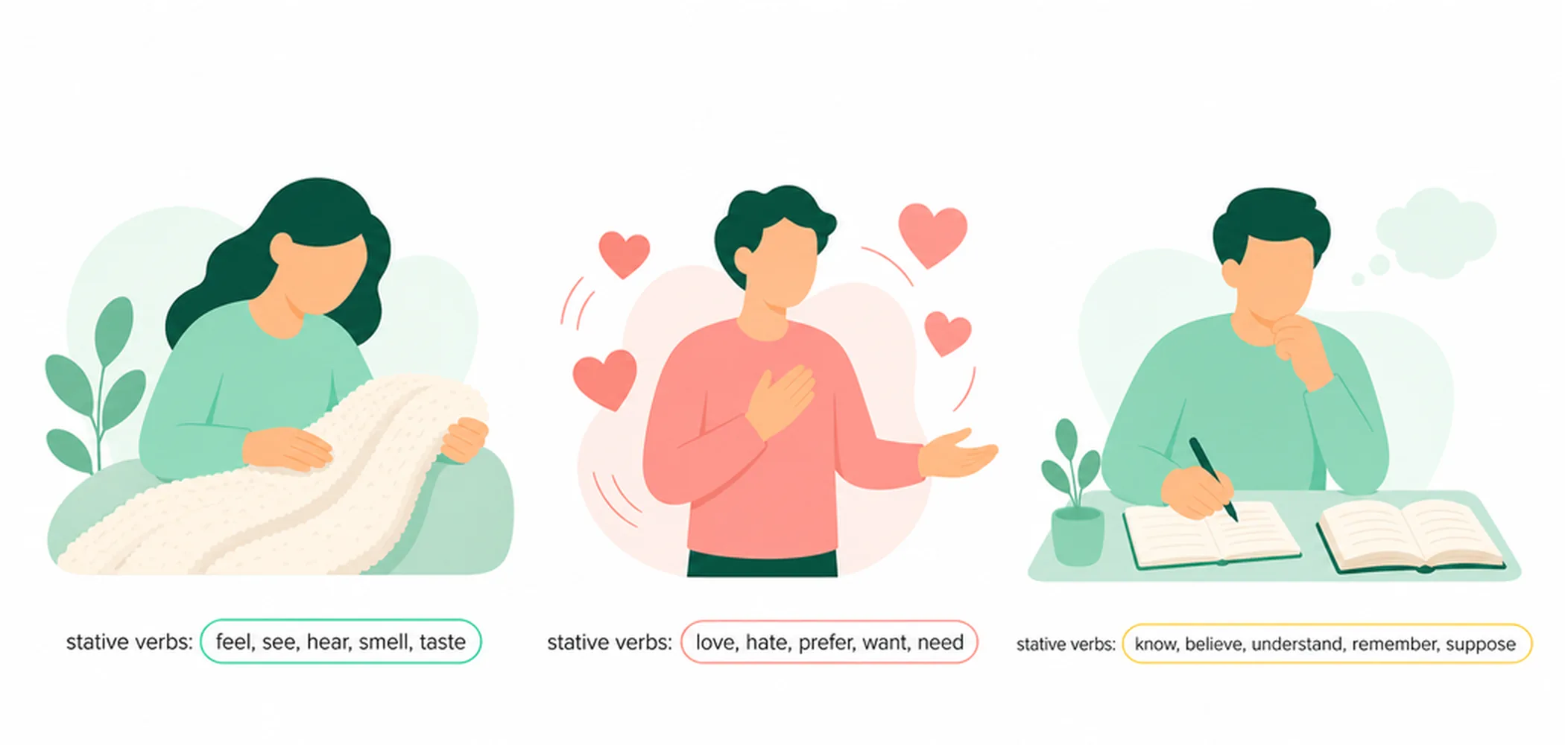
What are stative verbs?
Stative verbs describe a state or condition that does not change over time. They express feelings, opinions, thoughts, senses, and possession. Unlike dynamic verbs (which show action), stative verbs do not show movement or change. In English, stative verbs are rarely used in the continuous form (am/is/are + -ing).
Three main categories
Stative verbs divide into three groups: senses (see, hear, smell, taste, feel), emotions (love, hate, like, fear, enjoy), and thoughts or opinions (believe, think, know, understand, suppose). Many of these verbs describe mental states or sensory experiences that remain constant during a moment in time, which is why they cannot usually be used in continuous tenses.
Common mistake: continuous forms
Learners often try to use stative verbs in continuous forms. You cannot say 'I am loving chocolate' or 'She is knowing the answer.' Instead, use the simple form: 'I love chocolate' and 'She knows the answer.' This rule applies to most stative verbs, though some (like think, feel, smell) can be dynamic in certain contexts.
Stative Verbs List: Senses, Emotions, and Thoughts
| Category | Verb | Example | Note |
|---|---|---|---|
| Senses | see | I see a bird. | Passive perception; not am seeing |
| hear | She hears music. | Passive; contrast with listen to | |
| smell | It smells fresh. | Can be dynamic when used actively | |
| taste | The soup tastes salty. | Can be dynamic: She is tasting the soup | |
| feel | The fabric feels soft. | Stative when describing texture or state | |
| look | He looks tired. | Stative = appear; dynamic = use eyes | |
| sound | That sounds great. | Not is sounding in this sense | |
| appear | She appears calm. | Synonym of seem in stative use | |
| Emotions | love | I love jazz. | Not am loving in standard use |
| like | She likes coffee. | Describes ongoing preference | |
| hate | He hates waiting. | Permanent emotional state | |
| want | I want a snack. | Expresses desire, not action | |
| need | They need help. | Expresses requirement or necessity | |
| fear | She fears heights. | More formal than is afraid of | |
| prefer | I prefer tea to coffee. | Ongoing comparative preference | |
| care | He cares about honesty. | Expresses ongoing concern or value | |
| mind | I don't mind the noise. | Often used in negatives or questions | |
| Thoughts and Opinions | think | I think it's correct. | Stative = hold opinion; dynamic = actively consider |
| believe | She believes in fairness. | Not is believing | |
| know | He knows the answer. | Describes a mental state, not a process | |
| understand | I understand the rule. | Not am understanding | |
| realize | She realizes the risk. | Can mark a moment of insight | |
| suppose | I suppose so. | Expresses tentative opinion or assumption | |
| doubt | He doubts the claim. | Not is doubting for habitual skepticism | |
| agree | They agree with the plan. | Stative = hold a position; dynamic = reach agreement | |
| disagree | I disagree with that view. | Describes a mental position | |
| remember | She remembers the day. | Describes a mental state, not an action |
Examples






What to Remember
- Stative verbs describe states or conditions, not actions or movement.
- Stative verbs are rarely used in continuous forms like "am seeing."
- Stative verbs express senses, emotions, thoughts, opinions, and possession.
- Common stative verbs include: see, hear, love, hate, believe, know, understand.
- Some verbs like "think" and "feel" are stative when describing states, not actions.